


Wholesale Thank You Gifts: How Retailers Can Build a Year-Round Floral Gift Assortment


A buyer once raised a practical concern during a product discussion: “Thank-you gifts sound useful, but will the inventory become too specific?”
That question gets to the heart of the category.
A gift printed with “Best Teacher Ever” may sell well during one campaign, then become difficult to move. A box developed only for employee appreciation may have limited use after the event ends. What begins as a creative decision can quickly turn into an inventory problem.
The more reliable approach is to build a versatile core assortment, then adapt it with removable cards, belly bands, tags, ribbons, and display messages.
A strong wholesale thank-you gift assortment combines flexible floral products, clear price tiers, retail-ready packaging, and occasion details that can be changed without redesigning the entire product.
This allows retailers to serve several appreciation occasions throughout the year while keeping the number of product SKUs under control.
Key Takeaways
Thank-you gifts can sell year-round because appreciation is linked to personal, retail, and corporate occasions.
The main product and box should usually remain versatile, while cards, sleeves, and tags carry the occasion message.
A practical starting assortment includes entry, core, and premium options.
Preserved flowers, plush flowers, decorative soap flowers, and selected floral gift boxes serve different channels and price levels.
Packaging should support display, gifting, storage, and shipping.
Retailers should test a focused range before expanding colors, formats, or customized packaging.
Why Can Thank-You Gifts Sell Throughout the Year?
Thank-you gifting is not tied to one holiday.
People thank teachers, employees, clients, hosts, caregivers, volunteers, event guests, neighbors, and colleagues at different times. Companies also use appreciation gifts for customer retention, employee recognition, membership programs, conferences, and project milestones.
This creates steady opportunities, but the demand is spread across many smaller occasions rather than concentrated around one date.
That difference should influence product development.
A Valentine’s Day collection can rely on red, romantic messages, and a clear selling window. A thank-you assortment needs broader appeal. It should feel warm without looking too romantic, too formal, or too closely connected to one recipient.
Appreciation occasion | Typical purchaser | Suitable channel | Product priority |
Teacher appreciation | Parents, students, schools | Gift shops, supermarkets, online stores | Compact and easy to carry |
Employee recognition | Companies and HR teams | Corporate gift suppliers | Brandable and easy to distribute |
Client appreciation | Companies and professional services | Corporate gifting and premium retail | Refined packaging and reliable delivery |
Hostess gifts | Individual shoppers | Florists, gift shops, lifestyle stores | Neutral and gift-ready |
Volunteer recognition | Schools, charities, event organizers | Promotional gift companies | Scalable and budget-conscious |
Wedding and event thanks | Couples and event planners | Event suppliers and wholesalers | Easy to personalize in quantity |
Everyday thanks | General consumers | Florists, gift shops, supermarkets | Broad appeal and clear value |
Retailers do not need a separate product for every occasion in this table. One well-designed floral gift can often serve several of them with a different message card or sleeve.
That flexibility is what makes the category suitable for year-round retail.
Which Floral Products Fit a Thank-You Gift Assortment?
Product choice should follow the sales channel, target price, customer profile, and shipping method.
A supermarket checkout display needs compact products that are easy to understand. An online gift brand needs packaging that can survive parcel delivery. A corporate gift supplier may require branding space, personalization, and coordinated delivery.
Small Preserved Flower Gifts
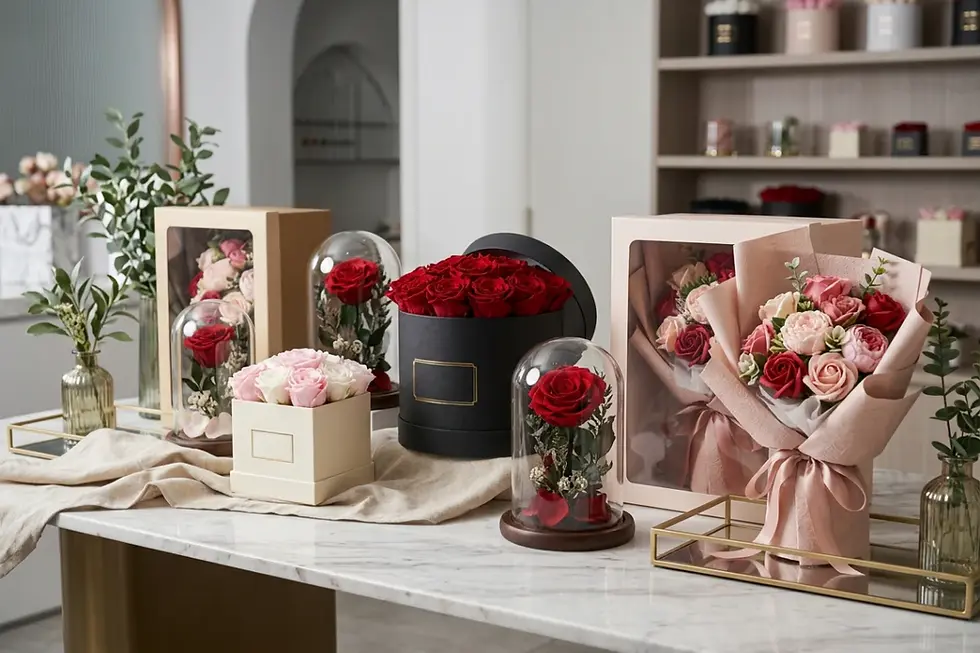
Small preserved flower gifts are suitable when retailers want a product that feels thoughtful but does not require fresh-flower care.
Useful formats include:
Single preserved roses in clear boxes
Mini rose boxes
Small acrylic displays
Compact floral ornaments
Mini glass dome arrangements
Preserved rose ring boxes
These products can work for teacher appreciation, hostess gifts, customer thank-you gifts, event favors, and smaller corporate programs.
They also use relatively little shelf space. A compact item can be placed near a checkout counter, included in a display carton, or added to a larger gift set.
Buyers should check how the rose is fixed, whether the flower head touches the packaging, and whether the outer structure protects the product during storage and shipping.
Care instructions should also be clear. This can reduce customer complaints and help retailers explain that preserved flowers should not be watered or repeatedly handled.

Plush Flowers
Plush flowers offer a softer and more casual interpretation of a floral gift.
They can be developed as:
Single stems
Small bouquets
Flower pots
Gift boxes
Baskets
Magnets
Retail display sets
Plush flowers are especially suitable for younger shoppers, lifestyle stores, social-commerce brands, casual appreciation gifts, and collections that also include get-well or thinking-of-you products.
They allow retailers to build several price levels around one visual idea. A single plush stem can serve as an entry product, while a bouquet, flower pot, or boxed set can sit in the core or premium range.
Sweetie develops plush flowers in multiple gift and display formats, with options for adjusting flower shapes, colors, labels, and packaging.

Decorative Soap Flower Gifts
Decorative soap flowers can provide the look of a full floral arrangement at a different cost position from preserved flowers.
Common formats include:
Small bouquets
Boxed arrangements
Cone bouquets
Single-flower displays
Mixed floral gift sets
Retail-ready display packs
These products may suit gift shops, supermarkets, online stores, wholesalers, and promotional gift programs.
Product descriptions must be accurate. The soap flowers discussed here are designed mainly for gifting and decoration. They should not be presented as ordinary washing soap.
Buyers should also confirm fragrance level, ingredient information, labeling, and destination-market requirements before placing a bulk order.

Playful Floral Gifts and Rose Animals
Rose bears and other floral animals have strong visual appeal. They can attract attention in window displays, social media content, and colorful gift sections.
They tend to work best for:
Younger customer groups
Friendship gifts
Informal appreciation
Beauty and lifestyle promotions
Event giveaways
Social-commerce campaigns
These products are not suitable for every business setting. A bright rose bear may work well for a playful retail collection but feel out of place in a formal client appreciation program.
Color, size, accessories, and packaging determine whether the product feels romantic, cheerful, youthful, or premium.

Premium Preserved Flower Boxes
Premium preserved flower boxes suit more important appreciation occasions, including:
VIP customer gifts
Client appreciation
Employee service awards
Executive gifting
Brand events
Loyalty and membership programs
They provide room for upgraded materials, custom colors, printed cards, branded ribbons, metal plaques, drawers, or space for another product.
A preserved flower box can also be combined with jewelry, fragrance, cosmetics, gift cards, or branded accessories. The flower provides an emotional element, while the additional product supports the commercial purpose of the gift.

Product Comparison
Product type | Typical position | Main advantage | Main sourcing concern |
Small preserved flower gift | Entry to core | Compact and refined | Flower fixation and color consistency |
Plush flower | Entry to core | Soft, friendly, and easy to extend into sets | Shape, stitching, and packaging volume |
Decorative soap flower | Entry to core | Full floral appearance and broad color choice | Fragrance, labeling, and product explanation |
Floral animal | Core or promotional | Strong visual and social appeal | May be too playful for some channels |
Premium preserved flower box | Premium | High perceived value and branding space | Packaging cost and shipping protection |
Share your target channel and retail price range with sales@sweetie-group.com to receive suitable product suggestions.
How Should Retailers Plan Price Tiers and Starting SKUs?
A thank-you collection is easier to shop when customers have several spending options.
One premium flower box will not serve someone looking for a small teacher gift. A collection made only of inexpensive single stems may generate impulse purchases but fail to offer a suitable client or employee gift.
A simple tiered structure is usually more effective.
Tier | Product role | Suggested starting SKUs | Suitable formats |
Entry | Impulse and add-on purchases | 2 to 3 | Single stems, mini boxes, small ornaments |
Core | Main sales range | 2 to 4 | Small bouquets, flower pots, boxed gifts |
Premium | Important recipients and higher budgets | 1 to 2 | Preserved flower boxes, domes, combination gifts |
Custom | Corporate and event projects | Project-based | Branded cards, sleeves, boxes, and gift sets |
This is a planning model, not a fixed industry standard.
A small retailer may begin with six products. A chain retailer may need more colors, packaging versions, or store-specific formats. A corporate gift supplier may develop products only after confirming a project.
For a first test, a retailer might choose:
Two compact preserved flower gifts
Two plush or decorative soap flower options
One premium preserved flower box
One product with interchangeable cards or sleeves
The final number should reflect:
Shelf space
Online or offline sales
Supplier MOQ
Mixed-color ordering
Packaging size
Storage conditions
Target retail price
Replenishment time
Existing sales data
The goal is not to offer every possible thank-you gift. It is to create a clear choice without making the assortment difficult to understand or replenish.
How Can Modular Packaging Reduce Inventory Risk?
The most effective way to reduce occasion-specific inventory is to separate the core product from the occasion message.
The floral product and main box can remain consistent. The thank-you message can be added through a lower-cost component that is easier to replace.
For example, a cream preserved rose in a neutral clear box could be sold with:
A general thank-you card
A teacher appreciation belly band
An employee recognition tag
A client appreciation sleeve
A wedding favor label
A blank message card
The retailer keeps one main product in stock instead of several nearly identical versions.
Which Elements Should Stay Consistent?
The following parts are usually more efficient to standardize:
Product structure
Main flower color
Basic gift box
Protective insert
Barcode position
Master carton
General care instructions
Standardization improves packaging efficiency and makes repeat ordering easier.
Which Elements Can Be Changed?
The following parts are generally easier to adapt:
Greeting cards
Belly bands
Ribbons
Stickers
Hang tags
Printed sleeves
Display headers
Small branded inserts
Product element | Recommended approach | Reason |
Floral product | Keep consistent | Reduces product-level SKUs |
Main gift box | Keep versatile | Extends the selling period |
Greeting card | Change by occasion | Low-cost way to update the message |
Belly band or sleeve | Change when needed | Adds visible campaign information |
Ribbon | Use selectively | Supports branding and premium presentation |
Internal printed message | Customize carefully | Difficult to reuse if demand changes |
Shipping carton | Standardize | Simplifies storage and replenishment |
The more permanently an occasion is printed onto the main product or box, the less flexible the inventory becomes.
Choosing Colors That Work Across Several Occasions
Thank-you gifts should feel warm, but they do not always need to look romantic.
Useful starting colors include:
Soft pink
Cream
White
Warm yellow
Lavender
Sage green
Soft peach
Neutral beige
Muted blue
These colors can work across teacher gifts, hostess gifts, employee recognition, friendship gifts, and casual client appreciation.
Red can still be used, especially for premium or luxury products, but it may create a stronger romantic association. Black and gold can add sophistication, although they may feel too formal for an everyday gift range. Bright colors can attract younger shoppers but may not suit every retail environment.
Color decisions should be based on the retailer’s customer group, brand identity, price position, and test results.
Making the Packaging Retail-Ready
A thank-you gift package must attract attention, protect the product, communicate the occasion, and work for the intended sales channel.
Shelf Display
Retail packaging may need:
A clear window
A transparent display box
An open-front structure with safe spacing
A compact display carton
Clear gift messaging
Consistent sizing across the assortment
Small gifts can also be grouped inside a PDQ display for checkout counters, endcaps, or seasonal tables.
Gift Readiness
The product should feel complete without requiring extra wrapping.
Useful features include:
A writing area
A removable message card
A ribbon or pull tab
A neat carrying handle
A finished interior
Simple care instructions
Space for barcode and price labels
Shipping Protection
Different products require different protective structures.
A closed flower box usually protects the flowers from direct contact, although the outside of the box still needs protection from scratches and dirt.
An open flower box needs enough space between the flower heads and the protective carton. Cardboard supports or cushioning can stabilize the base and prevent contact with the walls or top of the package.
Glass dome products require stronger fixation, cushioning, and a protective outer carton.
For e-commerce orders, internal supports can keep the flower box away from the sides and top of the shipping package. This helps reduce damage while avoiding unnecessary packaging volume.
For a packaging review, send your product format and shipping channel to sales@sweetie-group.com.

How Can Retailers Test the Collection Before Scaling?
A small trial order should answer specific questions.
Ordering a random group of products may show which item sold first, but it may not explain why. A structured test provides more useful information.
1. Define the Primary Customer
Decide whether the first collection is intended for:
Everyday gift shoppers
Teachers and schools
Corporate clients
Supermarket customers
Online gift buyers
Younger lifestyle shoppers
Event and promotional buyers
A product cannot be evaluated fairly when the target customer is unclear.
2. Test Different Product Roles
Select two or three formats with different strengths.
For example:
One compact preserved flower gift
One plush flower
One decorative soap flower arrangement
One premium option, when appropriate
This provides more useful information than testing several similar rose boxes.
3. Limit the First Color Range
Too many colors divide the sales data.
A first test may include:
One soft neutral
One warm pastel
One brighter color
This helps show whether customers respond better to restrained, romantic, or playful presentation.
4. Keep the Main Packaging Flexible
Use a versatile box where possible. Cards, sleeves, and stickers can carry the occasion message.
This prevents the test order from creating several small groups of highly specific packaging.
5. Track More Than Unit Sales
Useful information includes:
Sell-through by SKU
Customer comments
Most requested occasion
Preferred color
Damage and return reasons
Size expectations
Personalization requests
Online review language
Reorder timing
Performance at different display locations
6. Use the Second Order to Correct the First
The second order should not simply repeat everything.
It should increase products with clear demand, remove confusing options, and correct packaging problems found during the test.
This step often provides more value than launching an oversized first collection.
What Should Buyers Check Before Choosing a Supplier?
A good sample is important, but it does not prove that the supplier can maintain the same result across production, packaging, and repeat orders.
Buyers should discuss the following points before confirming a project.
Product and Assortment
Which products are suitable for year-round appreciation gifting?
Can one product serve several occasions?
Can different colors or products be mixed in one order?
Which products suit retail shelves, e-commerce, and corporate gifting?
Customization
What is the MOQ for standard products?
What is the MOQ for custom cards, sleeves, ribbons, and boxes?
Can the supplier match a brand color?
Can a digital mock-up be created before sampling?
Quality Control
How are handmade variations controlled?
How is flower color consistency checked?
What sample will be used as the production standard?
How will repeat orders be matched to the original order?
Packaging
Is the packaging ready for shelf display?
Can the supplier provide PDQ or counter displays?
How is the product fixed inside the package?
What protection is used for parcel delivery?
Production and Documentation
What is the sample timeline?
What is the expected production lead time?
Which steps may delay the project?
Which test reports or product documents are available?
Can third-party testing be arranged when required?
Certificates and reports should match the actual product, materials, intended use, and destination market. A document shown for one item should not automatically be assumed to cover every product in a mixed assortment.
Common Assortment Mistakes
Several problems appear repeatedly in first-time projects.
Printing “Thank You” permanently on every box.This makes the message clear but limits the inventory. A removable card or sleeve provides greater flexibility.
Creating too many similar SKUs.Several nearly identical colors can divide sales and make replenishment harder.
Selecting products only by appearance.The product also needs to fit the shelf, storage space, shipping method, price target, and customer expectations.
Over-customizing the first order.Complex boxes, permanent printing, custom molds, and too many color versions can increase cost before demand has been proven.

Year-Round Thank-You Gift Assortment Checklist
Before approving the collection, confirm that it includes:
At least two price levels
A clear entry product
A complete core gift
One premium option where appropriate
At least one broadly suitable color
Packaging that is not limited to one occasion
A removable card, sleeve, tag, or belly band
One product suitable for shelf or counter display
One product suitable for parcel delivery
Confirmed product and packaging MOQs
A sample approval standard
A repeat-order and replenishment plan
Frequently Asked Questions
What Products Work Best as Wholesale Thank-You Gifts?
Preserved flower gifts, plush flowers, decorative soap flower arrangements, small floral displays, and premium flower boxes can all work well. The best option depends on the retailer’s customer, price level, sales channel, packaging space, and customization needs.
Are Thank-You Gifts Seasonal or Year-Round?
Thank-you gifts can sell throughout the year because appreciation is connected to teachers, employees, clients, hosts, caregivers, volunteers, weddings, events, and everyday relationships. Flexible products and changeable messages help retailers serve these occasions without creating separate inventories.
How Can Retailers Avoid Leftover Thank-You Gift Inventory?
Keep the main product and box versatile. Place the occasion message on a removable card, belly band, sleeve, sticker, or tag. This allows the same product to support other occasions when demand changes.
What Packaging Is Best for Wholesale Thank-You Gifts?
The best packaging protects the product, looks complete as a gift, supports shelf display, and suits the shipping method. Clear boxes, window boxes, compact display cartons, protective inserts, and removable occasion sleeves can all be effective.
What MOQ Should Retailers Expect for Customized Thank-You Gifts?
MOQ depends on the product structure and level of customization. A standard product with a custom card may require a lower commitment than a fully customized gift box, flower shape, or branded mold. Buyers should request separate MOQs for the product, printed packaging, and accessories.
What Should Buyers Check Before Placing a Bulk Order?
Buyers should approve the product sample, color range, packaging structure, artwork, labeling, carton specifications, inspection method, lead time, and repeat-order standard. Required testing and import documentation should also be confirmed before production.
Build a Collection That Can Keep Selling
A thank-you gift assortment should not depend on one recipient, one campaign, or one printed message.
The most practical collections begin with versatile products, then create relevance through packaging, cards, color, and display. A small preserved flower can become a teacher gift. A plush flower can support everyday appreciation or get-well gifting. A premium flower box can serve client recognition, employee awards, or a branded event.
This flexibility protects inventory and gives retailers more opportunities to sell the same core product.
Start with a focused range. Test the customer response. Review the packaging, colors, price tiers, and reorder data before expanding.
To discuss samples, customization, MOQ, and production timing, contact sales@sweetie-group.com.

Annie Zhang
CEO of Sweetie Group


Comments