


Soap Flower Quality Control: What Importers Should Check Before Shipment


A soap flower sample can look excellent on a desk and still become a problem when 3,000 pieces arrive at the warehouse.
Perhaps the red in one carton is noticeably different from the red in another. Some flower heads have been pressed out of shape. A few stems are loose. The flowers themselves are acceptable, but the clear gift boxes have scratches across the front.
These are not unusual questions in bulk floral gift sourcing. They are also why soap flower quality control should look beyond a single flower head.
In this article, soap flowers means decorative soap-based flowers made for bouquets, gift boxes, floral arrangements, and retail display. They are not bath flowers and are not intended for washing or skincare.
For a typical decorative soap flower order, quality control should answer six basic questions.
What to Check | Main Concern |
Approved sample | Does mass production match what was confirmed? |
Flower heads | Are petals, shape, and surface in good condition? |
Color and scent | Are they reasonably consistent across the order? |
Assembly | Are flowers, stems, fillers, and accessories securely finished? |
Gift packaging | Will the product still look good at retail after shipping? |
Bulk inspection | Is the quality consistent across different cartons? |
The details matter, but the basic principle is simple: inspect the product your customer will receive, not just the sample you approved months earlier.
Start With the Approved Sample
Good quality control begins with a clear reference.
Before mass production, the supplier and importer should agree on the final sample and the key specifications that affect the finished product. For a soap flower bouquet, this may include the flower type, flower count, color combination, bouquet size, wrapping style, ribbon, fragrance, accessories, gift box, and branding.
The point is not to create a complicated specification document for every small order. It is to remove ambiguity.
“Nice pink” is difficult to inspect.
“Match the approved pink sample” is much easier.
The same applies to bouquet shape. A photograph can help, but a confirmed physical sample is usually a stronger reference when checking mass production.
At Sweetie, customized soap flower projects are normally confirmed before moving into bulk production so that the production and QC teams have a clear product reference.
Developing a custom soap flower collection? Send your product idea or reference images to sales@sweetie-group.com to discuss sampling and production details.
Check the Flower Heads Carefully
The flower head is usually the most visible part of a decorative soap flower gift, so this is where inspection should spend the most attention.
Petal Condition and Flower Shape
Start with obvious damage.
Look for cracked petals, broken edges, crushed flower heads, unusual folds, stains, or visible deformation. A very small irregularity may not matter, especially on a product with many flowers, but damage to a main flower in the front of a bouquet is much more noticeable.
Shape is also important.
Place several flowers from the same SKU next to each other and compare their diameter, petal opening, center shape, and overall fullness. They do not need to be perfectly identical, but large differences should not make the products look like different versions of the same item.
Storage and transport conditions can also affect the appearance and shape of decorative soap flowers. During inspection, unusually brittle, soft, or distorted flower heads deserve attention because they may be more vulnerable during packing and shipping.
Color Consistency
Color variation is much easier to see when several units are placed side by side.
Do not judge color from one bouquet alone. Compare products taken from different cartons with the approved reference.
This is particularly important for solid-color products such as red Valentine’s Day bouquets, white gift boxes, or single-color rose arrangements. A deliberately mixed pastel bouquet can tolerate more natural visual variation than a row of identical red products displayed together.
For designs that combine dark and light colors, also check whether there is any visible staining or unwanted color transfer after packing and storage.
Fragrance and Surface Condition
For products that include fragrance, the practical QC question is consistency.
Does the scent resemble the approved sample? Is one carton unusually strong while another is noticeably weak? Is there an unexpected or unpleasant odor?
Fragrance does not need to dominate the inspection of a decorative product, but obvious differences are worth catching before shipment.
The flower surface should also be reasonably clean. Dust, stains, glue residue, or marks on light-colored petals can quickly affect the appearance of the finished gift.
Look at the Complete Bouquet, Not Just Individual Flowers
A beautiful flower head does not automatically make a good finished bouquet.
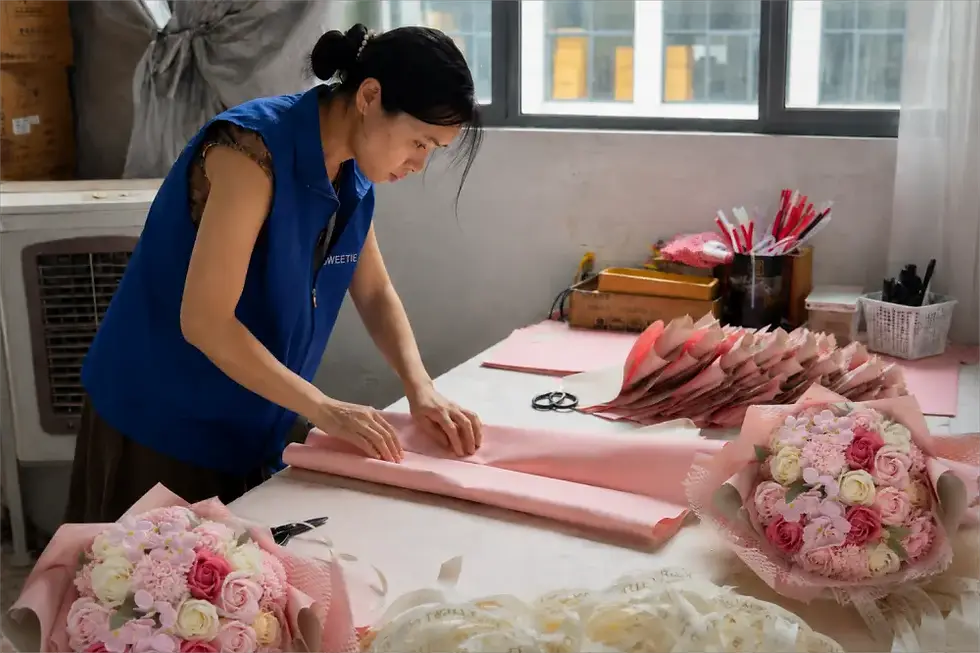
Soap flower gifts often combine flower heads with stems, artificial leaves, filler flowers, wrapping paper, ribbons, gift boxes, ornaments, and other accessories. The finished arrangement should therefore be inspected as one product.
Check whether the flower heads are securely attached and whether the stems hold the intended position. Loose flowers, badly bent stems, exposed wire, excessive visible glue, or missing accessories can turn a good-looking sample into an inconsistent bulk order.
Flower count is another simple but important check. If an approved design contains eleven flowers, ten flowers should not become acceptable simply because the bouquet still looks full.
Then step back and look at the overall arrangement.
Does the bouquet have the correct height and fullness? Are the main flowers distributed evenly? Does the wrapping sit properly? Is the ribbon positioned consistently? Does the front of the product look like the approved design?
Because many soap flower gifts involve manual assembly, small differences are normal. The goal is not absolute uniformity. The goal is that products from the same SKU still look clearly like the same product when displayed together.
If you are working on a bouquet, gift box, or promotional soap flower program, you can send the target design, quantity, and packaging requirements to sales@sweetie-group.com.
Check the Finished Gift and Packaging
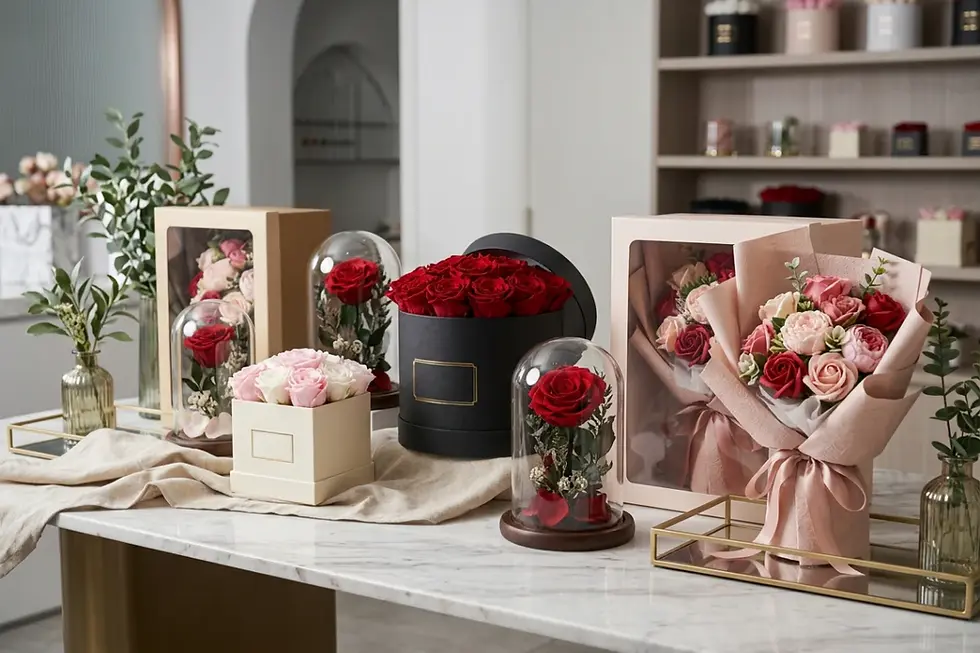
For decorative soap flowers, packaging is part of the product.
A perfect bouquet inside a scratched clear box is not a perfect retail item.
Inspect gift boxes for dents, crushed corners, dirt, poor closure, printing issues, and obvious scratches. Transparent PVC or window packaging deserves extra attention because surface marks are immediately visible on a retail shelf.
Labels and branding should also match the approved files. Check the SKU, barcode, logo orientation, color reference, printed artwork, and any agreed product information before shipment.
The next question is protection.
The flower heads should not be continuously pressed against the top or sides of the packaging. The bouquet should not move so freely that it repeatedly hits the inner wall during transport. Inserts, internal supports, or protective outer boxes may be needed depending on the product structure.
Packaging also needs to match the sales channel.
A soap flower gift moving in master cartons from an importer’s warehouse to stores faces a different distribution environment from a product shipped individually through an e-commerce fulfillment network. Mail-order packaging normally needs more protection against impact and repeated handling.
The most attractive retail box is not useful if it cannot protect the product long enough to reach the shelf.
How to Inspect a Bulk Order Before Shipment
One of the easiest inspection mistakes is to look at several products from the same carton and assume they represent the entire order.
For a bulk soap flower inspection, samples should come from different cartons and, where practical, different parts of the production lot.
This makes it easier to see whether color, fragrance, flower shape, assembly, and packaging remain reasonably consistent throughout production.
The finished pieces should be compared with the approved sample and specification rather than judged only on whether they “look good.”
For larger orders, some importers also use an AQL-based sampling plan. AQL gives the inspection team a structured way to select samples and classify defects as critical, major, or minor.
For example, a detached main flower, wrong product color, missing component, or badly crushed gift box could have a greater impact than a very small hidden glue mark.
There is no single AQL setting that is automatically correct for every soap flower order. The acceptance criteria should be agreed before inspection based on the product, order size, retail channel, and project requirements.
The important point is consistency. Everyone should know what counts as an unacceptable defect before the shipment is waiting at the factory door.
Consistency Matters Beyond the First Order
The first order is only one part of supplier quality.
A stronger test is whether the same design can be produced consistently six months later or for the next Valentine’s Day program.
Keeping the approved sample, product specifications, color reference, packaging files, artwork, and inspection photos makes repeat production much easier to control.
This is particularly useful for seasonal floral gifts because a successful design may return with only small packaging or color changes.
At Sweetie-Gifts, repeat soap flower projects are managed against confirmed samples and product specifications so that production teams have a clear reference when the same or similar design returns.
Consistency does not mean that handmade assembly will be identical down to every millimeter. It means that the key features customers approved remain recognizable and controlled from one production run to the next.

Frequently Asked Questions
What are the most common soap flower defects?
Common issues include cracked or deformed petals, visible color differences, loose flower heads, bent stems, missing accessories, obvious glue marks, uneven bouquet shapes, scratched gift packaging, and flowers compressed during packing or transport.
The importance of each defect depends on where it appears and how much it affects the finished gift.
How do you check color consistency in a bulk soap flower order?
Compare several products from different cartons side by side with the approved sample or color reference.
Color differences that are difficult to notice on one flower often become obvious when multiple products are displayed together.
Should soap flower importers use AQL inspection?
AQL can be useful for larger orders because it provides a structured sampling and defect-classification method.
The buyer and supplier should agree on the inspection criteria and acceptable defect levels before the pre-shipment inspection rather than trying to define them after problems are found.
How should decorative soap flowers be packed for shipping?
Packaging should prevent flower heads from being crushed or rubbing against the package, keep the arrangement reasonably fixed in position, and protect the retail box from scratches and impact.
Products intended for individual parcel delivery may require stronger protection than products shipped mainly in master cartons for store distribution.
Final Thoughts
Soap flower quality control does not need to become a technical exercise.
Start with an approved sample. Check the flower heads closely. Compare several products for color and assembly consistency. Look at the finished gift from the customer’s point of view, then make sure the packaging can protect it through the real distribution journey.
For bulk orders, the best inspection is not the one with the longest checklist. It is the one that catches the problems that could make the product difficult to sell after arrival.
If you are sourcing decorative soap flower bouquets, gift boxes, or customized floral gifts, contact sales@sweetie-group.com to discuss sampling, quality requirements, packaging, and bulk production.
Annie Zhang

Comments