


How Brand Merchandise Agencies Can Source Custom Floral Gifts from China Without Supplier Fatigue

Brand merchandise agencies can source custom floral gifts from China without managing dozens of individual vendors by partnering with an integrated floral category specialist that coordinates multi-material development, custom packaging, kitting, and pre-shipment quality control across dedicated regional manufacturing hubs. This operational model consolidates communication while preserving direct oversight on material integrity, lead times, and client branding standards.
Why Do Multi-Material Floral Projects Overwhelm Brand Merchandise Agencies?
When a creative or promotional agency takes on a complex gifting campaign, the creative brief rarely calls for just a single standard product. For instance, imagine a hypothetical holiday activation for a luxury cosmetics brand. The client brief might demand an ornate presentation box containing real preserved roses, a custom-embroidered plush mascot, matching decorative soap flower accents, and bespoke foil-stamped rigid packaging.
Under a traditional procurement model, the agency must source each component separately:
Preserved Botanicals: Sourced from fresh flower processing hubs in southwestern China.
Decorative Soap Flowers and Foam Bears: Sourced from specialty synthetic gift factories in eastern China.
Plush or Hand-Crocheted Accents: Sourced from textile and needlework workshops.
Bespoke Presentation Boxes: Sourced from regional paper and packaging converters.
Managing four or five independent factories for a single client deliverable quickly multiplies administrative risk. Each factory operates with its own minimum order quantities (MOQs), production schedules, color-matching standards, and payment terms. If the packaging manufacturer in Guangdong finishes ahead of schedule while the textile workshop in Zhejiang experiences a dye delay, the agency is left coordinating logistics, absorbing intermediate warehousing fees, and troubleshooting color mismatches.
When an agency tries to act as the general contractor across multiple discrete factories in China, communication overhead skyrockets. If the final gift box arrives crushed or the preserved rose stems bleed onto the plush fabric during ocean freight, assigning accountability between separate vendors becomes nearly impossible.
What Are the Key Differences When Manufacturing Preserved, Soap, Plush, and Foam Floral Gifts?
To effectively source custom floral gifts from China, procurement teams must understand the physical characteristics and manufacturing parameters of distinct floral gifting categories.
Each material category has its own supply base, baseline lead times, and structural tolerances:
Preserved Flowers (Real Botanicals): These are natural, grade-A cut flowers (primarily roses, hydrangeas, and moss) grown and harvested in specialized agricultural regions like Kunming. They undergo a multi-stage replacement process where natural sap is replaced with cosmetic-grade glycerin, dyes, and organic stabilizers. They require climate-controlled processing and delicate handling.
Decorative Soap Flowers: Manufactured using starch and surfactant blends poured into precision molds or petal sheets. These are designed purely for decorative aesthetics and fragrance diffusion in promotional gift sets, not as daily personal cleansing soaps. They are sensitive to extreme humidity and require dry storage.
PE Foam Rose Bears: Constructed using a high-density expanded foam core covered with individually adhered polyethylene (PE) micro-roses. They offer high visual volume at a lighter weight, making transit protection and carton crush resistance essential.
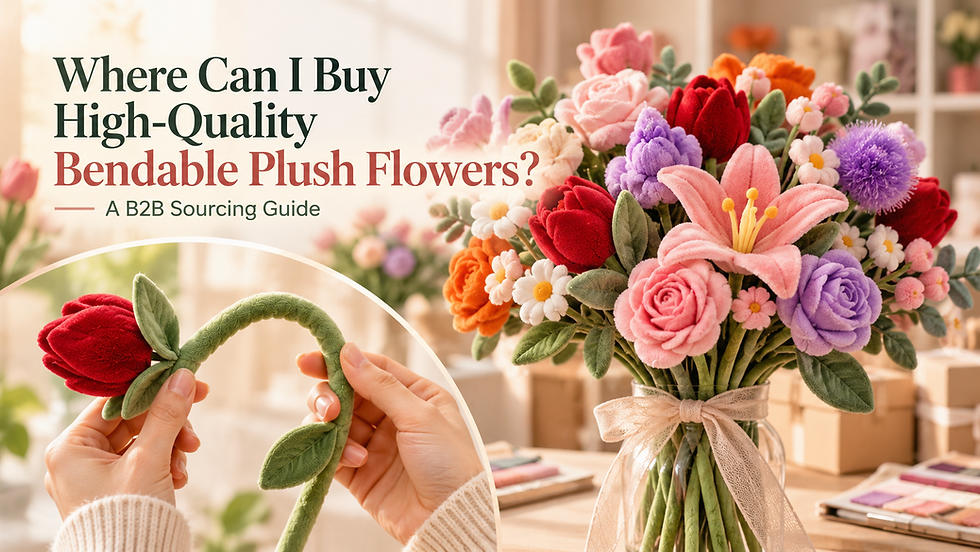
Plush and Hand-Crocheted Flowers: Produced through cut-and-sew textile manufacturing or manual yarn crochet. These items add tactile warmth and high perceived craft value to brand campaigns, but they carry distinct lead time requirements due to manual assembly.

Precision color matching and moisture control across preserved botanicals and synthetic floral components.
Understanding these distinct material characteristics prevents agencies from making unrealistic timeline assumptions when executing multi-material promotional floral gift sourcing.
Should Agencies Split-Source or Work with a Floral Category Integration Partner?
When evaluating custom floral merchandise manufacturing, agencies generally weigh two distinct operating models: splitting orders across discrete component factories or collaborating with an integrated floral category partner.
Evaluation Metric | Direct Split Sourcing (Multiple Factories) | Floral Category Partner Consolidation |
|---|---|---|
Communication Overhead | High (5–8 contacts across paper, botanicals, and plush) | Low (Single technical project manager) |
Color & Finish Consistency | High risk of variance across substrate materials | Centrally monitored against unified Pantone masters |
MOQ Flexibility | Rigid (Each factory enforces its own raw material MOQ) | Flexible (Aggregated project volumes across categories) |
Kitting & Assembly | Requires 3rd-party logistics hub or domestic assembly | Handled at origin manufacturing facilities |
Accountability & QA | Diffuse (Suppliers blame one another for fit issues) | Single-point accountability for final finished gift set |
Freight Consolidation | Multiple LCL shipments or split origin routing | Single consolidated FCL/LCL ocean or air shipment |
Split sourcing may offer marginal unit-cost savings on paper when purchasing massive volumes of a single SKU (such as 100,000 identical basic soap flower boxes). However, for brand activations that combine multiple components, the hidden costs of split-vendor management—communication delays, cross-docking fees, independent quality inspections, and sample consolidation—often erase those initial margins.
A specialized China floral gift supplier with cross-category coordination capabilities absorbs the friction of raw material alignment, intermediate assembly, and pre-shipment quality verification.
How Can Brand Agencies Vet a China Floral Gift Partner for OEM and ODM Projects?
Selecting the right production partner requires looking beyond generic trading companies and single-line factories. Agencies should conduct targeted operational due diligence using a structured evaluation checklist:
Distinguish Dedicated Production from Sourcing Reach: An ideal partner maintains dedicated facilities for primary lines (such as preserved floral processing bases in Kunming and assembly facilities in Yiwu) while managing established networks for packaging, textiles, and specialty hardware.
Verify Multi-Substrate Color Calibration: Inquire how the partner matches brand-specific Pantone tones across different materials—for example, matching a client's signature crimson red across a preserved rose petal, a satin ribbon, and a dyed cotton crochet stem.
Review Packaging Engineering and Kitting Capacity: Does the supplier outsource kitting to an external freight forwarder, or do they operate clean assembly and kitting lines within their own facilities?
Examine Lead Time Realism and Change Management: A dependable partner provides transparent, critical-path production schedules, accounting for botanical drying cycles, dye approvals, tooling windows, and pre-shipment drop tests.
Assess IP and Design Confidentiality: Top-tier agencies require strict non-disclosure agreements (NDAs) to safeguard unreleased brand campaigns, custom tooling molds, and proprietary visual assets.
If your team is managing a time-sensitive client brief and needs rapid technical guidance on material compatibility or MOQ feasibility, you can reach out directly to sales@sweetie-group.com to review sample parameters and preliminary production schedules.
How Do You Manage Custom Packaging, Kitting, and Fragile Transit Protection?
Floral merchandise presents unique structural packaging challenges. Unlike rigid consumer goods, preserved botanicals and intricate soap flower arrangements cannot withstand direct structural loading or moisture exposure during long ocean voyages.

To ensure flawless out-of-box presentation for high-profile brand activations, agencies must address three core packaging disciplines:
1. Structural Transit Engineering
Preserved flower heads and foam rose bears require rigid gift box construction (typically 1200–1800 gsm greyboard wrapped in specialty coated paper) combined with custom thermoformed PET blisters, high-density EVA foam cavities, or custom paper inserts. Inserts must hold floral stems securely in place, preventing shifting during transit while leaving adequate clearance so petals do not abrade against interior acrylic windows or box lids.
2. Moisture and Climate Barrier Protection
Preserved roses and botanicals are sensitive to ambient relative humidity. During maritime transit through tropical zones, shipping containers experience dramatic humidity and temperature fluctuations ("container rain"). Professional floral packaging integrates food-grade desiccant sachets, shrink-wrapping, or hermetically sealed inner polybags to maintain optimal relative humidity (between 40% and 60%) inside the master carton.
3. Origin Kitting and Barcoding
Having your supplier perform end-to-end kitting at origin—placing floral arrangements into bespoke gift boxes, inserting client greeting cards, applying SKU barcodes, adding hangtags, and packing into drop-tested 5-ply corrugated export cartons—saves agencies significant domestic labor costs upon container arrival.
How Can Agencies Accelerate Concept Curation and Planning with Sweetie AI?
During the initial pitch phase of an agency campaign, creative directors and procurement planners often lose days waiting for raw supplier catalogs, generic pricing tiers, or material compatibility assessments. To streamline this early-stage workflow, brand teams can utilize Sweetie AI.
This specialized digital assistant helps procurement planners quickly evaluate floral product configurations based on specific project parameters:
Input target client budget tiers (e.g., $5–$10 VIP promotional tier vs. $25–$50 premium retail tier).
Specify retail or event channels (e.g., direct-mail influencer kits, beauty counter GWPs, corporate hospitality gifts).
Filter combinations of preserved flowers, soap florals, plush accents, or rose bears that match defined target audiences.
Generate structured conceptual outlines and component breakdowns to jumpstart internal agency presentations.
While Sweetie AI provides actionable planning frameworks and preliminary curation insights, formal engineering reviews, custom sample development, exact volume quotations, and final manufacturing sign-offs are subsequently handled directly by technical production specialists.
What Quality Control, Material Compliance, and IP Safeguards Are Essential?
Executing successful OEM preserved flower gifts china programs requires rigorous quality assurance protocols from raw material intake to final container loading.

Standardized pre-shipment inspections verify structural integrity, print accuracy, and finish consistency across all components.
Quality Control Gateways at Every Production Phase
Raw Material Inspection (IQC): Preserved roses are graded for petal density, radial symmetry, stem integrity, and uniform dye penetration. Soap flower blanks are checked for surface smoothness and moisture content.
In-Process Assembly QA (IPQC): Technicians monitor adhesive application (ensuring zero hot-melt glue stringing), insert alignments, ribbon placement, and structural box gluing.
Final Pre-Shipment Inspection (FQC/PSI): Conducted according to international AQL standards (typically AQL 2.5/4.0). Inspectors check print registration, foil stamping adhesion, barcode readability, carton drop-test integrity, and total piece counts.
Material Testing and Destination Market Compliance
Different export markets enforce specific safety and environmental standards. While dried and preserved flowers do not require fresh agricultural phytosanitary quarantines in most jurisdictions, specific regional regulations may apply depending on the materials used:
North America: Toxicological Risk Assessments (TRA) or California Proposition 65 testing for dye formulations, phthalates in packaging plastics, and heavy metal limits in metallic accents.
European Union: REACH compliance for chemical dyes, SVHC declarations, and packaging waste directive compliance.
Customs Documentation: Clear export declarations detailing non-living preserved botanical status to ensure smooth customs clearance without agricultural delays.
Compliance testing should never be assumed as a generic, universal certificate; testing protocols and accredited laboratory reports (such as SGS, Intertek, or TÜV) must be confirmed and scheduled on a per-project basis according to destination market regulations.
How Does Sweetie Coordinate Multi-Category Floral Gift Manufacturing?
Sweetie addresses the supplier management bottleneck by bridging agricultural origin processing with industrial gift manufacturing hubs across China.
Our manufacturing ecosystem leverages distinct regional strengths:
Kunming Production Center (Preserved Botanicals): Situated at the heart of China's premium floral growing regions, our Kunming facilities oversee fresh botanical selection, stabilization processing, specialized dyeing, and moisture-controlled preservation.
Yiwu Manufacturing & Integration Hub: Operating within one of the world's most dynamic gift manufacturing ecosystems, our Yiwu facilities produce PE foam rose bears, decorative soap floral items, plush/fabric accents, and handle comprehensive assembly, precision packaging, multi-component kitting, and export container consolidation.
This bi-regional operational structure allows brand agencies to source custom floral gifts from China with high creative versatility. Rather than negotiating with separate botanical processors, plastic molders, ribbon mills, and box makers, agencies work with a cohesive project management team that oversees design translation, tooling, cross-material color matching, rigorous quality control, and export logistics.
Need a floral-gifting manufacturing partner in China for an agency project? Email sales@sweetie-group.com with the client brief, quantity, market and required categories to discuss sourcing and OEM/ODM options.
FAQ
What is the typical production lead time for multi-material custom floral gift sets?
Lead times depend on material complexity, tooling needs, and order volume. Typically, custom sample development and physical prototyping take 7 to 12 business days. Mass production generally requires 25 to 35 business days following sample approval and packaging proof sign-off. Projects requiring custom injection-molded components, specialized textiles, or accredited lab compliance testing may require additional scheduling buffer.
How do preserved flowers differ from decorative soap flowers in agency gifting projects?
Preserved flowers are 100% natural, grade-A botanicals that undergo a glycerin-based preservation bath to maintain their natural texture, flexibility, and vibrant appearance for 1 to 3 years without water. Decorative soap flowers are synthetic craft florals molded from a starch and soap-surfactant blend, designed primarily for cost-effective decorative volume, visual symmetry, and light fragrance in gift sets rather than personal cleansing.
What minimum order quantities (MOQs) should agencies expect for custom floral merchandise?
MOQs vary based on customization depth. Standard in-line designs with custom-printed logos or ribbons may start at 300 to 500 units per SKU. Fully bespoke OEM/ODM projects involving custom-engineered rigid packaging, bespoke dye-matched fabrics, or proprietary structural inserts typically require 1,000 to 3,000 units to amortize raw material setup and packaging printing costs efficiently.
Are preserved flowers and soap floral gifts subject to strict agricultural customs quarantine?
Unlike live fresh-cut flowers, preserved botanicals have undergone chemical stabilization and thermal drying, which removes biological pests and moisture. Consequently, preserved flowers do not carry live plant quarantine restrictions in most major markets like the US, EU, and Australia. However, accurate customs commodity classification and proper commercial invoice declarations are essential for seamless import clearance.



Comments