


The Strategic Buyer’s Guide to Building a Profitable Floral Gift Assortment

To build a profitable floral gift assortment, retail buyers must organize products into structured Entry, Core, and Premium price tiers, define clear roles for Hero versus Supporting SKUs, balance everyday evergreens with high-volume seasonal inventory, and customize the material mix—such as preserved, soap, plush, or crochet flowers—to match specific sales channels and shipping constraints. A successful strategy requires curated, retail-ready floral gifts, not just ordering what a supplier has in stock.
Why is a vendor's catalog not the same as a structured retail gift assortment?
Many retail buyers fall into the trap of treating a floral gift wholesale catalog as a ready-made purchase order. They select items based purely on personal aesthetic preference or what looks attractive on a singular PDF page. However, a vendor catalog is simply a menu of manufacturing capabilities; it is not a commercial strategy.
An actual retail gift assortment is a highly deliberate product architecture. It must guide the consumer's eyes, respect their wallet, and answer different purchasing intents. Buying without a structured plan often leads to visual clutter on the shelves, internal SKU cannibalization, and unexpected inventory bottlenecks. For example, if you buy five different styles of medium-sized pink soap flower boxes, they will compete with each other for the exact same customer dollar, leaving other price brackets and color preferences completely unserved.
Effective buyers separate vendor sourcing from product-mix design. They define their target shelf footprint, identify the exact gaps in their current gift shop product mix, and then search the wholesale market to fill those specific slots. This approach turns floral gifts from a volatile impulse category into a reliable, high-margin, year-round revenue driver.
How do you structure the Entry, Core, and Premium price ladder for floral gifts?
To maximize gross margin return on investment (GMROI), your assortment must capture different consumer psychological profiles through a clear pricing ladder. A balanced retail gift assortment generally spreads products across three distinct pricing tiers:
Entry-Level (Impulse & Add-on): Typically priced to encourage quick buying decisions without overthinking. These items drive high volume, generate cash flow, and serve as excellent point-of-sale (POS) add-ons. They use cost-efficient, high-yield materials like single-stem soap flowers, small plush rose keychains, or simple crochet floral pins.
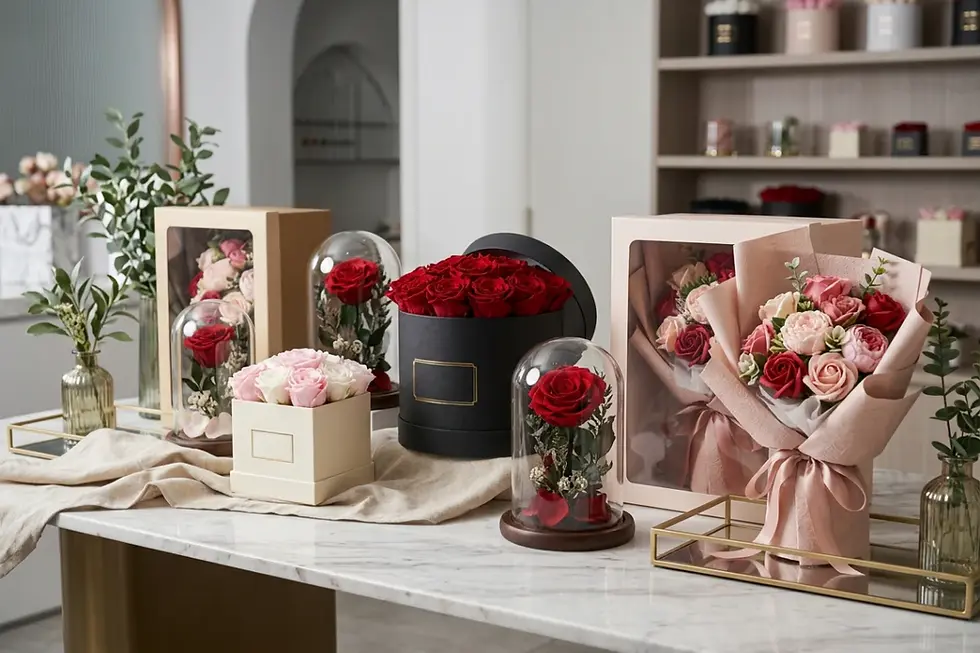
Core-Level (The Volume Driver): This is the heart of your collection. It represents the majority of your inventory investment and revenue. Core products offer the perfect balance of visual volume, premium packaging, and approachable pricing. Ideal examples include mid-sized soap flower bouquets, classic preserved rose glass domes, and multi-stem crochet potted arrangements.
Premium-Level (The Brand Statement): High-ticket, visually arresting masterworks that sit at the top of your display. While these sell in lower quantities, they establish your brand's authority, elevate the overall perception of your shop, and command high absolute dollar margins. Think massive multi-stem preserved rose acrylic trunks, complex LED-lit floral glass displays, or oversized luxury soap flower arrangements in custom hatboxes.
Here is a functional framework for allocating these roles within your assortment plan:
Price Tier | Assortment Role | Target Inventory Share | Primary Materials | Key Consumer Purchase Intent |
|---|---|---|---|---|
Entry | Cash-flow booster & add-on | 25% – 30% of SKUs | Single soap roses, small crochet flowers, plush accessories | Casual gifting, self-rewards, quick add-on purchases |
Core | Volume & margin engine | 50% – 60% of SKUs | Mid-sized soap bouquets, standard preserved rose domes | Birthdays, anniversaries, thank-you gifts, home decor |
Premium | Visual anchor & high-dollar margin | 10% – 15% of SKUs | Large preserved arrangements, luxury multi-material box sets | Major milestones, luxury corporate gifts, premium proposals |

What is the difference between Hero SKUs and Supporting SKUs in a retail gift assortment?
Every profitable retail gift assortment relies on a clear division of labor between "Hero" SKUs and "Supporting" SKUs.
Hero SKUs are the showstoppers. They are the highly photogenic, conversation-starting products that you feature in your storefront window, your catalog covers, or your social media advertisements. These items might feature unique design details, such as built-in LED lighting, rotating mechanical bases, or unexpected material pairings (like a preserved rose box accompanied by an integrated plush bear). The job of the Hero SKU is not necessarily to sell the most units, but to stop foot traffic and drive digital clicks, drawing customers into your brand ecosystem.
Supporting SKUs, on the other hand, are the silent workhorses of your gift shop product mix. These are classic, reliable designs in popular, safe colorways (such as blush pink, deep crimson, and warm cream) that customers naturally gravitate toward once the Hero SKU has captured their attention. They are designed for efficient production, easy packing, and high margins. If a Hero SKU is a brilliant 12-rose preserved light dome, the Supporting SKUs are the clean, elegant single-rose and three-rose versions that offer a simpler, more affordable pathway to purchase.
How do you balance everyday essentials with high-stakes seasonal floral gift demand?
A major risk in the retail-ready floral gifts sector is seasonal carryover. Over-ordering highly specific seasonal items can leave you with dead stock that ties up capital and takes up valuable backroom storage for an entire year.
To protect your cash flow, split your assortment into a 70/30 baseline formula: 70% of your assortment should consist of Everyday Essentials, while 30% is allocated to Seasonal Surges.
Everyday Essentials: Keep these in stock year-round. These products focus on evergreen themes—such as birthday, thank you, anniversary, and get-well-soon gifts. Use classic packaging that does not reference specific calendar dates. Neutral or soft pink tones, preserved red roses, and high-quality soap flower baskets work beautifully here.
Seasonal Surges (Valentine's Day, Mother's Day, Christmas): These require high-impact, time-sensitive designs. To minimize inventory risk, design these seasonal products using modular components. For example, use your everyday high-volume core flower arrangements, but pair them with seasonal-specific outer sleeve packaging, holiday ribbon sets, or removable cardholders. This allows you to easily strip away the holiday branding and fold any unsold units back into your everyday inventory once the holiday ends.
How can you combine different materials—like preserved, soap, plush, and crochet—into a cohesive product mix?
Modern consumers seek novelty and tactile diversity. Merely stocking one type of floral gift limits your market reach. By combining multiple material types into your floral gift wholesale purchase plan, you can appeal to different demographics and usage scenarios:
Preserved Flowers (The Luxury Standard): These are real, natural flowers treated with non-toxic polymers to maintain their fresh look for years. They are perfect for traditionalists who demand real petals, making them ideal for high-end home decor and premium romance gifts.
Soap Flowers (The High-Value alternative): Crafted from scented soap materials, these flowers offer vibrant, rich colors, uniform petal shapes, and a subtle fragrance. They provide immense visual volume at a highly competitive cost, making them excellent choices for large, impressive bouquets that remain budget-friendly.
Plush & Crochet Flowers (The Gen Z & Lifestyle Play): These non-traditional, whimsical creations are highly durable, completely shatterproof, and incredibly popular with younger consumers. Crochet flowers bring a cozy, handmade charm that appeals to craft lovers, while plush flower combinations add a playful, emotional element that is perfect for graduation gifts and casual friendship tokens.
When curated under unified color palettes—such as a cohesive "Dusty Rose & Sage" collection or a "Champagne & Cream" line—these distinct materials feel like part of a single, well-thought-out lifestyle statement rather than a disjointed product dump.
How do you optimize your retail gift assortment for specific sales channels?
Your sales channel dictates the physical constraints of your retail gift assortment. A product that performs exceptionally well in a brick-and-mortar storefront might fail in an e-commerce model, and vice versa.
For Brick-and-Mortar Retailers: Focus on tactile experiences, shelf footprint optimization, and instant visual impact. Your products must stand up to physical handling by customers. Avoid overly fragile, unshielded paper boxes that easily dent. Instead, prioritize glass or acrylic domes, robust structured gift baskets, and products with clear, open-face windows that allow shoppers to appreciate the textures and scents directly. Maximize your vertical shelf space with varied heights (e.g., using risers for tall flower stands while keeping flat gift boxes below).
For E-commerce and Omnichannel Brands: Shipping safety and dimensional weight are your primary concerns. Fragile glass covers require extensive, drop-tested custom foam packaging, which increases shipping volume and fulfillment costs. For online sales, focus on flat-packable items, high-density foam-locked preserved rose boxes, and unbreakable materials like soap flower bouquets wrapped in robust, non-crushable craft sleeves. Your retail-ready floral gifts must be designed to survive rough courier handling while offering a beautiful "unboxing" experience without requiring messy loose-fill packing peanuts.
Why are small-batch testing and agile reordering critical in floral gift wholesale?
The absolute worst way to manage a retail gift assortment is to commit your entire seasonal budget to a single massive shipment months in advance. Consumer tastes can shift, local economic conditions change, and certain colorways will always outperform others in unpredictable ways.
To build a highly profitable program, establish an agile buying loop:
Test Small (The Trial Run): Launch a new season or category with a tight, curated assortment of 12 to 18 SKUs in small quantities. This limits your upfront capital exposure and lets you test real-world customer reactions.
Monitor Early Sell-Through: Track which colors and price tiers sell out within the first two weeks. Do not guess; rely on actual transaction speed.
Execute Rapid Reorders: Work with a supplier that maintains domestic or fast-transit warehouse stock, or offers flexible manufacturing pipelines. This allows you to quickly double down on your best-performing "Hero" items while letting slower-moving "Supporting" items sell through without replacement.
This agile approach drastically reduces the risk of post-holiday clearance markdowns, keeping your overall retail margins healthy and your cash flow highly liquid.
How Sweetie AI Can Support Floral Gift Assortment Planning
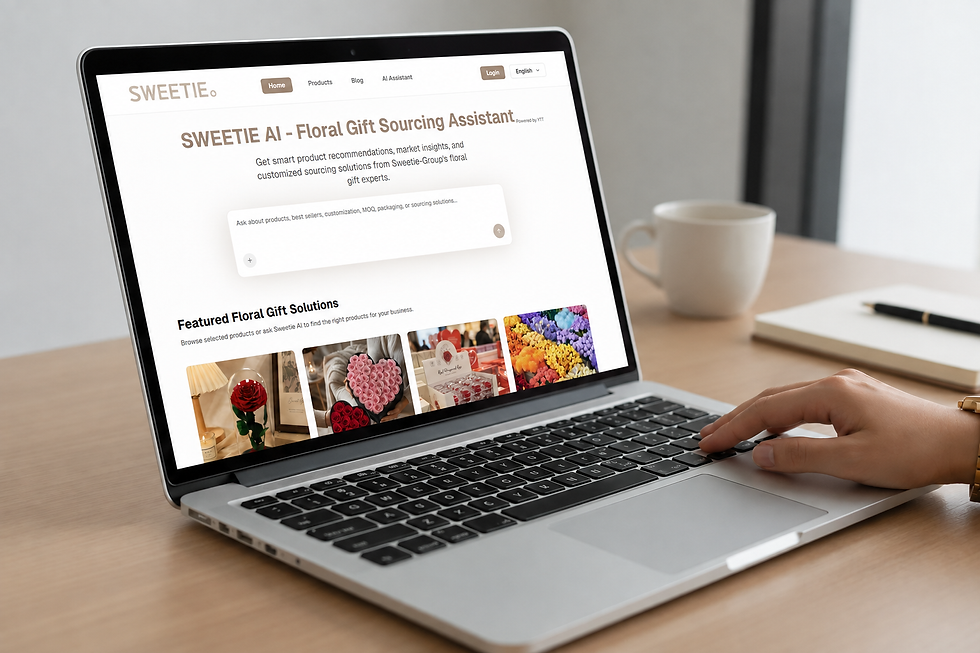
To simplify this complex planning process, retail buyers can utilize Sweetie AI. This specialized system helps buyers explore product opportunities, suggest cohesive design directions, brainstorm unique collection ideas, and outline tailored packaging and purchasing considerations.
By inputting details about your target market, audience profiles, primary sales channels, and overall market positioning into Sweetie AI, you can generate structured recommendations for your product mix. For instance, if you tell the AI that you are targeting Gen Z gift shoppers via an online Shopify store with a price ceiling of $45, it can recommend a tailored selection of plush keychains, shatterproof soap flower bouquets, and flat-packable crochet items.
Please note: Sweetie AI is a creative and strategic planning tool; it is not an automated inventory, POS, or financial management system. It does not read your live store sales data, track active inventory levels, or automatically calculate exact purchasing quantities or target profits. All final operational details, including specific product costs, minimum order quantities (MOQs), packaging modifications, physical sample creation, safety compliance, and manufacturing timelines, must be reviewed and confirmed directly with the expert human sales and production teams at Sweetie.
Planning a new retail gift assortment does not have to be a guessing game. By structuring your price tiers, prioritizing high-impact hero products, and designing modular seasonal transitions, you can create a reliable, profitable category that delights your customers and drives repeat business.
Planning a new floral gift assortment? Email your market, channel, target retail prices, launch season, and expected quantity to sales@sweetie-group.com for product-mix recommendations.
FAQ
What is the recommended gross margin target for a retail gift shop product mix?
For a healthy and profitable retail gift shop product mix, buyers should target a gross margin of 55% to 65% on core items. Entry-level items can sometimes operate on a slightly lower margin (around 50%) to drive volume and attract foot traffic, while premium, highly customized items should command margins of 70% or higher to offset their slower turnover rate.
How can I prevent damage to delicate preserved rose domes during e-commerce shipping?
To ensure your retail-ready floral gifts arrive in pristine condition, work with a supplier that utilizes custom-molded high-density foam inserts, double-walled shipping boxes, and drop-tested packaging structures. Avoid loose-pack materials like packing peanuts, and ensure that internal glass or acrylic elements are structurally locked into the base of the gift box.
How early should a retail buyer place wholesale orders for Mother's Day and Valentine's Day?
For high-volume global holidays, planning should begin 5 to 6 months in advance. Buyers should finalize their floral gift wholesale assortment and lock in production schedules at least 3 to 4 months before the holiday launch. This leaves sufficient lead time for ocean freight, customs clearance, warehouse receiving, and store-level visual merchandising setup.
What are the advantages of soap flowers over preserved flowers in a retail-ready floral gift assortment?
Soap flowers are significantly more cost-effective to produce, allowing for larger, more dramatic bouquet presentations at lower retail price points. They are also less sensitive to humidity fluctuations than real preserved flowers, making them much easier to store, display, and transport in a wide variety of retail environments.
What is the best way to handle leftover seasonal floral gift inventory?
The best approach is proactive: design seasonal items with modular packaging, such as removable holiday ribbons or sleeve wraps, so they can easily transition into everyday birthday or anniversary stock. If you have leftover holiday-specific products, apply a prompt post-holiday clearance discount of 30% to 50% to quickly liquidate the inventory and free up valuable shelf space for the next product cycle.
How many individual SKUs should a boutique gift store carry in its initial floral assortment?
For a mid-sized boutique, we recommend launching with a tight, highly curated assortment of 12 to 18 SKUs. This allows you to represent 3 distinct price tiers (Entry, Core, Premium) and 2 to 3 key color stories (e.g., classic reds, blush pinks, and soft neutrals) without overwhelming your shelf space, confusing your customers, or overextending your initial purchasing budget.


Comments