


Artificial Flowers vs Preserved Flowers: A B2B Buyer’s Guide to Categories, Materials, and Sourcing

A preserved rose, a silk rose, a soap rose, and a crochet rose can all last much longer than fresh flowers. They may even appear in the same gift section.
But they are not the same type of floral product.
The most important distinction is simple: preserved flowers are real flowers that have undergone a preservation process, while artificial flowers are manufactured from materials such as fabric, polyester, plastic, latex, or foam.
That difference affects more than terminology. It influences appearance, quality control, customization, packaging, storage, and the types of products each material works well for.
Artificial Flowers vs Preserved Flowers at a Glance
Factor | Artificial Flowers | Preserved Flowers |
Origin | Manufactured | Real flowers |
Typical materials | Fabric, polyester, plastic, latex, foam | Natural flowers treated for preservation |
Appearance | Realistic or decorative, depending on design | Retains the natural structure of a real flower |
Color flexibility | Very high | Broad, with some natural variation |
Water required | No | No |
Custom shapes | Highly flexible | Limited by natural flower structure |
Environmental sensitivity | Generally lower | More sensitive to humidity, sunlight, and heat |
Common uses | Home décor, displays, events, gifts | Floral gifts, premium décor, keepsakes |
Key sourcing concerns | Material and construction consistency | Flower quality, petal condition, and protection |
The easiest way to remember the distinction is this: artificial flowers are made, while preserved flowers are grown first and preserved later.
What Is the Difference Between Artificial and Preserved Flowers?
Artificial Flowers
Artificial flowers are created from manufactured materials and shaped to reproduce or reinterpret natural flowers.
Traditional examples include polyester roses, fabric peonies, plastic greenery, latex flowers, and foam flowers. Some are designed to look extremely realistic. Others use unusual colors, oversized forms, or stylized shapes that would be difficult to achieve with natural flowers.
This makes artificial flowers a broad category rather than a single material type.
Their manufacturing process also allows considerable control over features such as color, flower size, stem length, and petal shape. For seasonal collections or products built around specific brand colors, that flexibility can be useful.
Preserved Flowers
Preserved flowers begin as real, natural flowers.
After harvesting, they undergo a preservation treatment that allows them to maintain their shape, color, and decorative appearance for much longer than ordinary fresh flowers. They do not require watering.
A preserved rose is therefore still a real rose.
Because the material is natural, some variation should be expected. Flower size, petal shape, and color can differ slightly even within the same production batch. Good production control does not eliminate nature. It keeps that natural variation within an acceptable range.
At Sweetie-Gifts, preserved flowers are handled as a distinct product category from soap flowers, rose animals, crochet flowers, and plush flowers. Our current product structure also separates these categories according to their materials and production methods.
Where Do Dried, Soap, Crochet, and Rose Products Fit?
This is where floral terminology can become less straightforward.
Dried flowers are similar to preserved flowers in one important respect: both start as real botanical materials. They are not, however, the same product. Dried flowers primarily lose moisture and usually become drier and more brittle, while preserved flowers are treated to retain more of the appearance and texture associated with fresh flowers.
That is why preserved and dried flowers are often grouped together in retail categories. Amazon US, for example, separates Artificial Plants & Flowers from Dried & Preserved Flora. This is a useful retail distinction, although marketplace categories should not be treated as universal technical definitions.
Newer floral gifts create another layer of classification.
Product | Material Origin | Common Commercial Name |
Preserved rose | Real flower | Preserved Flowers |
Dried flower | Real flower | Dried Flowers |
Fabric or plastic flower | Manufactured | Artificial Flowers |
Soap flower | Manufactured | Soap Flowers |
Crochet flower | Manufactured | Crochet Flowers |
PE foam rose bear | Manufactured | Rose Bears / Floral Gifts |
Soap Flowers
Soap flowers are decorative flowers formed from soap-based materials. They are manufactured products, not preserved natural flowers.
They can fit within the broader artificial floral category, but in practice, Soap Flowers is a more useful commercial name because the material and gift format are quite different from traditional fabric or plastic flowers.
Our soap flower specifications also treat soap flowers as a separate product line intended mainly for bouquets, gifts, and decoration.
Crochet Flowers and Rose Bears
Crochet flowers are made from yarn, so they also sit on the manufactured side of the floral market. However, they are normally sold as Crochet Flowers rather than simply as artificial flowers.
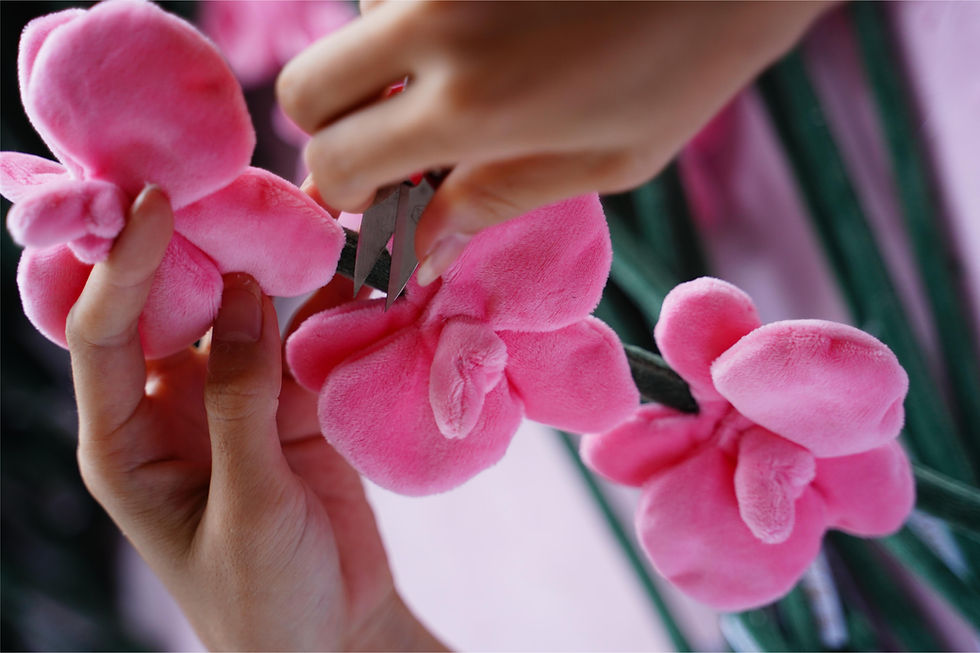
The same principle applies to PE rose bears. Artificial foam rose heads are assembled into a bear or other decorative shape, but the finished product has developed its own recognizable commercial category. Sweetie's rose animal collection uses this type of artificial rose construction.
The broader classification is useful for understanding the material. The more specific product name is usually more useful for selling and sourcing it.
Developing a floral gift collection across several materials? Contact us at sales@sweetie-group.com to discuss product formats and customization options.

How the Difference Affects Sourcing
Material classification becomes much more practical once production starts. Artificial and preserved flowers require different quality standards and different approaches to packaging.
Quality and Consistency
For artificial flowers, quality control often focuses on the manufactured components:
flower shape and color consistency
fabric, plastic, or foam quality
petal alignment
visible glue or poor finishing
loose components
stem construction
Repeatability is particularly important when the same SKU will be replenished over several orders.
Preserved flowers need a different inspection standard. Petal condition, flower size, color consistency, arrangement position, and flower-head stability all matter.
Natural variation is unavoidable, so a useful specification should define what level of variation is acceptable rather than expecting every flower to look identical.
Customization
Artificial flowers provide considerable flexibility for custom colors, shapes, seasonal themes, decorative accessories, and unusual product structures.
Preserved flower gifts can also be highly customized. Common options include flower combinations, color palettes, gift boxes, ribbons, cards, logo placement, and decorative accessories.
The key difference is that preserved flowers still follow the physical structure of natural flowers. A molded foam rose can be produced to a very controlled shape. A preserved rose will always retain some natural individuality.
Packaging, Shipping, and Storage
Packaging is one of the clearest practical differences between the two categories.
Artificial flowers can be affected by crushed petals, bent stems, or deformation. Packaging therefore needs to protect the intended shape without adding unnecessary shipping volume.
Preserved flowers are more sensitive to direct contact and compression. Flower heads should have enough clearance inside the package, and the arrangement needs to remain stable during transport.
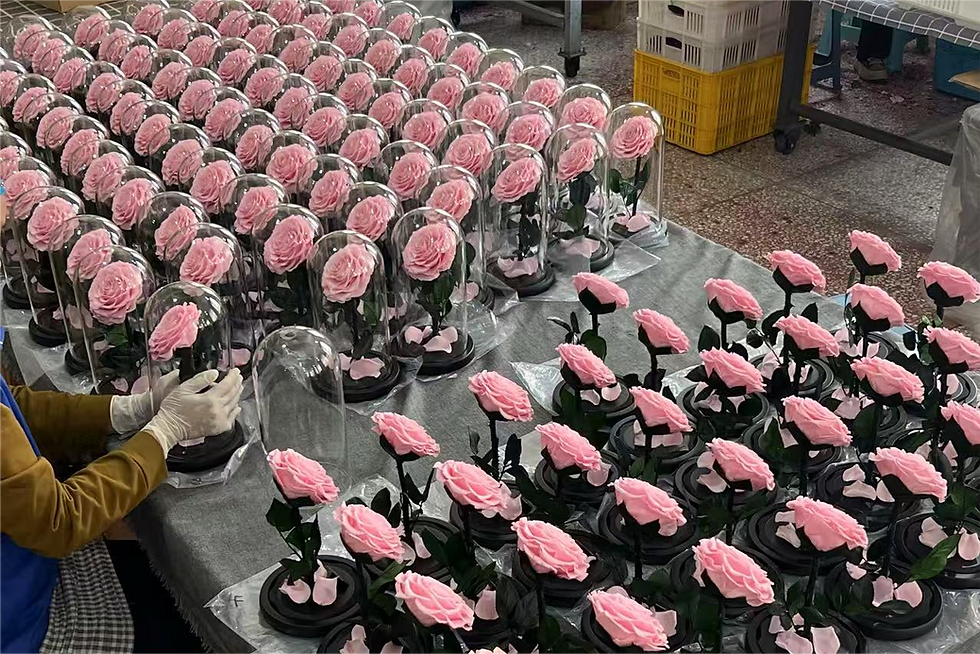
Different product formats require different solutions. For example, our preserved flower packaging methods distinguish between covered flower boxes, open flower boxes, and glass dome products. Open arrangements need enough clearance to keep flowers away from the surrounding protective box, while glass domes require secure fixation and cushioning against breakage. E-commerce packaging may need additional internal support because parcel delivery creates more vibration and impact.
Storage also differs. Many artificial flowers are less sensitive to humidity than preserved flowers. Preserved products should generally be kept away from water, high humidity, strong sunlight, and excessive heat.
These differences are worth discussing before packaging is finalized, not after the first shipment has already been packed.
For packaging, OEM/ODM, or sampling questions, email sales@sweetie-group.com with the product type, quantity, and target market.

Which Type Fits Different Retail and Gift Programs?
Neither category is universally better. The right material depends on how the finished product will be used.
Product Program | Often Suitable |
Everyday home décor | Artificial flowers |
Long-term commercial displays | Artificial flowers |
Premium floral gift boxes | Preserved flowers |
Jewelry or beauty gift combinations | Preserved flowers |
Highly customized seasonal gifts | Artificial or soap flowers |
Handmade-style lifestyle gifts | Crochet flowers |
Valentine’s Day gift collections | Preserved flowers, soap flowers, rose bears |
Corporate or promotional gifts | Preserved or manufactured floral gifts |
Artificial flowers are often practical when durability, repeated display, precise shapes, or highly controlled colors are important.
Preserved flowers are particularly suitable when the natural origin of the flower is part of the product value. This is one reason preserved roses are widely used in gift boxes, glass domes, jewelry combinations, and other long-lasting floral gifts.
Soap flowers, crochet flowers, and rose bears provide further options when a collection needs a distinctive material, a themed design, or a different target price.
The final choice should consider the complete product, including materials, packaging, customization, freight, storage, and expected retail use.
Final Thoughts
Artificial flowers and preserved flowers may serve similar decorative and gifting purposes, but they come from fundamentally different materials.
Preserved flowers are real flowers treated for long-term display. Artificial flowers are manufactured from non-botanical materials. Dried flowers are also real botanicals, while products such as soap flowers, crochet flowers, and PE rose bears belong to the manufactured side of the market even when they are sold under their own category names.
For sourcing, that distinction matters because different materials require different standards for consistency, customization, handling, packaging, and storage.
At Sweetie-Gifts, we develop products across preserved flowers, soap flowers, PE rose animals, crochet flowers, plush flowers, and other floral gift categories. Our manufacturing and supply network includes preserved flower production in Yunnan and a Yiwu supply chain for several manufactured floral gift categories, with OEM/ODM and packaging development available for custom projects.
Have a floral gift concept in development? Send the details to sales@sweetie-group.com and our team can help evaluate the material, structure, and packaging approach.
Frequently Asked Questions
Are preserved flowers artificial?
No. Preserved flowers are real flowers that have undergone a preservation process so they can remain decorative for much longer than ordinary fresh flowers.
Are preserved flowers the same as dried flowers?
No. Both start as real botanical materials, but they are processed differently. Dried flowers generally lose moisture and become drier, while preserved flowers are treated to retain more of their original appearance and texture.
Are soap flowers artificial flowers?
Soap flowers are manufactured rather than grown, so they can be placed within the broader artificial floral family. Commercially, they are usually identified more specifically as soap flowers.
Are crochet flowers considered artificial flowers?
Crochet flowers are manufactured from yarn rather than grown as natural flowers. They can therefore sit within the broader artificial floral category, although Crochet Flowers is normally the more useful product name.
Which lasts longer, artificial or preserved flowers?
Many artificial flowers can remain in use for a long time with relatively simple care. Preserved flower longevity depends more strongly on humidity, sunlight, temperature, handling, and storage conditions.

Annie Zhang

Comments