


How Is a Preserved Rose in a Glass Dome Made? Inside Our Factory

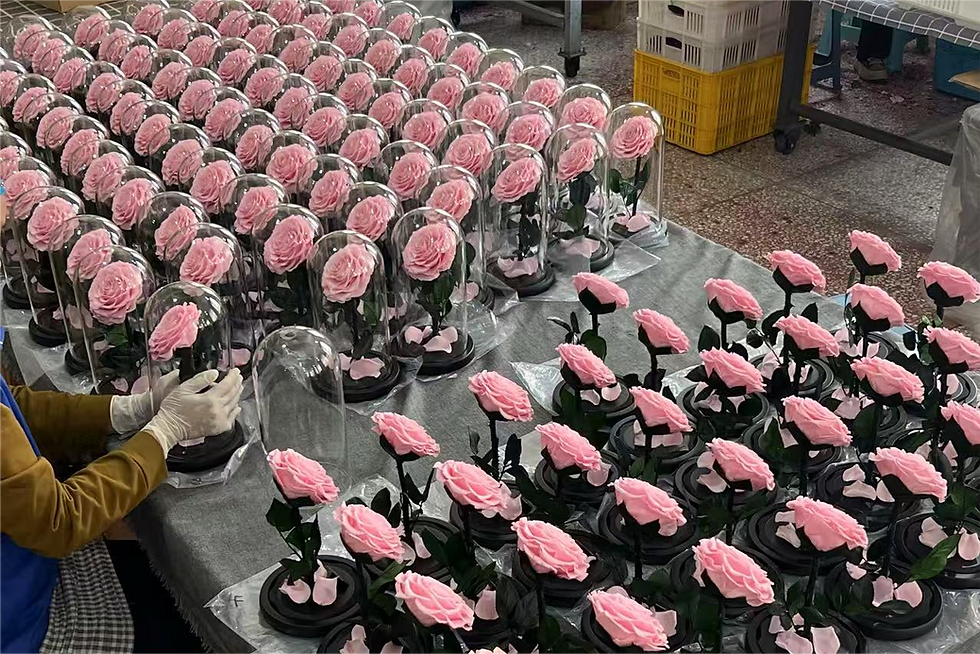
A preserved rose in a glass dome looks like a simple gift: one beautiful rose, a clear glass cover, and a decorative base. But making one attractive sample is very different from producing thousands of pieces that look consistent on retail shelves.
What many buyers don't realize is that some of the fullest-looking preserved roses are carefully shaped by hand. Instead of using the original flower head exactly as it is, skilled workers attach individual preserved petals to create a fuller, more balanced bloom.
That's only one part of the process. The stem, leaves, base, and glass dome all need to be assembled carefully before the product is ready for shipping.
At Sweetie-Gifts, we've been developing preserved rose glass dome products since 2015. Our bestselling designs include hand-shaped rose heads, and our factory team has spent years improving the assembly structure and protective packaging.
Here's how we turn preserved rose heads into finished glass dome gifts at our factory, and why certain production details matter when manufacturing in bulk.
How Is a Preserved Rose in a Glass Dome Made?
A preserved rose in a glass dome is made by selecting and shaping a real preserved rose, attaching it to a supporting stem, arranging the leaves, securing the flower to a base, and covering the arrangement with a glass dome. The finished product is then inspected and packed for shipping.
Our production process follows eight main steps:
Selecting preserved rose heads
Shaping the rose heads by hand
Attaching the rose heads to stems
Adding and arranging the leaves
Fixing the roses to their bases
Installing the glass domes
Inspecting the finished products
Packing the glass domes for transportation
The roses have already undergone preservation treatment before these steps begin. The glass dome itself does not preserve the flower. It mainly serves as a decorative cover that helps protect the rose from dust and accidental contact.
If you're interested in how fresh roses are treated before assembly, we've explained that separate process in our guide to making eternity flowers.
Here, we'll focus on the manufacturing work that transforms preserved flower heads into finished retail gifts. Need samples or a wholesale quotation? Contact sales@sweetie-group.com.
Step 1: Selecting Preserved Rose Heads
The process begins with choosing suitable preserved rose heads.
Because preserved roses are real flowers, their sizes, shapes, and petal arrangements naturally vary. Some have a beautifully balanced opening, while others may have uneven outer petals or minor imperfections.
Our workers examine the rose heads before assembly, checking their size, color, petal condition, and overall shape.
The choice also depends on the intended glass dome design. A larger flower head may work beautifully in a spacious dome but look crowded in a smaller one.
For bulk production, the selected flowers need to fall within an acceptable size and appearance range.
This helps maintain a consistent look across the finished products, especially when they're displayed together in gift shops, supermarkets, or online product collections.
Step 2: Shaping the Preserved Rose by Hand
This is one of the most important steps in our manufacturing process, and it's also where different preserved rose glass dome products can vary significantly.
Not every preserved rose head is used exactly as it comes from the preservation process.
At Sweetie-Gifts, we use two different shaping approaches depending on the product design.
Method 1: Adjusting a Naturally Full Rose Head
Some preserved roses already have an attractive, well-balanced shape.
For these flowers, workers inspect the petals, remove visibly damaged or unnecessary parts, and make small adjustments to improve the overall appearance.
The original flower structure is largely preserved.
This method is suitable for designs where a natural rose shape is preferred and the flower head already meets the required appearance.
Method 2: Rebuilding a Fuller Rose, Petal by Petal
For some of our bestselling glass dome designs, we use a more detailed handcrafted technique.
Workers carefully attach individual preserved rose petals to reshape the flower head, gradually building up the outer layers to create a fuller and more balanced bloom.
The process requires more than simply adding extra petals.
Each petal must be positioned at the right angle and overlap naturally with the surrounding layers. Workers also need to consider the overall diameter, opening, and symmetry of the flower.
For example, placing the outer petals too close together can make the rose look tight and compact. Spreading them too far apart may create an unnatural appearance.
Experienced workers make these adjustments gradually, checking the shape as they go.
In our factory, this work is done by hand using adhesive to secure the petals. The result is a rose head with a more developed shape and a fuller appearance.
This extra handwork is one reason two preserved rose products made from similar flower materials can look noticeably different.
It's particularly useful for designs where the rose is the main visual feature, such as a single-rose glass dome.
The goal isn't to make every rose look artificial or perfectly identical. It's to achieve the intended flower shape while retaining the natural appearance of preserved rose petals.
For wholesale orders, buyers can choose between a more natural flower head and a fuller handcrafted style, depending on the design, target market, and product positioning.

Step 3: Attaching the Rose Head to the Stem
Once the rose head has been shaped, workers attach it to a supporting stem.
The stem supports the flower and determines how it will be positioned inside the glass dome.
Workers secure the rose head to the stem, making sure the connection is stable and the flower faces the intended direction.
The height and angle are adjusted according to the approved design.
This step is especially important for single-rose arrangements because the flower stands on its own. Even a slight tilt can affect the finished appearance.
A secure connection also helps the flower maintain its position during subsequent assembly and handling.
Step 4: Adding and Arranging the Leaves
The next step is attaching and arranging the leaves along the stem.
For our classic long-stem rose designs, green leaves help create a more natural appearance and provide contrast with the rose petals.
Workers select suitable leaf positions and secure them to the stem. They then adjust the direction and spacing so the greenery complements the flower without covering it.
The leaves also need to fit comfortably within the glass dome.
If they extend too far outward, they may press against the glass after installation.
Once the flower head, stem, and leaves are assembled, the arrangement is ready to be installed onto the base.
Step 5: Fixing the Rose to the Base
The base is more than a decorative component. It holds the floral arrangement in position and supports the glass dome.
At our factory, workers prepare the base according to the product design and install the assembled rose into its fixing position.
The stem must be secured firmly enough to support the flower head without unwanted movement.
For our glass dome products, stem fixation is an important part of the structural design.
If the fixing point is weak, the rose may lean or shift during transportation, even when the flower itself is in excellent condition.
The base design also affects the overall proportions of the finished product. The rose should stand at the correct height, with enough room for the flower head and leaves inside the dome.
Our production team has continued refining these structural details as part of our glass dome product development.
For customized products, the base may also include branding elements, decorative nameplates, or other design details.
Planning a custom preserved rose glass dome collection? Share your design requirements with our team at sales@sweetie-group.com.

Step 6: Installing the Glass Dome
Once the rose is securely fixed to the base, the glass cover can be installed.
Before assembly, workers check the glass dome for visible damage, marks, and dirt. A clear, clean surface is essential because the glass is part of the finished product's presentation.
Workers carefully lower the dome over the floral arrangement and position it on the base.
During this process, they check that the flower head and leaves remain in place and do not touch the inner glass surface.
The space between the rose and the glass is important.
If the dome is too narrow or the flower is positioned incorrectly, the petals may come into contact with the glass. This can affect the appearance of the arrangement and increase the risk of damage during handling.
The flower should have enough space to display its shape naturally while remaining well proportioned within the dome.
Once the glass is correctly positioned and installed according to the product design, the assembly is complete.
Step 7: Inspecting the Finished Glass Dome
Before packaging, the assembled glass dome undergoes a final quality inspection.
Because the glass is transparent, small imperfections can be easy to notice. Workers check the flower's appearance as well as the overall assembly.
The main inspection points include:
Component | What We Check |
Rose head | Shape, petal condition, and overall appearance |
Color | Consistency with the approved product reference |
Stem and leaves | Position, stability, and arrangement |
Base | Surface finish and secure fixation |
Glass dome | Cleanliness, visible defects, and damage |
Finished product | Overall proportions and loose components |
The approved sample serves as an important reference during production.
Since preserved roses are natural materials and many assembly steps are performed by hand, some variation between finished products is expected.
What matters is keeping that variation within the agreed product requirements.
For large orders, this means paying attention not only to the appearance of individual roses but also to the consistency of the finished collection.
Step 8: Packaging for International Shipping
After inspection, the completed glass domes are packed for transportation.
Glass dome gifts require careful packaging because both the glass cover and the floral arrangement can be damaged by improper handling.
For our products, a typical packaging structure includes:
Finished glass dome → Gift box → Individual protective box → Shipping carton
The gift box provides the retail presentation. Depending on the design, it may include a positioning structure to help keep the glass dome in place.
The individual protective box provides additional support and cushioning.
Finally, the products are placed into shipping cartons with suitable protection to limit movement and reduce the risk of damage during transportation.
Packaging for Different Sales Channels
Packaging requirements can vary depending on how the products will be sold.
For example, glass dome gifts intended for online sales may need stronger individual protective packaging because they can travel through parcel delivery networks.
Products distributed to retail stores in master cartons may have different packing requirements.
At Sweetie-Gifts, we can develop packaging solutions based on the product structure and intended distribution channel. Customized gift boxes and alternative packaging materials can also be discussed during product development.
A well-designed package should protect the product without unnecessarily increasing its size or making the customer experience complicated.
What Should Wholesale Buyers Check Before Ordering?
Knowing how a preserved rose glass dome is made can help buyers evaluate samples more effectively.
Start with the rose head itself. Check whether the flower shape matches the intended design and whether it is naturally shaped or reconstructed with additional petals.
Then examine the stem, leaves, and base. The arrangement should look balanced, and the flower should remain securely positioned.
Pay attention to the space inside the glass dome. The petals and leaves should not press against the glass.
Finally, review the protective packaging based on your sales channel and shipping requirements.
It's also worth discussing which details can be customized and which need to remain standardized for consistent production.
For example, a premium gift brand may prioritize a fuller hand-shaped rose and customized presentation, while a supermarket collection may place greater emphasis on retail pricing, packaging dimensions, and repeat-order consistency.
Choosing the Right Design for Your Market
Different markets and sales channels may call for different rose colors, flower shapes, glass dome sizes, and packaging styles.
If you're comparing options, you can use Sweetie AI to explore floral gift recommendations based on your sales channel and product requirements. It can also help you organize product choices and prepare an initial purchasing plan.
Once you've identified a suitable direction, samples and detailed specifications can be reviewed before moving into bulk production.
Need samples or a wholesale quotation? Contact sales@sweetie-group.com with your preferred designs, quantities, and destination market.

Frequently Asked Questions
Is the rose inside a glass dome real?
Yes. A preserved rose glass dome can contain a real rose that has undergone professional preservation treatment.
The flower retains much of its natural appearance but no longer requires watering like a fresh rose.
However, some glass dome products use artificial flowers, so buyers should confirm the materials when sourcing.
How are preserved rose heads made to look so full?
Some preserved rose heads are naturally full and only need minor adjustments.
For other designs, workers carefully reshape the flower by attaching individual preserved rose petals, gradually creating a fuller and more balanced bloom.
This handcrafted technique is used in some of our bestselling glass dome designs.
Does the glass dome preserve the rose?
No. The rose has already been preserved before it is placed inside the glass dome.
The glass cover mainly protects the flower from dust and accidental contact while providing an attractive display.
It does not replace the chemical preservation process.
How long does a preserved rose in a glass dome last?
A properly preserved rose can maintain its appearance for years under suitable conditions, although the actual lifespan varies.
Humidity, direct sunlight, temperature, handling, and the quality of the preservation treatment can all affect its condition.
Preserved roses should be kept in a dry indoor environment, away from direct sunlight and excessive moisture. They should not be watered.
Can preserved rose glass domes be customized for wholesale orders?
Yes. Wholesale buyers can discuss rose colors, flower head styles, dome dimensions, base designs, decorative details, branding, and packaging.
Customization options and minimum order quantities depend on the product specifications and materials.
For projects requiring a particular appearance, an approved sample helps establish the production reference before bulk manufacturing.
Final Thoughts: From a Preserved Rose to a Finished Gift
Making a preserved rose glass dome involves a series of careful assembly steps, beginning with flower head selection and shaping and ending with the installation of the glass cover and protective packaging.
For some designs, the most detailed work happens before the rose is attached to its stem, when workers reconstruct the flower head petal by petal to achieve a fuller shape.
The remaining steps ensure that the flower is properly positioned, securely assembled, and ready for transportation.
Understanding these details makes it easier for buyers to evaluate samples, communicate design requirements, and develop preserved rose glass dome products that suit their markets.
Annie Zhang
CEO of Sweetie-Group


Comments