


What The Million Roses Gets Right About Luxury Preserved Rose Branding

Some preserved rose brands sell a pleasant gift. A much smaller number sell a luxury object. The difference matters.
The Million Roses is a useful case study because it does not behave like a traditional flower shop. It behaves like a premium gifting brand built around preserved roses, structured product lines, occasion-based merchandising, and a fulfillment model that treats delivery as part of the product itself. Its official positioning centers on roses that last three years or more, handcrafted arrangements, Los Angeles same-day delivery, and a broad assortment that now reaches beyond classic rose boxes into domes, home décor, and jewelry.
That combination is exactly why the brand is worth studying. It shows what happens when preserved roses stop being a novelty and become a system for luxury gifting.
The Million Roses Is Not Just a Flower Brand
The first thing The Million Roses gets right is category framing. It does not present itself as a florist with a preserved line. It presents itself as a luxury brand whose hero material happens to be preserved roses. The language on its site is consistent with that strategy. The focus is on timelessness, gifting, design, and display value rather than the usual florist language of freshness, bouquets, or daily floral needs.
That sounds subtle, but commercially it changes everything.
A traditional flower business usually sells perishability with urgency. A luxury preserved rose brand sells permanence with emotional weight. One model is about today’s delivery. The other is about a gift that stays visible for months or years and keeps signaling the moment it was given.
Its public pricing also supports that positioning. The Million Roses sells products that range from entry pieces around the $150 to $200 level to large dome and statement arrangements priced in the hundreds and even thousands of dollars.
What that tells us
The brand is not trying to win as a standard floral retailer. It is trying to win as a premium gifting business with a floral core.
A few signals make that clear:
It emphasizes longevity over freshness
It treats packaging as a central part of the value
It sells display-ready objects, not just arrangements
It uses luxury gifting language rather than everyday flower-shop language
If this kind of product architecture is on your roadmap, sales@sweetie-group.com is a good place to start the conversation.

It Sells a Premium Gift, Not a Commodity
A lot of preserved rose brands talk about longevity. The stronger ones know longevity alone is not enough.
The Million Roses succeeds because it wraps longevity inside a safer gifting proposition. Preserved roses solve one obvious problem with fresh flowers. They do not fade in a few days. But the brand goes further than that. It reduces gifting anxiety in several ways at once. The arrangements are visually controlled, the presentation is standardized, the boxes and domes already feel display-ready, and the delivery options are built around exact dates, local same-day service in Los Angeles, and pickup flexibility.
Many buyers are not shopping for “flowers” in the narrow sense. They are shopping for a result. They want the gift to look expensive, arrive on time, and make the right impression without requiring expert taste in floral design. The Million Roses is built for that buyer.
What customers are really buying
At its best, the product is offering more than preserved roses. It is offering:
a premium gifting experience
a longer emotional shelf life
a ready-made display object
a lower-risk luxury gift choice
That is a big reason the brand can support much higher pricing than ordinary floral gifting.
Its Product Structure Is More Disciplined Than It Looks
From the outside, the assortment can seem highly emotional. Hearts, domes, classic boxes, drawer boxes, crystal editions, long stem roses, statement arrangements, and now jewelry. Look more closely, though, and the product architecture is commercially disciplined.
There is a clear entry layer. Single-rose products, smaller acrylic formats, and compact giftable shapes bring new customers into the brand at lower risk. There is a strong middle layer built from classic boxes, square boxes, heart boxes, and standard domes. These are the products most likely to carry repeatable margin because they balance emotional appeal with operational repeatability. Then there is the top layer, including larger Superdome and Deluxe arrangements, which function as high-ticket statement pieces and brand anchors.
A simple way to read the assortment
Product layer | Typical role | What it helps the brand do |
Entry products | Lower-risk first purchase | Bring in new customers |
Core products | Repeatable gifting bestsellers | Drive stable revenue and margin |
Halo products | Visual and price anchors | Raise brand perception and pricing ceiling |
Expansion categories | New demand testing | Explore growth beyond roses |
This kind of assortment strategy gives the brand multiple jobs to do at once. One product can attract first-time buyers. Another can maximize gifting spend for Valentine’s Day. Another can create visual drama on social media. Another can serve home décor buyers who care more about lasting presence than romance.
That is what mature gifting brands do. They do not just add SKUs. They assign roles to them.
Occasion Merchandising Is One of the Brand’s Strongest Moves
The Million Roses does not depend on constant reinvention. It depends on repeated recontextualization.
Its collection structure makes this visible. The brand builds specific pathways around Valentine’s Day, Mother’s Day, Thank You gifts, Graduation, Weddings, Sympathy, and Corporate Gifts, while also maintaining everyday emotional categories such as “The Unprompted Gesture” and “Say More.” Seasonal mood collections such as Summer Sorbet help refresh the visual language without forcing a full product overhaul.
Why this works so well
This approach does two things at the same time:
It creates more entry points for search and browsing
It helps the brand reuse a proven product system across multiple emotional occasions
Instead of inventing a new business every quarter, the company keeps a stable architecture and changes the emotional frame around it.
That is especially smart in preserved gifting, where the strongest products often do not need to be reinvented. They need to be re-merchandised with precision.
For brands planning next season’s gifting collections, you can contact us at sales@sweetie-group.com.

The Design DNA Is Clear, Consistent, and Luxury-Adjacent
One of the easiest ways to weaken a preserved flower brand is to make it feel too floral.
Luxury buyers do not always want a product that feels like a flower arrangement. Very often they want a product that feels like a polished gift object. The Million Roses understands that, and its design language reflects it. The brand is container-led, not bouquet-led. Boxes, domes, acrylic formats, drawers, and structured presentation frames do a lot of the branding work before the roses are even considered.
Its color system also helps. Black, white, gold, red, pink, and soft pastels are not just decorative choices. They are commercial signals. Black and gold suggest authority and formality. Red and blush suggest romance and gifting. Softer tones create room for Mother’s Day, home décor, and non-romantic occasions.
The design signals it uses well
A few design choices do a lot of heavy lifting:
container-first presentation
strong, repeatable color coding
packaging formats that feel closer to jewelry or fragrance
display-ready visual structure
products that photograph well for gifting and social sharing
That is a big reason the brand can sit comfortably in a luxury gifting conversation.
The Real Barrier Is Fulfillment Consistency
This is where many outside observers stop too early. They see the flowers, the box, the colors, and the price. Then they assume the magic is mostly branding.
Branding matters, but premium gifting lives or dies in execution.
The Million Roses’ own site makes that clear in practical ways. Delivery date selection, same-day local delivery, pickup, final-sale policy, care guidance, and even disclaimers around metallic rose finishes all point to the same reality. In this category, fulfillment is not a support function. It is part of the product.
That same reality shows up in public review patterns. Positive reviews often mention beautiful presentation, strong gifting impact, and timely arrival. Negative reviews tend to cluster around damage, delivery timing, gift-card issues, communication, and customer service response. In other words, the complaints are not usually about whether preserved roses are a good concept. They are about whether the brand successfully executed a high-stakes gift moment.
Why fulfillment matters more here
A premium preserved rose gift carries unusually high expectations because:
the order is often tied to an important emotional date
the packaging is part of the perceived value
the product is judged as a luxury object, not just a flower item
small execution problems feel larger at a premium price point
A late shipment for an ordinary household item is inconvenient. A late shipment for an anniversary gift can feel like failure. A small packaging flaw on a commodity item is forgettable. The same flaw on a luxury preserved rose gift can make the product feel overpriced.
The higher the emotional stakes, the lower the customer’s tolerance for inconsistency.

What Makes the Model Powerful Also Makes It Hard to Scale
The strengths of this model are real. So are the pressures that come with it.
A high-end preserved rose brand sits under a very specific kind of strain. It has to maintain premium presentation, color consistency, packaging integrity, seasonal freshness in the assortment, and date-sensitive delivery performance all at once. Every one of those layers adds complexity. Together, they create a real operating threshold.
1. Higher prices create higher expectations
The more customers spend, the more exact they become. Buyers are no longer judging only the roses. They are judging:
proportion
finish
scent expectations
packaging quality
delivery precision
overall emotional payoff
Public review platforms suggest that even a small execution miss can quickly outweigh the beauty of the product itself.
2. Assortment breadth adds hidden complexity
A rich product mix is commercially useful, but it increases the burden on:
inventory planning
packaging coordination
photography
merchandising
fulfillment
The Million Roses has built a broad enough assortment to support multiple customer journeys, but that same breadth naturally raises the operational bar.
3. Brand stretch creates strategic tension
Jewelry and home décor open new growth paths, and those additions clearly suggest that the company is thinking beyond preserved roses alone. At the same time, every successful gifting brand eventually faces the same question: how far can the assortment expand before the original identity starts to lose sharpness?
The Million Roses is not alone in that tension. It simply makes the tension easier to see.
4. This is a category challenge, not just a brand challenge
None of this should be read as a brand-specific flaw. It is better understood as the operating reality of the category. Premium preserved gifting looks elegant from the outside. Inside the business, it demands discipline.
What Other Premium Gifting Brands Can Learn From This
The Million Roses offers several lessons that go well beyond one brand.
Lesson 1: Position the product as a gift system
Preserved roses perform best when they are positioned as a gift system, not just a flower type. Longevity matters, but it is the combination of longevity, structure, packaging, and emotional clarity that creates pricing power.
Lesson 2: Build a layered assortment
Entry products, core products, and halo products each serve different commercial purposes. That logic is easy to miss when looking only at surface styling, but it is one of the clearest signs of a serious gifting brand.
Lesson 3: Let occasions drive repeat demand
Collections built around holidays, gratitude, milestones, sympathy, and celebration help the same base product work much harder over time.
Lesson 4: Treat packaging and delivery as brand assets
Packaging, inserts, protection, card accuracy, and shipping confidence are not minor details. They are brand-level decisions.
Lesson 5: Growth depends on backstage capability
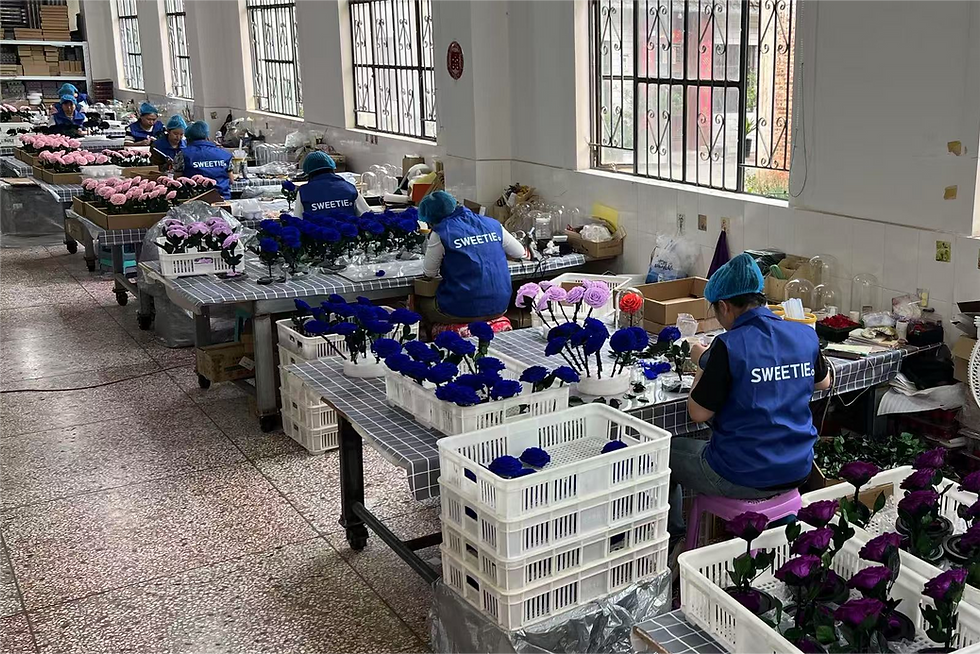
Stable flower quality, consistent color output, premium packaging development, safe e-commerce structures, and fast seasonal sampling are all far more valuable than they may appear in the final product shot.
This is exactly why many fast-growing gift brands eventually stop asking, “Where can we source preserved roses?” and start asking a better question: “Who can help us build a premium gifting system that holds up under growth?”
That conversation can begin at sales@sweetie-group.com.

What Brands Like This Often Need Next
Once a preserved rose brand has established strong visual branding, the next phase is usually less glamorous and more decisive.
It needs dependable material consistency.
It needs packaging that protects visual quality without killing the unboxing experience.
It needs a development process that can translate seasonal concepts into real products quickly.
It needs enough flexibility to test new shapes, new colors, and new categories without turning every new idea into a production risk.
And it needs the kind of supply support that does not collapse under gifting peaks.
In practical terms, that usually means needing support in areas like:
stable flower quality and color consistency
premium packaging development
e-commerce-safe protection structures
fast seasonal sampling
small-batch testing for new ideas
scalable production support during gifting peaks
That is where the market becomes more demanding. A basic flower supplier is not enough. A generic packaging vendor is not enough either. Brands in this space usually need a partner who understands how product, packaging, and gifting rhythm work together.
The Million Roses makes that need visible because it operates at the point where aesthetics and execution meet. That is also the point where many preserved gifting brands either become more sophisticated or begin to stall.
Final Thoughts
What The Million Roses gets right is not just preserved rose branding. It gets the broader luxury gifting equation right.
It understands that premium pricing depends on more than flower longevity. It depends on product structure, design discipline, occasion strategy, and fulfillment control. It understands that customers are often buying a result, not merely an arrangement. And it shows, quite clearly, that the most successful preserved rose brands are not built on aesthetics alone. They are built on systems.
The bigger takeaway
The brand is worth studying because it shows how a preserved rose business becomes something larger:
not just a flower offer
not just a gift box
but a premium gifting system
That is what makes the brand worth studying. It is also what makes this category more interesting than it first appears.
CEO of Sweetie Group


Comments