


From Craft Purchase to Occasion Purchase: What Michaels Is Really Reorganizing


Michaels still looks, at first glance, like a traditional craft retailer. That description is still true. But it is no longer the full story.
A quick look at its current retail front shows a company built not only around making, but also around celebrating. Party Supplies, Balloons, Graduation, Floral, Kids, Fabric, and Yarn & Needlecraft now sit much closer together in the customer journey than many people would have expected a few years ago. That is why Michaels is worth studying right now. It is not just expanding categories. It is reshaping what customers come to the store to get done.
What makes this shift important is simple. A retailer can add categories without changing its business model. Michaels appears to be doing something larger than that. Its current assortment and services suggest a move from supporting projects alone to supporting moments, milestones, and occasion-based shopping trips. That is a meaningful difference for any specialty retailer.
If your team is rethinking how occasions reshape retail, you can reach us at sales@sweetie-group.com
Michaels is still a craft retailer, but that definition no longer explains enough
For years, the Michaels shopping mission was fairly easy to read. A customer came in with a project in mind and needed materials, tools, or inspiration to complete it.
Paint, brushes, yarn, fabric, scrapbook paper, beads, seasonal crafting supplies, and framing services all fit naturally inside that model. Michaels still serves that mission today. Its craft foundation remains visible and important.
What has changed is the range of missions the store now seems willing to serve.
Graduation collections, party décor, balloons, kids’ activities, floral, and milestone-focused gifting language point to a broader retail purpose. The shopper is not always entering with a craft project. Sometimes the shopper is preparing for a birthday, a graduation party, a school event, a family gathering, or a quick but thoughtful gift occasion.
That may sound like a small distinction, but in retail terms it changes everything.
A project-led visit and an occasion-led visit do not behave the same way. One is driven by making. The other is driven by completion.
Traditional craft purchase | Occasion purchase |
The shopper already knows the project | The shopper knows the event or moment |
Materials and tools lead the trip | Completion and presentation lead the trip |
Categories can stay separate | Categories need to work together |
The customer assembles the solution | The retailer helps shorten the path |
This table matters because it explains why Michaels’ current category mix makes more sense than it first appears.
Party, Balloons, Kids, Graduation, and Floral are not only adjacent on the site or in-store. They are adjacent in the customer’s real task.
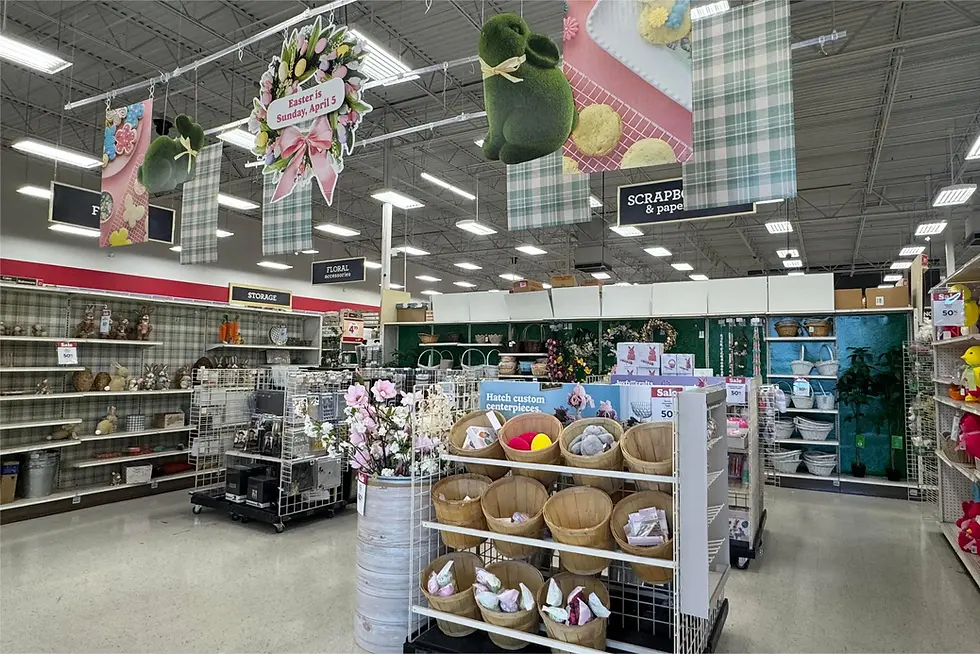
Michaels had real reasons to broaden the customer mission
This shift did not happen in a vacuum. It is tied to changes in the wider retail landscape.
Three forces help explain why Michaels moved in this direction:
legacy specialist channels weakened
customer expectations became more occasion-driven
competition for celebration-related spending became more intense
JOANN’s full store closure in 2025 left a major gap in fabric, sewing, and yarn retail. Michaels then moved quickly to acquire JOANN’s intellectual property and private brands, while expanding its Knit & Sew assortment and related in-store capabilities.
That tells us Michaels was not simply adding random merchandise. It was stepping into demand that had lost one of its old retail homes.
A similar pattern appeared in celebration retail. After Party City’s old store footprint collapsed, demand for balloons, party décor, favors, and milestone supplies did not disappear. It was redistributed.
Michaels expanded The Party Shop across its store base and kept adding party assortment, while other retailers such as Walgreens also moved to capture parts of the same occasion-driven spend. Michaels is therefore best understood not as the inventor of this shift, but as one of the clearest retailers responding to it.
That distinction matters. Michaels is not creating celebration demand out of nowhere. It is recognizing that modern consumers often shop for an outcome rather than a narrow category.
They are not just looking for paper goods, floral accents, or kids’ items in isolation. They are looking for a store that helps a birthday feel finished, a graduation feel more thoughtful, or a small event feel more complete. Michaels’ expansion makes more sense when read through that lens.
If category analysis like this is relevant to your business, feel free to write to sales@sweetie-group.com.
The real shift is from project-led shopping to occasion-led shopping
This is the most important point in the whole Michaels story.
The company is not only broadening what it sells. It is broadening what kind of shopping trip it wants to own. That is a deeper strategic move than simple assortment growth.
Project-led shopping is relatively clear. A customer knows what she plans to make and shops accordingly.
Occasion-led shopping is different. A customer may only know that she needs to prepare for graduation this weekend, make a child’s party look better, bring a small gift, or pull together a last-minute celebration.
The shopping trip is less about one category and more about reducing friction. The winning retailer is the one that helps the customer make faster, more confident decisions across multiple connected categories.
This is why Michaels’ current retail structure deserves more serious attention than a simple “craft chain expands party” headline allows.
The company appears to be moving from a model that supports isolated creative activity to one that also supports occasion completion. That makes categories such as balloons, party décor, floral, kids’ activity products, graduation items, and small gifting solutions feel less separate and more functional together. They are no longer just merchandise departments. They are pieces of a shared customer task.
Seen this way, Michaels is not merely chasing seasonal revenue. It is trying to own more of the shopping trip.
That usually means larger baskets, more cross-category attachment, and greater relevance in moments where customers are short on time but still want the result to feel meaningful. That is a strong retail position if it can be executed consistently.
This is an inference based on Michaels’ public category structure and rollout decisions, rather than a claim about undisclosed financial performance.

What Michaels reveals about the next pressure point in specialty retail
The bigger lesson is not that every retailer should become Michaels. Different retail formats start from very different foundations.
A drugstore, a mass merchant, a specialty gift chain, and a craft retailer will not all respond to the same market changes in the same way. Michaels matters because it makes a broader pressure point easier to see.
Specialty retail is increasingly being asked to own not just a category, but a clearer reason for the visit. In practice, that means three things:
category depth alone is no longer enough
the shopping trip matters as much as the assortment
coherence matters as much as expansion
That pressure point is likely to matter far beyond Michaels.
When demand becomes more occasion-led, category depth alone stops being enough. The retailer also has to answer a harder question: can all these categories feel like one useful, coherent retail story to the customer?
Michaels’ challenge is not simply expansion. It is coherence. Can party, balloons, floral, kids, graduation, fabric, and making still feel like one believable store identity? That is the hard part, and it is the same challenge many specialty retailers will face as they move from product-centered shopping to mission-centered shopping.
For that reason, Michaels is best viewed as a diagnostic sample, not a universal template. It shows what happens when a legacy specialty retailer tries to widen its role in the customer’s life without abandoning its original core.
Whether that balance becomes a lasting competitive advantage will depend less on how many categories it adds and more on how clearly those categories serve a connected purpose.
For teams thinking seriously about retail structure and customer missions, sales@sweetie-group.com is open.
The most revealing thing about Michaels is not that it sells more party goods or more décor than before. It is that the company increasingly seems to understand that shoppers are not always buying items. Very often, they are buying progress toward a moment.
Once that becomes the organizing logic, the meaning of the store changes with it.

CEO of Sweetie Group


Comments