


From Screen to Shelf: How to Turn a Trending Floral Gift Image into a Manufacturable OEM Product

To turn a trending floral gift image into a manufacturable OEM product, you must bridge the gap between creative aesthetic inspiration and industrial feasibility. This transformation requires evaluating material stability, labor complexity, target costs, and shipping durability. Partnering with a specialized custom floral gift manufacturer helps you reverse-engineer digital concepts into structured bills of materials, customized protective packaging, and scalable assembly workflows suitable for mass production.
What is the Sourcing Dilemma: 'Looks Good Online' vs. 'Works in Bulk Production'?
A viral social media photo or an e-commerce mockup presents a single, handcrafted creation styled under perfect studio conditions. However, transitioning from an online trend to a repeatable physical product requires deep expertise in floral gift product development. What looks stunning on a screen may fail on the assembly line due to fragile construction, rare seasonal components, or excessive hand-assembly times.
When starting a custom project, we adhere to the strict principle of "reference, do not copy." Replicating a copyrighted design or trademarked competitor IP poses legal risks. Instead, our role as a floral gift OEM is to extract the core visual appeal—such as color palettes, structural concepts, or novelty materials—and re-engineer them into unique, legally compliant private label floral gifts.
Feature | Looks Good Online (Concept Image) | Works in Bulk Production (OEM Standard) |
|---|---|---|
Component Stability | Fragile elements arranged loosely for a single photo. | Mechanically secured, glued, or anchored elements that survive transit. |
Material Selection | Rare, seasonal, or hyper-sensitive natural flora. | Standardized preserved flowers, durable plush fabrics, or resilient bases. |
Labor Allocation | Hours of meticulous handcrafting by a specialized artist. | Optimized, repeatable assembly steps executable by trained factory staff. |
Packaging Design | Oversized, un-padded decorative boxes with loose space. | Custom-molded, drop-tested protective packaging optimized for shipping volume. |
Color Consistency | Highly edited and filtered digital colors. | Standardized dyes with controlled, acceptable natural variations. |

What Are the Key Feasibility Dimensions for Custom Floral Gift Manufacturing?
Before launching mass production, a professional custom floral gift manufacturer must evaluate the commercial viability of your reference image across six physical dimensions.
1. Material Stability and Chemical Integrity
Preserved flowers, dyed moss, specialized fabrics, and wooden bases react differently to environmental factors. For custom flower gifts, materials must undergo baseline checks to ensure they do not mold, bleed color, or warp when exposed to humidity and heat during sea transit.
2. Labor Hours and Process Complexity
While custom flower gifts often retain a premium handcrafted feel, excessive manual assembly drives up unit costs and leads to high defect rates. We identify which elements can be standardized or semi-automated to preserve your margins while maintaining high-end aesthetics.
3. Target Cost and Margin Alignment
Raw materials, factory labor, customized packaging, and international shipping determine your ultimate unit cost. During floral gift product development, we analyze your reference image and suggest material alternatives—such as choosing high-grade polyester plush over fragile fabrics—to align with your target wholesale or retail pricing.
4. Packaging Volume and Dimensional Weight
In international logistics, shipping costs are heavily dictated by volumetric weight. A voluminous, airy floral arrangement that cannot be packed tightly will become cost-prohibitive to ship. We design products to pack efficiently, sometimes utilizing nesting or minor customer re-assembly to save cargo space.
5. Transit Durability and Drop Resistance
Glass domes, delicate dried stems, and ceramic containers are highly fragile. Structural engineers must design the protective packaging concurrently with the product, ensuring that the finished goods survive standard warehouse handling and drop tests.
6. Sourcing MOQs and Component Availability
Custom-dyed ribbons, unique glass molds, or specific LED light configurations require meeting strict raw-material minimum order quantities (MOQs). We assess component availability early to prevent supply chain bottlenecks.
The Custom Floral Gift Manufacturability Checklist
Material Selection: Certified non-toxic dyes, preserved flora, or high-grade fabrics.
Structural Anchoring: Secure physical bases (wooden, heavy paperboard, or plastic) with hidden glue points.
Assembly Blueprint: Step-by-step production routing designed to minimize worker error.
Packaging Integration: Engineered EPE foam or molded pulp trays that pass drop tests.
Regulatory Compliance: Safe adhesives, CE/RoHS certified electronics (for LED features), and phytosanitary compliance.
Case Study: Re-Engineering a Preserved Rose Glass Dome for Bulk Production
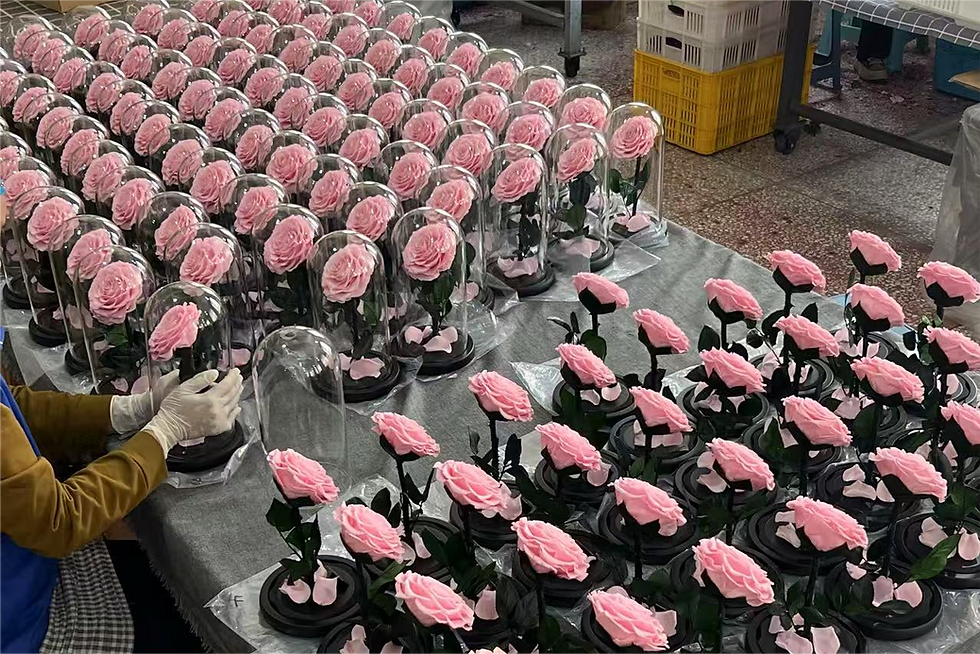
To illustrate how to turn a trending floral gift image into a manufacturable OEM product, let us examine a common industry challenge: a client wants to mass-produce a complex preserved flower glass dome containing delicate dried botanicals and integrated LED micro-lights, based on an online image.
The Aesthetic Concept vs. Manufacturing Risks
The original reference image presented three major issues:
Extreme Fragility: The dried botanicals were arranged loosely on loose decorative sand. Under shipping vibration, the sand would coat the inside of the glass, and the botanicals would break.
High Labor Cost: The LED wiring was hand-wrapped intricately around the main rose stem, creating a high-variance, slow process on the production line.
Logistics Risk: The glass dome used a non-standard, ultra-thin curved shape, making custom shock-absorbing packaging extremely expensive.
The OEM Production Solution
Structural Redesign: We replaced the loose sand with a custom-molded, textured resin base decorated with fixed preserved moss. The delicate dried botanicals were securely anchored with specialized high-strength clear adhesives, ensuring they remained upright during inverted transit tests.
Modular LED Assembly: We swapped the hand-wrapped wire with a pre-assembled, modular LED micro-light string integrated directly into a standardized grooved wooden base, reducing hand-assembly time by over 35%.
Glass Standardization: We transitioned the unique dome to a highly durable, standardized borosilicate glass shape. This allowed the use of existing glass molds and enabled us to source pre-molded, cost-efficient protective packaging.
What Is the Step-by-Step Floral Gift OEM Development Process?
Transitioning a visual concept into a retail-ready bulk product requires a disciplined, multi-phase roadmap.
Phase 1: Conceptual Brief: The client provides reference images, URLs, target pricing, estimated order quantities, and target markets.
Phase 2: Technical Specifications & BOM: Our team translates the visual concept into a detailed physical bill of materials (BOM), mapping out exact material specifications, grades, and dimensions.
Phase 3: Physical Prototyping: We build the first physical sample of the custom floral gift. This prototype allows the client to inspect the physical dimensions, color accuracy, and material feel.
Phase 4: Packaging Engineering: We design custom EPE foam inserts, protective inner boxes, and structural master cartons. The fully packaged sample undergoes rigorous drop and vibration testing.
Phase 5: Golden Sample Sign-Off: Once the prototype and packaging are approved, it becomes the "Golden Sample." We establish strict quality boundaries, including acceptable natural variations for dyed flowers or handmade elements.
Phase 6: Mass Production & QC: Mass production begins. Our quality control inspectors monitor raw material preparation, assembly routing, adhesive curing, and final packaging packaging to ensure complete consistency with the approved Golden Sample.
How Sweetie AI Can Help Turn Inspiration Into a Sourcing Direction
Navigating the early stages of product development can be complex. To streamline this process, buyers can utilize Sweetie AI to map out their initial product concepts digitally.
By uploading a reference image, social media screenshot, or e-commerce link to the Sweetie AI platform, you can quickly explore styling directions and structural options. You can input critical business parameters—such as target retail channels, price points, geographic markets, and expected order volumes. The AI processes these inputs to suggest matching materials, coordinate color schemes, and structure your ideas into a professional development brief.
It is important to note that Sweetie AI is an exploratory tool. It does not replace physical engineering, design refinement, or manufacturing operations. The AI cannot calculate exact material chemistry, precise physical cost breakdowns, factory tool availability, or real-world shipping tolerances. Once you have established your conceptual direction on the platform, our physical team of designers, material experts, and factory engineers takes over to execute the project physically.

Why Are Packaging and Transit Planning Critical in Early Floral Gift Product Development?
Many brands make the mistake of designing the packaging only after the product is finalized. In custom floral gift manufacturing, this delay often leads to catastrophic shipping damage or unexpectedly high shipping costs due to volumetric weight.
Because floral gifts are lightweight but highly voluminous and fragile, the outer packaging must be engineered in parallel with the product's physical structure. By coordinating packaging design early, we can optimize the product's overall dimensions to fit standard container sizes efficiently, reducing shipping costs and minimizing shipping breakage.
How Sweetie’s Physical Production Team Executes Your Vision
Once your initial concept is mapped out, Sweetie's physical production team coordinates the entire supply chain. Led by experienced product managers, we physically source certified raw materials, construct durable structural prototypes, negotiate bulk raw-material pricing, and manage assembly line quality. We ensure that every piece manufactured on the factory floor matches the quality, stability, and design standards of your approved Golden Sample.
If you are ready to take your trending designs and turn them into a profitable, scalable product line, partnering with an experienced manufacturer makes all the difference. Have a reference image or product link you want to develop? Email it with your target market, quantity, budget, and launch date to sales@sweetie-group.com for a feasibility discussion.
FAQ
What is the typical MOQ for custom floral gift OEM projects?
MOQs generally range from 500 to 1,000 units per style, depending on specialized custom components, custom-molded glass, or proprietary fabric dyes. Utilizing standardized components can help lower the initial MOQ requirements.
Can we copy an exact copyrighted character or a competitor's exact floral gift design?
No. To prevent copyright and patent infringement, we operate under a 'reference, do not copy' policy. We analyze your reference images to extract key trends, color ways, and functional structures, then design a unique product tailored specifically to your brand.
How do you maintain color consistency in mass-produced preserved flowers?
Preserved flowers are natural materials, so minor color variations are normal. We establish a pre-approved 'Golden Sample' and define strict acceptable tolerance ranges to ensure color consistency across high-volume production runs.
What testing does a custom flower gift undergo before international shipping?
Completed products and their packaging are subjected to environmental chamber tests (humidity and high-temperature checks to ensure adhesive and mold resistance), physical drop tests, and vibration tests to simulate maritime and air transport.
How does Sweetie AI help in the initial sourcing phase?
Sweetie AI allows you to input trends and business constraints to instantly explore style directions and sourcing options. This establishes a structured digital brief, which our physical production team then verifies, quotes, and manufactures.
Can we request custom-molded glass or unique ceramic bases for our private label floral gifts?
Yes, custom glass molds and ceramic designs are fully customizable. However, custom tooling requires initial mold fees and higher component MOQs, which we evaluate and plan during the technical specifications phase.

Warm regards,
Annie Zhang


Comments