


How to Find a Preserved Flower Manufacturer in the USA: What Buyers Should Know


Searching for a preserved flower manufacturer in the USA usually comes down to one goal: lowering sourcing risk.
Shorter lead times. Easier communication. Faster follow-up. A supplier that feels easier to manage.
That logic makes sense. But in preserved flower gifts, a U.S. address does not automatically mean strong manufacturing depth. Some companies mainly distribute. Some import preserved flowers and assemble finished products locally. Some are visually strong, but less equipped for customization, packaging coordination, or seasonal scale.
The better question is simple: Who can reliably deliver the product, packaging, and repeatability the business actually needs?
For project discussions, email sales@sweetie-group.com.
Index:
What a Preserved Flower Manufacturer Really Means
In preserved flowers, the word manufacturer can describe very different kinds of companies. That is why buyers often spend time comparing suppliers that are not truly comparable.
Not every supplier plays the same role
Under the same search term, the market often includes four different types of players:
suppliers strongest in preserved floral materials
suppliers focused on assembling finished gift products
integrated manufacturers that coordinate flowers, packaging, and finished presentation
importers, wholesalers, and distributors
From a buying perspective, the most useful question is not, “Do they call themselves a manufacturer?”
It is this: How much of the product system do they actually control?
Material strength is not the same as product strength
Some suppliers are strongest in floral materials such as preserved roses, hydrangeas, moss, and foliage. That can be valuable when a buying team already handles design, arranging, or assembly in-house.
But preserved flower gifts are rarely just flowers. A sellable product often includes:
floral material
gift box
ribbon
card
insert
protective inner packaging
shipping carton
retail presentation details
A supplier may be strong in preserved flowers and still weak in the full product.
Attractive samples do not always mean strong manufacturing control
Other suppliers are good at turning preserved flowers into flower boxes, bouquets, domes, or gift sets. They may be quick with styling and visually appealing.
That can work for simple projects.
Still, a polished sample does not automatically mean strong upstream sourcing, packaging coordination, or scalable seasonal production. Those are different capabilities.
Integrated manufacturing is usually what serious buyers need
For retail, e-commerce, gifting, and private label programs, the strongest partner is often an integrated manufacturer.
That means a supplier that can coordinate:
floral materials
product structure
box and accessory matching
presentation details
protection for shipping
repeat production across orders
In preserved flower projects, success depends on the full system, not on one flower head or one attractive photo.
How to Evaluate a U.S. Preserved Flower Supplier
A local address can be useful. It should not be the whole evaluation.
Here are the checkpoints that matter more.
1. Product control
Start with the most practical filter:
How much of the finished product can this supplier really manage?
Key questions include:
Do they control preserved flower sourcing or processing?
Do they develop finished products in-house?
Do they manage boxes, ribbons, cards, inserts, and outer packaging?
Can they combine all of these parts into one stable, repeatable SKU?
The more key variables a supplier can control, the more predictable the project usually becomes.
2. Custom development ability
Ready-made styles are easy to offer. Commercially useful customization is harder.
A serious supplier should be able to support:
OEM and ODM development
logo application
box structure changes
holiday packaging updates
card and ribbon matching
sample development
visual mockups or structural suggestions
Without that support, the product may look acceptable, but differentiation becomes difficult.
3. Packaging capability
In preserved flower gifts, packaging is part of the product.
It affects:
shelf impact
breakage rate
unboxing experience
shipping cost
perceived quality
reorder consistency
This matters even more for e-commerce.
Sweetie’s packaging notes show different solutions for lidded boxes, open flower boxes, and glass dome products, plus more protective e-commerce packaging ideas and optional eco-friendlier alternatives.
Need custom preserved flower packaging support? Contact sales@sweetie-group.com.
4. Peak-season execution
A supplier can look organized during sampling and still struggle during Valentine’s Day or Mother’s Day production.
Peak-season readiness should cover:
batch consistency
timeline control
reorder support
packaging coordination
capacity during compressed selling windows
That is a much better test than a polished first sample.
5. Channel fit
Products for supermarkets, e-commerce sellers, gift brands, and flower shops are not the same.
Each channel values different things:
supermarkets care about consistency and retail readiness
e-commerce sellers care about shipping durability and pack-out efficiency
gift brands care about presentation and private label identity
flower shops may care more about design freshness and flexibility
A supplier who understands the sales channel will usually make better product decisions.
When a U.S.-Based Supplier Makes Sense
Domestic sourcing can absolutely make sense.
Common advantages include:
easier communication in the same market
faster local replenishment
simpler short-term coordination
possible access to local stock
For smaller and simpler projects, that may be enough.
At the same time, location alone does not guarantee manufacturing depth. Some U.S.-based suppliers are more focused on importing, stocking, or local assembly than on full development and scalable production. That may be fine for standard replenishment. It is often less effective for:
private label programs
custom gift box development
integrated packaging work
large seasonal orders
stronger price flexibility
The Better Question: Who Can Actually Deliver?
This is where supplier comparison becomes more useful.
The biggest sourcing risk is not simply “overseas versus local.”
The real risk is choosing a supplier that cannot consistently deliver:
quality
packaging
lead time
repeatability
seasonal reliability
That is why the most useful evaluation question is not: Where are they based?
It is: Can they turn a product plan into a reliable, sellable, repeatable business item?
That question separates stock sellers from true manufacturing partners very quickly.
Why Many Buyers Also Compare Manufacturers in China
Comparing U.S. suppliers with experienced manufacturers in China often makes practical sense in preserved flower sourcing.
The reason is simple: manufacturing depth and supply chain maturity matter.
In preserved flower gifts, buyers are rarely sourcing flowers alone. A finished product often includes floral materials, gift boxes, ribbons, cards, inserts, and protective packaging. That means the real sourcing decision is usually about the full product system, not just the flower itself.
This is why many buyers compare local suppliers with integrated manufacturers that can support development, packaging, and repeat production in one workflow.
What that comparison helps buyers assess
Better coordination across the full product
A preserved flower gift has to work visually, structurally, and commercially. That usually requires stronger coordination across sourcing, packaging, and production.
More support for custom projects
For private label, seasonal gifting, and retail-ready products, buyers often need more than stock styles. They need sampling, packaging matching, and development support.
Stronger seasonal execution
For programs tied to Valentine’s Day, Mother’s Day, Christmas, or campaign gifting, consistency and timing matter just as much as design.
More flexibility across product formats
Many commercial projects do not stay within one SKU or one format. Buyers often need a supplier that can support multiple preserved flower gift types under one project plan.
Where Sweetie-Gifts fits in
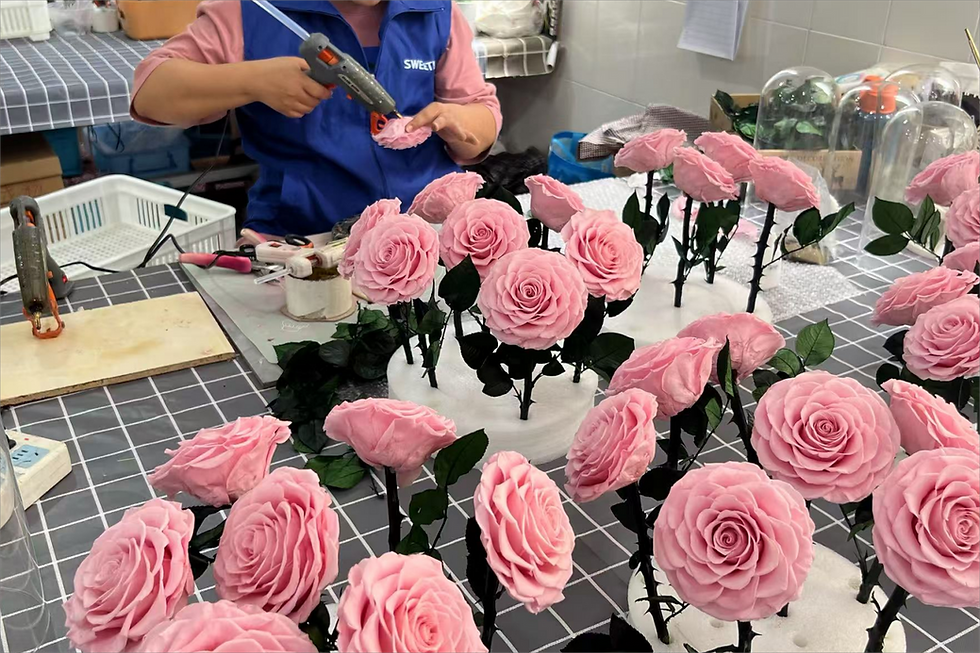
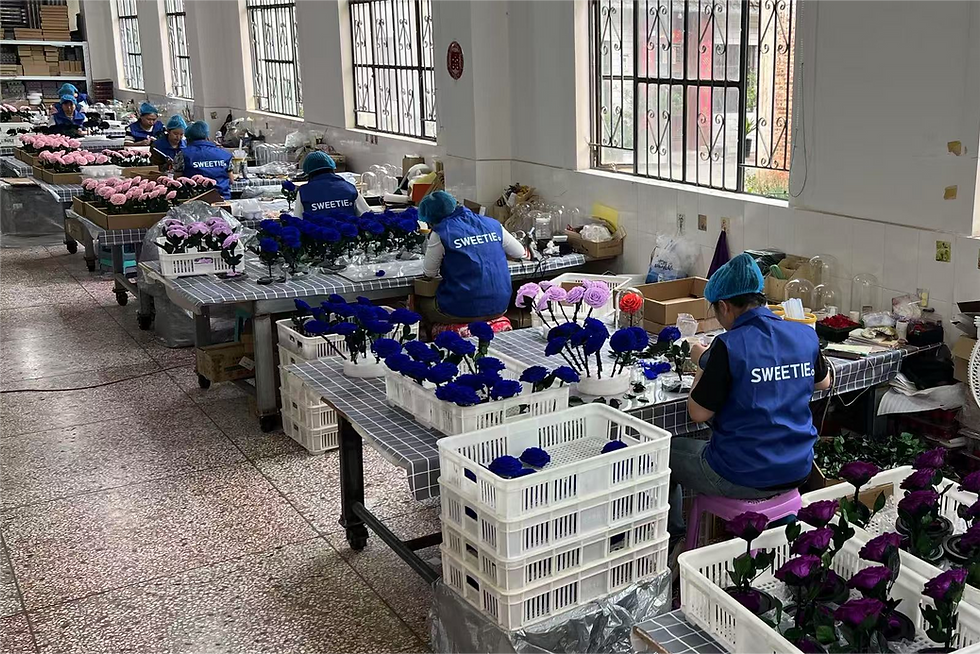
At Sweetie-Gifts, we work as an integrated preserved flower product manufacturer rather than a simple stock seller.
Our work covers preserved flower boxes, glass dome roses, bouquets, jewelry flower gifts, and related floral gift products, with support for customized development and packaging coordination. We also serve a wide range of B2B customers, including retail and gift-focused buyers in the U.S. and other international markets.
For buyers comparing supplier options, the value of that model is straightforward: it becomes easier to move from idea to sample, from sample to production, and from production to repeat orders with fewer gaps in between.
To compare options for your next preserved flower program, email sales@sweetie-group.com.
Which Supplier Type Fits Your Business Best
A simple framework makes the decision easier.
Business need | Local distributor | Integrated manufacturer |
ready stock | strong fit | possible |
urgent small replenishment | strong fit | possible |
private label development | limited | stronger fit |
custom packaging | limited | stronger fit |
seasonal bulk orders | sometimes | stronger fit |
product system coordination | limited | stronger fit |
long-term repeatable SKU development | limited | stronger fit |
For stock-based replenishment, a local distributor may be enough.
For product development, packaging coordination, and scalable seasonal supply, an integrated manufacturer is usually the better fit.
Buyer Checklist
Before choosing a preserved flower supplier, check whether the company can:
manage preserved flower sourcing or processing
support finished product development
coordinate boxes, ribbons, cards, and inserts
provide protective packaging for e-commerce or retail needs
handle peak-season production
support OEM or private label projects
maintain repeatable quality across orders
FAQ About Preserved Flower Manufacturers in the USA
What is the difference between a preserved flower manufacturer and a distributor?
A preserved flower manufacturer usually has more control over product development, packaging coordination, and repeat production. A distributor is more likely to focus on ready stock, local inventory, and resale.
Are all U.S.-based preserved flower suppliers true manufacturers?
No. Some U.S.-based suppliers mainly import preserved flower products or materials and then distribute or assemble them locally.
Is a local supplier always the best option for a U.S. buyer?
Not always. A local supplier may help with communication or urgent replenishment, but an integrated manufacturer may be a better fit for private label, custom packaging, and large seasonal programs.
What should buyers check before choosing a preserved flower supplier?
The most important checkpoints are product control, custom development ability, packaging capability, seasonal execution, and channel fit.
Why do many buyers also compare manufacturers in China?
Because preserved flower manufacturing often depends on supply chain depth, packaging coordination, and scalable production. Experienced manufacturers in China may offer stronger support for OEM, ODM, and retail-ready product development. Sweetie-Group’s materials describe long-term experience, international B2B service, and a one-stop customized service process.
What kind of projects can Sweetie-Gifts support?
Sweetie-Gifts supports preserved flower boxes, preserved roses in glass domes, bouquets, jewelry flower gifts, rose bears, soap flower gifts, and customized packaging solutions for B2B buyers.
Final Summary
Choosing a preserved flower manufacturer in the USA is not just about location.
It is about manufacturing control, packaging capability, product coordination, and repeatable delivery.
For simple replenishment, a local distributor may be enough. For private label, retail-ready packaging, and seasonal programs, an integrated manufacturer is often the better long-term choice. Buyers comparing U.S. suppliers may also benefit from speaking with experienced manufacturers in China, especially for customized preserved flower gifts and scalable production.
If you're evaluating preserved flower suppliers for your next project, email sales@sweetie-group.com to discuss custom development, packaging, and bulk production options.
CEO of Sweetie Group


Comments