


Plush Flowers for School Occasion and Children’s Event Programs: Are They Worth Adding to Your Product Line?


If you sell into school-related gifting, kids’ event supplies, or seasonal novelty channels, you already know the trap: a product can look fresh at first glance and still fail once the real buying questions show up. Is the unit cost too high for everyday use? Does it feel giftable enough for a graduation handout or recognition program? Will it survive bulk shipping without arriving crushed? And, maybe most importantly, does it belong in your product line as a true program item, or is it just another “cute” sample that never scales?
That is exactly where plush flowers get interesting. I do not see them as a replacement for low-cost classroom rewards like pencils, erasers, or stickers. I see them as a different layer of product—something better suited to school occasions, themed children’s events, graduation moments, and take-home gift programs than to daily prize-box replenishment.
That distinction matters, because the U.S. and U.K. school market still runs on class-sized distribution logic, while established bulk suppliers in education and children’s event channels clearly separate everyday incentives from event-driven giveaways.
Where plush flowers fit best
In my view, plush flowers work best when the program needs a small gift with emotional value, not just a low-cost item to fill a bin.
That usually means:
graduation handouts
end-of-term recognition gifts
themed daycare or after-school event gifts
church or camp take-home items
retail crossover programs tied to school occasions or children’s celebrations
Why here? Because plush flowers sit in a useful middle ground. They are more giftable than standard novelty incentives, but lighter and easier to position than premium gift sets. They can carry color themes, seasonal packaging, or simple message cards without becoming too complicated to source or too expensive to test.
If your customer is building a graduation, spring event, or children’s gifting program, email us at sales@sweetie-group.com and I’ll help you evaluate which plush flower formats actually fit the channel.
Where they usually do not fit
This category is not a perfect match for every buyer.
If your business is built around ultra-low-cost daily classroom rewards, plush flowers are usually not the first SKU I would push. Bulk classroom incentive programs in the U.S. are still dominated by practical, low-cost items designed for year-round frequency—pencils, stationery, mini novelties, and assorted prize-box fillers. Large education suppliers market those products very clearly as everyday reward tools, while separate bulk and wholesale suppliers serve event, church, daycare, and camp channels with more occasion-driven products.
That is why I would not position plush flowers as a substitute for daily incentives. I would position them as a special-moment SKU.
A simple way to judge fit
Program type | Is plush flower a good fit? | Why |
Daily classroom reward refill | Usually no | Unit economics and frequency tend to favor cheaper consumable incentives |
Graduation or end-of-term handout | Yes | Higher perceived value and stronger “gift” feeling |
Daycare, camp, or church event take-home gift | Yes | Works well when the item needs to feel memorable, not disposable |
School-occasion retail add-on | Yes | Can bridge event gifting and resale |
Rough-play toy program | Usually no | Plush flowers are gift items first, not heavy-use toy-category items |
That is the core buying logic. Not complicated. Just easy to misread.
Why some buyers are testing this category now
I think buyers are paying attention to plush flowers for a very practical reason: they solve a problem that basic novelty items do not solve very well. A basic novelty item is cheap, but often forgettable. A plush flower costs more, but it feels more intentional. It looks like a gift, photographs like a gift, and can still be distributed in quantity if the program is designed correctly.
That matters in channels tied to children’s events. Public data still points to class-size distribution patterns—about 20 students in many U.S. elementary settings and around 26 in England primary classes—so products that can be packed, handed out, and understood quickly at class or event scale have an advantage. At the same time, bulk suppliers continue to serve daycares, schools, churches, Vacation Bible School programs, and camp channels with ready-to-distribute items, which tells me the market is not only about classrooms; it is about organized children’s programs more broadly.
That is exactly why I believe plush flowers make the most sense in school occasion and children’s event programs, not in the narrow “teacher reward drawer” sense.
What buyers should check before adding plush flowers
This is where a lot of sourcing decisions go wrong. Buyers focus on whether the product is cute. I would focus on whether the product is operationally right.
1. Product format
A single stem, a mini bouquet, and a boxed gift are not the same business. One may be ideal for a 200-piece event handout. Another may only make sense as a retail add-on or premium recognition gift.
2. Price architecture
Ask one blunt question: is this item for distribution or for resale?If it is meant to be handed out to every child, the price band must stay disciplined. If it is meant to sit in a retail assortment for school occasions, you have more room to build presentation and margin.
3. Safety perception
Children’s channels change the conversation. Even if the product is not positioned as a toy, buyers will still look closely at stems, internal structure, detachable accessories, stitching consistency, and anything that could create concern during handling or distribution.
4. Packaging efficiency
This category lives or dies on arrival condition. A product that looks charming in a sample room can lose half its value if it reaches the warehouse bent, compressed, or awkward to sort.
5. Channel clarity
The best buyers know exactly where the item belongs:
event gift
recognition handout
school-occasion retail SKU
seasonal children’s gift
checkout add-on
When the role is fuzzy, sell-through gets fuzzy too.
If you want a fast format recommendation for your channel, send us a note at sales@sweetie-group.com and we’ll map the right structure before you invest in sampling.
Single stems, mini bouquets, or gift sets?
I would usually recommend starting with single stems for this segment.
Single stems are easier to test, easier to price, easier to distribute, and easier to merchandise across both event and retail programs. They give importers and distributors room to validate color assortment, packaging style, and end-use positioning without taking on too much cost or inventory complexity up front.
Mini bouquets can work well for:
graduation
premium recognition programs
themed event gift bundles
But they raise the bar on presentation, carton efficiency, and price expectation.
Gift-box formats are different again. They make more sense when a buyer wants a stronger retail story, a display-ready assortment, or a more premium seasonal item.
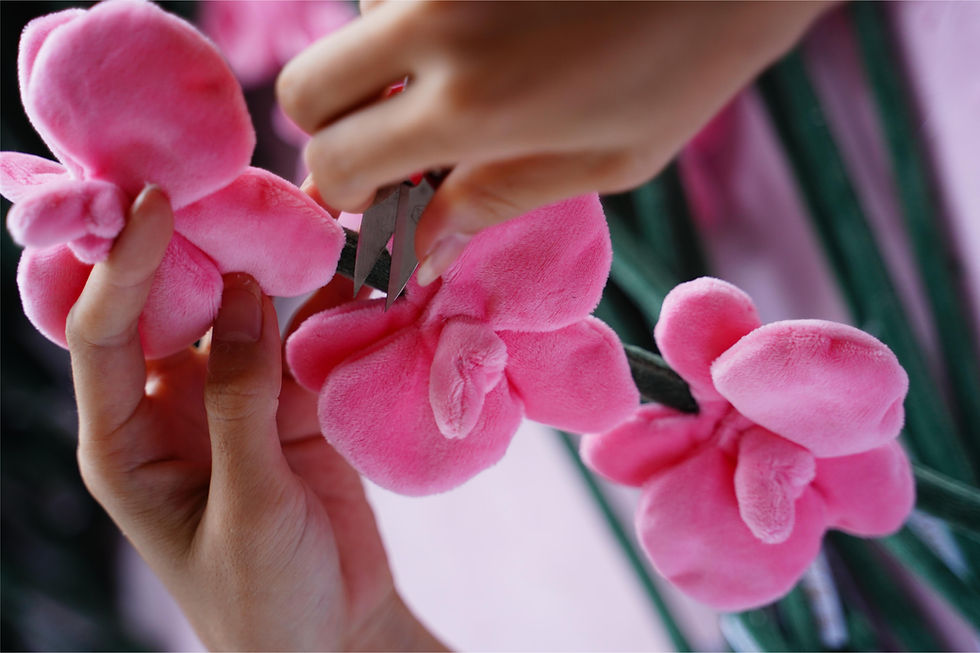
At Sweetie-Gifts, this is one advantage we can naturally bring to the table. We are not limited to one plush flower shape or one fixed retail concept. Our plush flower line already covers single plush flowers, baskets, pots, bouquets, plush toy bouquets, and display-oriented gift formats, which makes it easier for us to talk with importers and distributors about fit by channel, not just by design. We also support sampling, product development, and quality control in Yiwu factory, which matters when buyers want to move from a trial order to a repeatable program.

Why positioning matters more than novelty
A lot of products fail because they are launched as “something new” instead of “something useful.”
Plush flowers are not hard to understand. But they are easy to mis-position.
If you place them against the cheapest classroom reward items, they look expensive.If you place them against larger premium children’s gifts, they look small.If you place them in the right spot—as a modest but giftable item for school occasions and children’s event programs—they make much more sense.
That is the entire game. Positioning.
And that is also why a capable plush flower manufacturer matters. The supplier should not just quote a price. The supplier should help you decide:
which format belongs in which channel
what packaging supports your use case
what MOQ makes sense for a trial
what adjustments improve shipment condition and program usability
That is how we approach these projects at Sweetie-Gifts. We come from a broader flower-gift manufacturing background, with experience across preserved flowers, soap flower gifts, rose-animal products, and now plush flower formats as well. That broader product experience helps us think the way importers and distributors actually buy: not as a single item, but as a line architecture question.
So, are plush flowers worth adding to your product line?
My answer is simple: yes, if you put them in the right lane.
Plush flowers are usually not the best first choice for buyers who only want the lowest-cost daily reward item.They are often a smart choice for buyers serving:
school occasion programs
graduation gifting
themed daycare, camp, or church events
children’s seasonal gift programs
retail assortments that overlap with event gifting
If I were testing this category from scratch, I would begin with:
single stems
a disciplined color assortment
simple packaging
a clear event or school-occasion use case
That is the cleanest way to see whether the category has a real place in your line.
Ready to test plush flowers for your next school-occasion or children’s event program? Email sales@sweetie-group.com and we’ll help you build a practical starting assortment.
FAQ
Are plush flowers a good replacement for daily classroom rewards?
Usually not. They fit better as special-moment gifts than as everyday low-cost incentive items.
What buyers are the best fit for this category?
Importers, distributors, and retail buyers serving school occasions, children’s event gifting, daycare, camp, church, and seasonal novelty channels are usually the strongest fit.
Is a single stem the best format to start with?
In many cases, yes. It is easier to test for unit cost, handout programs, packaging, and channel response than a more complex bouquet or gift set.
What is the biggest risk in this category?
Wrong positioning. Buyers often treat plush flowers like cheap novelty fillers or like full toy-category products. They are neither.
Can plush flowers work in both event distribution and retail resale?
Yes. That crossover is one of the category’s strengths, especially when the format and packaging are chosen carefully.
What should I ask a supplier before placing a trial order?
Ask about format options, MOQ, stem structure, packaging method, carton efficiency, sampling support, and how the product is typically positioned in event or retail channels.

CEO of Sweetie Group

Comments