


How to Start a Plush Flower Business: Products, Costs, Pricing & Sourcing


A plush flower can look like a simple product until the first order needs to be planned.
Which flower styles should be included? How many colors are enough? What should the selling price be? Is it better to start with existing designs or develop something custom? And after freight, packaging, platform fees, and other costs are included, does the product still leave enough margin?
These decisions matter more than launching with a very large collection.
Plush flowers can work across gift stores, lifestyle retail, e-commerce, campus shops, pop-ups, shopping malls, restaurants, events, exhibitions, and branded projects. They can also be sold across different gifting occasions rather than depending on one short holiday season.
For a new plush flower business, the practical starting point is fairly simple: choose a focused range, understand the real cost of getting the product into inventory, set a workable selling price, test actual demand, and expand from the products that perform well.
Is a Plush Flower Business a Good Opportunity?
Plush flowers have several characteristics that make them suitable for gifting and retail.
Unlike fresh flowers, they do not require refrigeration, watering, or daily care. At the same time, they offer a tactile quality that conventional artificial flowers do not. Their visual form makes them familiar as floral gifts, while their materials and construction give them a different product identity.
The category can also support different retail positions. Product size, flower design, fabric, construction, packaging, and presentation can all influence the final selling price.
Another useful feature is occasion flexibility. The same core collection can be used for birthdays, Valentine's Day, Mother's Day, graduation, friendship gifting, seasonal promotions, or everyday gift sales without developing a completely new product for every occasion.
That does not mean every plush flower will sell well. Commercial results still depend on product selection, landed cost, selling price, presentation, and how quickly inventory moves.
A strong starting point is therefore not the largest possible assortment. It is a manageable group of products that can generate useful sales data and be reordered consistently.
Where Can Plush Flowers Be Sold?
Plush flowers are not limited to conventional gift shops. Their combination of gifting, decoration, color, and tactile appeal allows them to fit into several commercial settings.
Sales Channel | Typical Use |
Gift and lifestyle stores | Everyday gifts, seasonal collections and decorative products |
E-commerce | Individual products, coordinated color ranges and gift collections |
Campus retail | Graduation, friendship gifting and seasonal sales |
Pop-ups and shopping malls | Temporary retail, promotions and interactive product displays |
Restaurants and lifestyle venues | Merchandise, themed promotions and customer experiences |
Events and exhibitions | Merchandise, gifts, decorative products and customized projects |
Brand projects | Custom colors, branded details, special packaging and campaign products |
Retail and e-commerce make it relatively easy to track performance by design, color, and SKU. Other channels may place more emphasis on visual presentation, customization, project timing, or how the product supports a wider experience.
The important point is to give the first collection a clear purpose. A range developed for everyday gift retail does not need to be planned in exactly the same way as a short-term event collection.
Not sure which plush flower styles are practical for a first test? Send your target market and approximate quantity to sales@sweetie-group.com.
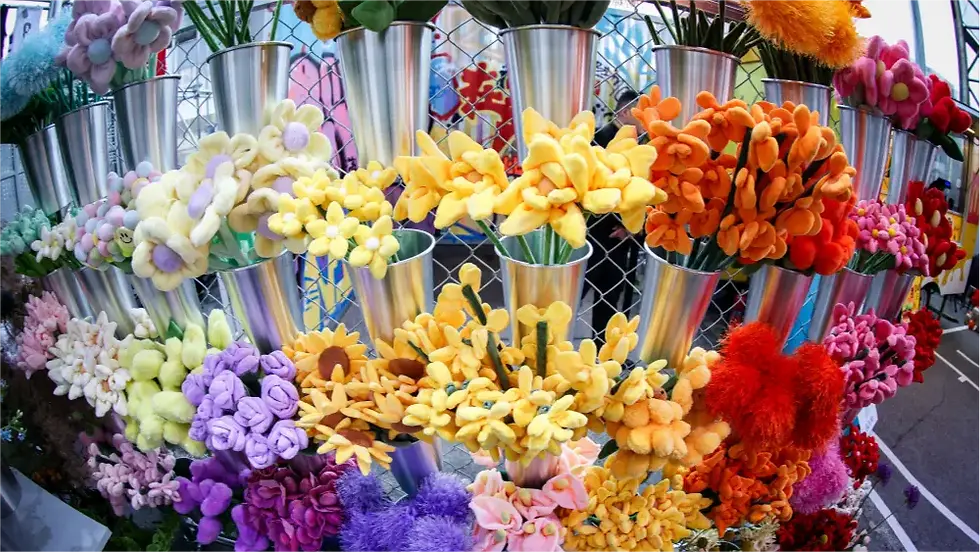
What Plush Flowers Should You Start With?
The first assortment has a direct effect on inventory risk.
A large collection may look impressive, but every additional flower type and color becomes another SKU that needs to sell, be stored, reordered, and forecast. A smaller range usually provides clearer information about what is actually working.
Start With Recognizable Flower Designs
Recognizable floral shapes are a useful foundation for an initial range.
Depending on the intended style, this may include roses, tulips, daisies, sunflowers, lilies, or other familiar botanical forms that remain easy to recognize when translated into soft fabric.
Recognition alone is not enough, however. The flower still needs a balanced silhouette.
Petal proportion, the flower center, leaves, stem thickness, fabric, and filling all influence the final appearance. Two products described as the same flower can look very different once they are placed side by side.
For this reason, flower shape should be evaluated as a complete product rather than as a name in a catalog.
Keep the First Range Focused
There is no fixed number of SKUs that works for every business.
As a practical example, an initial test may start with four to six flower designs and a limited number of colors rather than twenty or thirty combinations.
This makes it easier to understand which flower shapes sell consistently, which colors move faster, and which designs attract attention without converting into enough sales.
It also makes reordering more manageable. When too much inventory is spread across too many variations, even a reasonably successful launch can leave a large amount of slow-moving stock.
Use Color Variety Without Creating Too Many SKUs
Color can change the character of the same flower considerably.
A useful starting range normally needs enough variation to create visual interest without dividing inventory across too many similar options. Core colors can support ongoing sales, while a smaller number of seasonal or more distinctive colors can refresh the assortment.
The right balance depends on the channel. A campus store, lifestyle retailer, online gift brand, and premium concept store may all respond differently to the same color palette.
Rather than trying to predict every preference in advance, the first order should make those differences measurable.
How to Find and Evaluate a Plush Flower Supplier
Supplier evaluation should begin with the actual product, not only the quotation.
Plush flowers depend heavily on shape, sewing, filling, stem structure, and manual finishing. Small differences in these areas can have a noticeable effect on the finished appearance.
Evaluate Physical Samples
Photographs are useful for shortlisting products, but they cannot fully show hand feel, firmness, construction, or how the flower looks from different angles.
When reviewing a sample, look at the overall flower shape first. The petals should sit consistently, the flower center should be proportionate, and the leaves and stem should support the design rather than compete with it.
Then check the fabric texture, stitching, filling, visible seams, loose threads, stem firmness, color consistency, and finishing.
For products with flexible or supported stems, the internal construction also matters. The flower needs enough support to hold its shape while remaining practical to handle and display.
Understand How the MOQ Works
MOQ is not always a single number.
A supplier may quote a total order quantity, but the actual minimum can also depend on the number of flower designs, colors, fabrics, labels, or packaging options.
For example, one order concentrated in several core designs is usually easier to manage than the same total quantity divided into many small color combinations.
Before confirming an order, clarify the MOQ per design and color, whether styles can be mixed, whether packaging has a separate minimum, and what applies to repeat orders.
This is especially important when the first collection contains several different flower shapes.
Check Packing and Production Consistency
A sample can be excellent while bulk production is inconsistent.
For a repeatable retail product, the approved appearance needs to be reproduced across the production batch. Flower proportion, stitching, filling, stem position, color, and finishing should remain reasonably consistent from piece to piece.
Packing also deserves attention. Plush flowers are lightweight, but many designs occupy considerable volume. Carton size and packing density can therefore have a significant effect on freight cost.
At the same time, excessive compression may affect petals, leaves, flower centers, or stems.
Before placing a bulk order, ask for the proposed packing method, carton dimensions, carton quantity, gross weight, and any steps used to protect the product shape during transportation.
Sweetie-Gifts can support plush flower sampling, OEM/ODM development, packaging, quality control, and bulk production for retail, e-commerce, gifting, and commercial projects.
Need samples or a wholesale quotation? Contact sales@sweetie-group.com with the styles and quantities you are considering.
How Much Does It Cost to Start a Plush Flower Business?
There is no single startup budget that applies to every plush flower business.
A small online test using existing products has a different cost structure from a customized retail collection with branded packaging. The number of SKUs, order quantity, flower size, materials, packaging, freight method, and degree of customization can all change the initial investment.
The factory price is only one part of the calculation.
A more useful starting formula is:
Product cost + packaging + freight + import costs = landed product cost
The business may also need to account for samples, photography, selling-platform fees, warehouse or fulfillment charges, retail display materials, marketing, and promotional costs.
This is why two products with similar factory prices can still produce very different landed costs and final margins.
Pay Attention to Freight Early
Freight deserves particular attention with plush flowers because volume can matter as much as weight.
For air freight and express delivery, shipping charges may be based on volumetric weight. Larger flower heads, long stems, or inefficient carton packing can therefore increase transportation cost even when the product itself is light.
Sea freight reduces the importance of air volumetric weight, but carton efficiency still affects total shipping volume and warehousing.
The lowest possible carton size is not always the best solution. Packing should reduce unnecessary volume without causing excessive deformation.
For this reason, freight should be estimated before the final selling price is set, not after production is finished.
How Should You Price Plush Flowers?
Pricing should start with landed cost rather than the factory quotation.
Once the product is in inventory, additional selling expenses still need to be covered. For e-commerce, these may include marketplace commissions, payment fees, fulfillment, storage, advertising, returns, and promotional discounts. Physical retail may also need to account for staffing, rent, display space, and markdowns.
The appropriate selling price therefore depends on the full sales model.
A price that only covers product cost and freight can become difficult to maintain once promotions or other operating expenses are added.
It is also useful to leave some room for the business to develop. Future promotions, retail partnerships, advertising, changes in freight, or channel expansion can all put pressure on margin.
This is why comparing products only by unit price can be misleading. A small difference in factory price may matter less than differences in packing efficiency, defect rate, product consistency, or reorder reliability.
How to Test the Market Before Placing a Larger Order
A first order does not need to be large enough to answer every future product question.
Its purpose is to generate useful information.
Start with a manageable range and review physical samples before confirming production. The products should then be tested in the environment where they will actually be sold.
For e-commerce, photography and product presentation are part of that test. A flower may look good in hand but be difficult to communicate online if its scale or texture is unclear.
For physical retail, display several products together. Check whether the colors work as a group, whether the flower shapes are easy to compare, and whether the assortment is visually clear from a reasonable distance.
Once sales begin, track performance by flower design and color. It is also useful to look at how many pieces are purchased per transaction and whether certain products rely heavily on discounts.
The next order can then concentrate on the products that have shown reliable demand.
This approach produces better information than expanding the range simply because more designs are available.
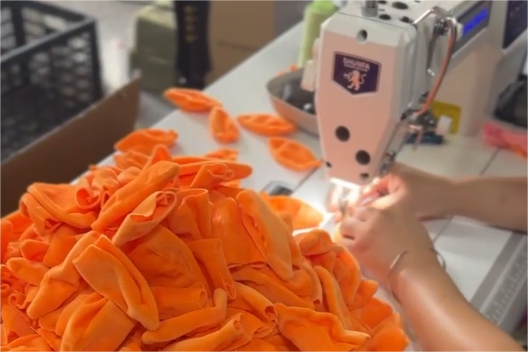
When to Consider Custom Plush Flowers
Customization is useful when it solves a clear product or branding need.
For an early market test, existing designs can often provide a faster and more practical starting point. They reduce development work and allow more attention to be placed on product selection, pricing, presentation, and actual sales.
Once the direction is clearer, customing plush flowers can help create stronger differentiation.
Depending on the project, this may involve flower shape, size, fabric, color, stem details, leaves, labels, hangtags, packaging, or branded presentation.
More extensive customization should be considered as a complete product-development decision. Changing the size of a flower, for example, may also affect stem construction, packing method, carton dimensions, freight cost, and final pricing.
The value of customization comes from creating something commercially useful, not simply from changing as many details as possible.
Common Mistakes to Avoid
Several early mistakes can make an otherwise workable plush flower range more difficult to manage.
Comparing Products Only by Unit Price
A lower factory price does not always create a lower final cost.
Poorer packing efficiency, inconsistent quality, higher defect rates, or problems with repeat orders can easily offset a small saving in unit price.
When comparing quotations, make sure the specifications, materials, packaging, and order terms are genuinely comparable.
Ignoring Freight and Packing Before Setting the Selling Price
Shipping should be part of the product calculation from the beginning.
If carton dimensions and freight costs are considered only after the retail price has already been set, the final margin may be much lower than expected.
Request packing information early enough to include it in the landed-cost estimate.
Customizing Too Much Before Demand Is Clear
Custom products can create differentiation, but they also increase the number of development decisions.
Developing many colors, flower shapes, labels, and packaging options before there is clear demand can tie up time and inventory unnecessarily.
Testing a simpler range first makes it easier to see which products are worth developing further.
Final Thoughts
A plush flower business does not need to begin with a large collection.
A focused assortment, realistic landed-cost calculation, sensible pricing, careful sample review, and reliable supply arrangement provide a stronger starting point than simply adding more designs.
Use the first range to learn which flowers and colors perform. Reorder what sells consistently, adjust what does not, and introduce customization when there is a clear reason to do so.
That approach can work for an online store, gift shop, lifestyle retailer, campus store, pop-up, or a wider commercial project.
Planning a plush flower range or custom project? Contact sales@sweetie-group.com to discuss samples, pricing, and product development.

Frequently Asked Questions
Are plush flowers profitable to sell?
Plush flowers can provide a workable retail margin when landed cost, selling price, and inventory turnover are managed carefully. Profitability varies by product, freight cost, order quantity, packaging, and sales channel, so there is no universal margin that applies to every business.
How much does it cost to start a plush flower business?
Startup costs depend on order quantity, number of SKUs, packaging, freight, import costs, and the selling channel. A test using existing designs normally requires less investment than a fully customized collection. Calculate landed cost and selling expenses before setting the initial budget.
Where can I buy plush flowers wholesale?
Plush flowers can be sourced from wholesalers, trading companies, and manufacturers. Existing wholesale designs are often suitable for early testing, while direct manufacturing becomes more relevant when consistent repeat orders, custom colors, packaging, private labeling, or exclusive product development are required.
What plush flowers should I start selling first?
A focused range of recognizable flower designs with a limited color selection is usually easier to test than a very large first collection. Actual sales data can then guide which flowers and colors should be reordered or expanded.
What is the MOQ for plush flowers?
MOQ varies by design, color, material, labeling, packaging, and whether the product is an existing design or a custom development. Always confirm whether the quoted MOQ applies to the total order, each flower design, each color, or a specific packaging option.
Can plush flowers be customized?
Yes. Customization can include flower shape, size, fabric, color, stem details, leaves, labels, hangtags, and packaging. More extensive development normally requires sampling before mass production.
Annie Zhang
CEO of Sweetie Group


Comments