


Francfranc Case Study: How a Design-Led Lifestyle Brand Balances Freshness, Repeat Visits, and SKU Complexity

Lifestyle retail has a built-in frequency challenge. A customer can like a brand very much and still have no need for another sofa, lamp, dining set, or storage item for months.
Francfranc has addressed that challenge by continually giving familiar products new relevance through design, seasonal themes, changing use cases, and original product development. Over time, its assortment has expanded well beyond furniture into tableware, fragrance, travel goods, small appliances, personal accessories, gifts, and other parts of everyday life.
The expansion creates more purchase occasions, but it also increases the number of products, variations, inventory decisions, and demands on limited store space. That trade-off has become particularly visible since Francfranc joined AIN Holdings in 2024. AIN's latest reform agenda for the business includes existing-store growth, SKU deployment, inventory management, store investment, and operating efficiency.
For Francfranc, the important question is therefore not simply how to keep launching attractive products. It is how to preserve the freshness that supports the brand while keeping the assortment productive and manageable.
Francfranc's Business Model Starts With Design, Not Category
Francfranc's mission, VALUE by DESIGN, offers a useful way to understand the business. The company describes design as a way to make everyday life more enjoyable and explicitly says it does not want to remain tied to a single aesthetic. Its view is that tastes and perceptions of value change, so the brand must remain flexible enough to create new value over time.
That philosophy helps explain why products with very different functions can sit under the same name. Furniture, fragrance, travel accessories, gifts, small appliances, kitchen goods, and decorative products do not need to share the same material or use case. They need to make sense within Francfranc's broader approach to everyday lifestyle design.
This is an important distinction. Francfranc is often described through visible characteristics such as color, feminine styling, floral motifs, or playful details. Those elements are certainly part of many collections, but they are not fixed rules. The more durable characteristic is the company's ability to reinterpret practical products through color, form, function, and presentation.
Francfranc has also treated design as an operating discipline rather than only a marketing layer. Its publicly available design guidelines were created to help people involved with the brand make design decisions more consistently and efficiently, including external business partners.
The result is a brand that can enter new categories without having to abandon its core proposition. That flexibility is commercially useful, but it also puts pressure on product selection. The wider the range of lifestyle situations a brand can address, the more carefully it has to decide which ideas deserve development and permanent space in the assortment.
Freshness Is Part of the Retail Model
Francfranc's recent product activity shows how strongly assortment renewal is built into the business.
Spring collections introduce new colors, motifs, and products for changing living spaces. Summer brings cooling products, travel items, tableware, and other products linked to warmer weather. Mother's Day shifts part of the assortment toward gifting, while other moments provide opportunities for new finishes, limited variations, or coordinated collections. Francfranc's current press calendar shows frequent launches across these different lifestyle situations rather than relying on only a few large collection changes each year.
This gives seasonal merchandising a broader role than promotion. It allows familiar categories to become relevant again in a new context without requiring Francfranc to continually redefine the brand itself.
The Fle Handheld Fan series is a particularly useful example.
Francfranc has continued to update the range through design changes, color variations, accessories, and additional functions. In July 2026, the company reported cumulative sales of more than 8 million units across the series. It attributed the product's popularity to factors including design, color choice, airflow performance, and the variety of models available for different situations.
The business value of the series goes beyond its sales volume. A handheld fan addresses a clear seasonal need, but Francfranc has also made it a design-led personal item. New colors and functions can renew interest in the category without requiring the underlying product concept to be rebuilt every season.
This is a useful model for lifestyle retail. A strong product platform can generate freshness through meaningful updates while retaining a familiar structure, which is generally easier to manage than creating an entirely new category for every seasonal story.
The same logic can be seen in other Francfranc launches, from travel goods and pouches to compact furniture and gift sets. The strongest extensions tend to have a recognizable use case as well as a design reason to exist.
Planning a seasonal floral or gift collection? Share the concept and target season with us at sales@sweetie-group.com.

How Francfranc Creates More Purchase Occasions
Francfranc's roots in furniture and interiors give the brand authority in the home, but these categories naturally have long replacement cycles. That makes purchase frequency an important part of the growth equation.
AIN highlighted this characteristic when explaining the strategic logic behind bringing Francfranc into the group. Its 2024 Integrated Report described Francfranc as a brand with high recognition but relatively low visit frequency because of the nature of its products. AINZ & TULPE, by contrast, operates in beauty, where visits occur more frequently.
This helps explain why Francfranc's smaller lifestyle categories matter strategically.
Travel accessories, handheld fans, pouches, bottles, gifts, work accessories, and beauty-related items can be purchased more frequently than furniture. They create additional opportunities for the brand to remain relevant between larger home purchases and allow seasonal demand to contribute more meaningfully to the sales calendar.
However, category expansion only works when the new products remain coherent with the brand. Simply adding more small, frequently purchased items does not necessarily strengthen a lifestyle retailer. If the products no longer share a recognizable design logic, the assortment can gradually lose the coherence that differentiates it.
This is where Francfranc's design-led model becomes particularly important. A travel product does not need to resemble a sofa, but both should feel as though the same brand made deliberate decisions about their appearance, function, usability, and role in everyday life.
The challenge, then, is not just to increase frequency. It is to create more purchase occasions without weakening the relationship between the products already in the assortment.
That requirement becomes harder as the number of categories and variations grows.
SKU Complexity Is the Hidden Cost of Freshness
A customer looking at one product in five colors sees choice. The operating side of the business sees five forecasts, five inventory positions, potentially different rates of sell-through, and five decisions about replenishment.
Add another size, a seasonal version, coordinating accessories, or a channel-specific variation, and a single product concept can quickly become a much larger SKU family.
Across a lifestyle assortment that includes tableware, bedding, fragrance, travel goods, seasonal products, small appliances, gifts, kitchen accessories, and decorative items, that multiplication can become significant.
Francfranc's original-product model makes the issue more relevant. AIN describes Francfranc as an SPA retailer and says almost all of its products are Francfranc originals. The company therefore participates much more deeply in product development than a retailer whose assortment is dominated by outside brands.
Original products create clear advantages. They make the assortment more distinctive, give the brand greater control over design, and make direct price comparison more difficult. But each additional variation can also introduce decisions involving materials, samples, packaging, production quantities, quality standards, allocation, and replenishment.
A color change may require new material approval or tighter color control. A packaging change can affect carton size, shipping efficiency, presentation, and handling. A short seasonal selling window can alter production timing and reorder decisions. A product intended for both stores and e-commerce may need protection that works in parcel delivery without adding unnecessary volume.
No single decision is unusual. Complexity comes from managing many of them simultaneously.
This issue is now part of Francfranc's formal reform agenda. In its FY2026 presentation, AIN listed difficulties in product deployment and a resulting shift toward SKU reduction among the challenges being addressed. It also identified the use of clearance to manage short-term sales and inventory issues.
Those disclosures do not mean that fewer products are automatically better.
For a design-led lifestyle brand, assortment richness contributes to the retail experience. Colors, coordinated collections, seasonal variations, and smaller products can make a store feel current and encourage exploration. Excessive simplification could improve operational efficiency while reducing some of the variety that differentiates the brand.
The more useful question is which SKUs justify the complexity they create.
A high-volume product may warrant several variations because the scale supports them. A lower-volume item may still have a legitimate role if it completes a collection or strengthens a display. A limited seasonal color can work with a deliberately short lifecycle and carefully controlled quantity.
The less productive variations are those that add another forecast, production run, inventory position, and markdown decision without creating enough additional demand or merchandising value.
Seasonal Assortments Make the Trade-Off More Visible
The economics become sharper when products have short selling windows.
A summer cooling product has a limited period of peak demand. Mother's Day or Valentine's Day products may have only a few weeks in which their seasonal relevance is strongest. Buying too conservatively can leave sales on the table, while buying too aggressively increases the amount of stock that may need to be carried or discounted after the occasion.
Clearance is a normal part of seasonal retail. The important distinction is whether it is built into the product lifecycle or repeatedly compensates for decisions made earlier in assortment planning. AIN's decision to include short-term inventory and clearance in Francfranc's reform agenda suggests that it sees value in addressing more of the issue upstream.
That moves attention back to product development.
How many colors does the concept really need? Which variation deserves deeper inventory? Does a seasonal theme need to extend across many categories, or would a smaller number of stronger products create enough impact? Which products should be designed for replenishment, and which should be treated as deliberately limited?
These decisions have direct supply-chain consequences. A small visual variation can become a separate sampling, material, packaging, inspection, and reorder requirement once the product moves into production.
For companies developing seasonal merchandise, assortment discipline therefore starts before the purchase order. It begins while the collection is still being defined.
For OEM/ODM projects involving several colors, packaging formats, or test quantities, contact us at sales@sweetie-group.com.
AIN Is Testing a More Productive Retail Model
Francfranc's current reform is not limited to assortment reduction. AIN's published plan also addresses existing-store growth, store renovation, expenses, product attractiveness, and investment where it believes additional spending can create value.
The co-location of Francfranc with AINZ & TULPE at atre MARUHIRO Kawagoe provides a useful early example.
After the project, Francfranc operated in roughly half its former floor area. Its own monthly sales decreased from ¥10 million to ¥7 million, but sales per tsubo increased from ¥116,000 to ¥166,000, an improvement of roughly 43 percent. AIN reported that the combined AINZ & TULPE and Francfranc site generated significantly higher overall sales than the previous standalone Francfranc store.
Francfranc at Kawagoe | Before | After co-location |
Floor area | 92.1 tsubo | 46.5 tsubo |
Monthly Francfranc sales | ¥10 million | ¥7 million |
Sales per tsubo | ¥116,000 | ¥166,000 |
The Francfranc-specific result is more informative than the combined-site headline. The experiment suggests that the brand can operate at higher space productivity in a smaller footprint when it is placed in a retail environment that generates additional traffic.
A smaller footprint, however, makes assortment decisions more important. There is less room for products or variations that do not contribute enough to sales, presentation, or the wider collection. Improving store productivity and improving assortment productivity therefore become closely connected.
AIN has said it is considering similar openings or renovations at around ten additional locations. It is also beginning to use Francfranc's design capabilities outside Francfranc stores, including products for the wider retail group under Francfranc design supervision.
That suggests the value AIN sees in Francfranc is not limited to the economics of its existing store network. Francfranc's experience in original product development and lifestyle design may also become a broader capability within the group.
The more interesting question will be whether higher productivity and tighter assortment decisions can coexist with the visual variety and sense of discovery that have long supported the Francfranc brand.
Bloom Bar Shows What Controlled Seasonal Newness Can Look Like
Francfranc's Bloom Bar provides a much smaller example, but one that is especially relevant to seasonal product development.
For Mother's Day, Francfranc opened a limited pop-up at JOINUS in Yokohama featuring its first original art-flower wagon. Customers could select individual artificial flowers and combine them into personalized arrangements. The company also offered limited balloon-wrapped bouquets and positioned the flowers as gifts that could remain in the home as interior decoration after Mother's Day.
The concept fits Francfranc's existing model without requiring a large permanent extension of the assortment.
Art flowers provide strong visual merchandising, support color-based coordination, and work naturally within both gifting and home décor. Selling individual stems adds personalization at the point of sale without requiring a completely customized manufacturing model. Most importantly, the temporary format allowed Francfranc to introduce a distinctive seasonal experience without first building a large year-round flower department.
From an assortment perspective, this is what makes Bloom Bar interesting.
Newness does not always need to mean permanent expansion. A limited collection, pop-up, seasonal material, or carefully edited product family can give a retail environment something new while keeping the longer-term SKU commitment controlled.
Francfranc itself emphasized the flexibility of art flowers in the Bloom Bar concept, including the freedom to create colors and forms beyond natural flowers, the ability to combine stems individually, and the benefit of keeping the finished gift as interior décor over time.
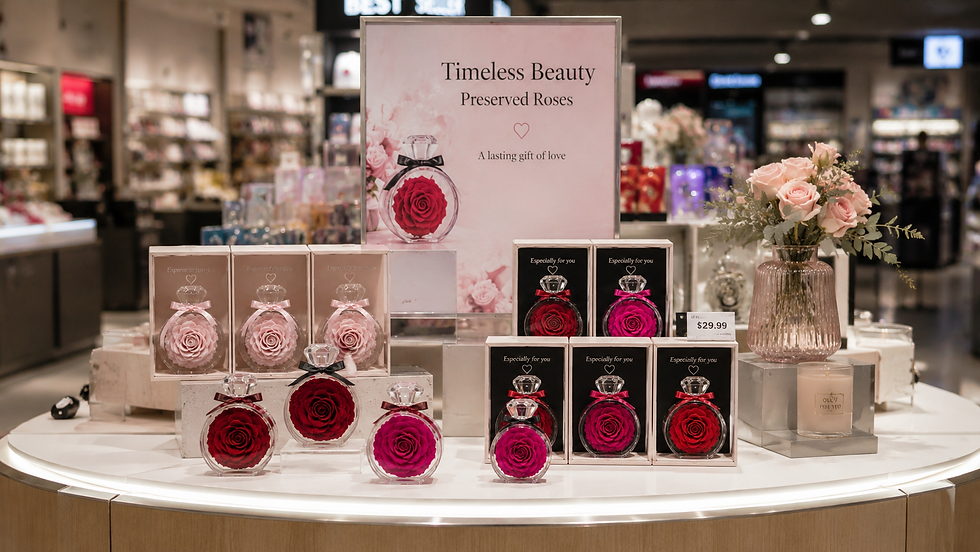
The same product-development logic can apply to other long-lasting floral formats. Preserved flowers, plush flowers, crochet flowers, fabric flowers, soap flowers, and related decorative products can function as seasonal merchandise, gifts, home accessories, or temporary retail concepts when their role in the assortment is clear.
The important question is not simply which type of flower to use. It is whether the product creates enough seasonal relevance, visual merchandising value, and usable selling life to justify the space and inventory it requires.
Developing long-lasting floral merchandise for seasonal retail, gifting, or a pop-up concept? Contact us at sales@sweetie-group.com to discuss the project.
Francfranc's Next Stage May Depend on Better Selection, Not More Selection
Francfranc has already demonstrated an ability to turn ordinary lifestyle products into distinctive original merchandise. Its current transition raises a more difficult question: how much assortment newness can the business support productively?
AIN's reform agenda makes the trade-off unusually visible. The group is addressing SKU deployment and inventory at the same time that it is investing in existing stores, product attractiveness, and new forms of collaboration.
These priorities do not necessarily conflict. A strong seasonal story does not need to create a large permanent SKU family. A successful product platform can be refreshed through carefully chosen updates rather than unlimited variation. A smaller store can still offer discovery if the assortment is well edited, and higher-frequency lifestyle categories can create more purchase occasions without diluting the brand's design logic.
Bloom Bar illustrates the same principle on a smaller scale. It added a new seasonal experience without requiring Francfranc to commit immediately to a large permanent flower category.
Taken together, these examples suggest that assortment discipline and creativity are closely connected in design-led retail. Every new variation requires some combination of forecasting, production, inventory, display space, and eventual exit planning. The value of newness therefore depends on what it contributes in return.
For Francfranc, the next stage will be worth watching because the brand is trying to preserve the flexibility expressed in VALUE by DESIGN while operating a large original-product assortment more productively.
The question is no longer whether Francfranc can continue creating new products. It is how consistently that newness can generate relevance and demand without adding unnecessary complexity.

FAQ
Why does Francfranc launch so many seasonal collections?
Seasonal collections allow Francfranc to make familiar lifestyle categories relevant to changing occasions and needs throughout the year. Spring, summer cooling, travel, Mother's Day, Christmas, and other moments can refresh the assortment while remaining within the broader Francfranc design system. Its recent release calendar shows this approach across interiors, accessories, appliances, gifts, and seasonal merchandise.
Why is SKU complexity important in lifestyle retail?
Lifestyle products often expand through colors, sizes, seasonal versions, packaging variations, and coordinated collections. Each additional SKU creates more work in forecasting, sampling, production, allocation, replenishment, inventory, and markdown planning. In Francfranc's case, AIN Holdings has specifically identified SKU deployment as an area being addressed through its current structural reform.
Why is Francfranc Bloom Bar relevant to seasonal retail strategy?
Bloom Bar combined Mother's Day gifting, personalization, visual merchandising, and long-term decorative use within a limited pop-up concept. This allowed Francfranc to introduce a fresh seasonal experience without first committing to a large permanent flower assortment, making it a useful example of controlled seasonal category development.
Annie Zhang


Comments