


How Flying Tiger Copenhagen Turns Small Joys Into Big Emotional Purchases


In many retail categories, the challenge is no longer simply offering more products. Consumers today have access to a wide range of choices, and many categories face increasing similarity between products, brands, and price points.
For retailers operating in gifts, home accessories, seasonal products, and lifestyle categories, one important question remains:
How can a product attract attention and create a reason for purchase when it is not an essential item?
Flying Tiger Copenhagen provides an interesting example.
The Danish retailer has built a global business around affordable, creative, and frequently refreshed product collections. Its assortment covers categories including home accessories, gifts, stationery, toys, party products, and seasonal items. The company operates more than 1,000 stores globally and is known for its high product rotation and colorful Scandinavian design approach.
The success of Flying Tiger Copenhagen is not based on one specific product category. Instead, it comes from a system that connects product concepts, consumer motivations, pricing, seasonal opportunities, and retail presentation.
This article examines how Flying Tiger transforms small products into meaningful purchase decisions and what this reveals about modern lifestyle retail.
1. The Foundation: Turning Everyday Products Into Discoverable Products
A key part of Flying Tiger Copenhagen’s product strategy is its ability to make ordinary categories feel more interesting.
Many products sold in lifestyle retail are not completely new inventions. They often belong to familiar categories:
stationery
home decoration
kitchen accessories
gifts
party products
The challenge is not creating a new category. The challenge is creating a product that feels different within an existing category.
Flying Tiger achieves this through product concepts that combine practical use with visual identity and emotional relevance.
For example, a notebook is not only a tool for writing. Its design, color, theme, and presentation can influence whether a customer feels attracted to it.
A decorative item is not only an object placed in a room. It can also represent personal taste, seasonal atmosphere, or a gifting opportunity.
The commercial value comes from adding additional reasons for purchase.
Product discovery is built through three elements
Element | Role in Consumer Decision |
Functional relevance | The product solves a practical purpose |
Visual differentiation | The product stands out among alternatives |
Emotional association | The product connects with a personal interest or occasion |
This approach helps explain why Flying Tiger can create demand for products that customers may not have actively searched for.
The product does not need to compete only through function.
It can compete through relevance, design, and timing.
From individual products to product concepts
A common characteristic of successful lifestyle retailers is that they think beyond individual SKUs.
Instead of asking:
“What product can we sell?”
They often ask:
“What product concept can attract customers in this category?”
A product concept may include:
a visual theme
a seasonal story
a color direction
related products
a specific usage scenario
This creates stronger connections between products and increases opportunities for customers to discover multiple items within the same collection.
For businesses developing floral gifts, decorative products, or seasonal collections, understanding this product concept approach is increasingly important. Sweetie-Gifts focuses on floral product development that combines design, gifting occasions, and retail application. For product discussions, contact sales@sweetie-group.com.

2. The Growth Engine: A Product Assortment Built Around Freshness and Occasions
Flying Tiger Copenhagen’s growth depends heavily on keeping the assortment fresh.
The company is known for launching a large number of new products regularly, creating a shopping environment where customers can discover different products during repeated visits.
This strategy is not simply about increasing the number of products.
It is about maintaining consumer interest.
Why product freshness matters
When customers know that the assortment changes frequently, each store visit has a higher possibility of discovery.
This creates a cycle:
New products→ Increased curiosity→ More store visits→ More purchase opportunities
The assortment itself becomes part of the retail experience.
The role of seasonal opportunities
Seasonality is another important part of Flying Tiger’s product strategy.
Retailers in gifts and lifestyle categories are often connected with consumer occasions.
Examples include:
Occasion | Product Opportunity |
Valentine’s Day | Romantic gifts and decorative products |
Mother’s Day | Appreciation-focused gifts |
Christmas | Home atmosphere and celebration products |
Back-to-school | Stationery and organization products |
A product’s commercial potential is often influenced by context.
A decorative item without a specific occasion may have limited urgency.
The same product connected with a seasonal event can become much more relevant.
Why collections create stronger results than isolated products
A single product can attract attention.
A collection can create a shopping destination.
For example, a seasonal theme may include:
decorations
gifts
accessories
complementary products
packaging elements
When products support each other, customers are more likely to explore the category rather than purchase only one item.
This is one reason lifestyle retailers often invest heavily in themed collections.
3. The Value Equation: How Flying Tiger Balances Accessibility and Emotional Appeal
Flying Tiger Copenhagen is widely recognized for affordable products, but its business model is not simply based on low pricing.
The challenge for any affordable retailer is balancing two factors:
Maintaining accessible prices
Creating enough differentiation to avoid becoming a commodity
Flying Tiger’s approach is based on increasing perceived value.
Price creates access. Design creates preference.
A lower price can reduce hesitation.
However, customers still need a reason to choose one product over another.
The perceived value of a lifestyle product often comes from several combined factors:
Factor | Contribution |
Price accessibility | Makes purchase decisions easier |
Product design | Creates differentiation |
Packaging and presentation | Improves first impression |
Occasion relevance | Gives customers a reason to buy |
Flying Tiger has historically positioned a significant part of its assortment within accessible price ranges, with many products priced below approximately 10 dollars or 10 euros.
This pricing structure supports frequent purchases, gifting, and product exploration.
Affordable does not mean interchangeable
A major challenge in low and mid-price retail is avoiding product similarity.
If customers see two products as identical, price becomes the main decision factor.
However, when design and product concept create differentiation, the purchase decision becomes less price-driven.
This is especially important in categories such as:
gifts
decorations
seasonal products
floral products
creative accessories
Products in these categories often compete through perceived meaning rather than technical performance.
For brands and retail groups exploring floral gifts, seasonal products, or lifestyle collections, Sweetie-Gifts works on product concepts that combine design, packaging, and market positioning. We welcome conversations about new product ideas at sales@sweetie-group.com.
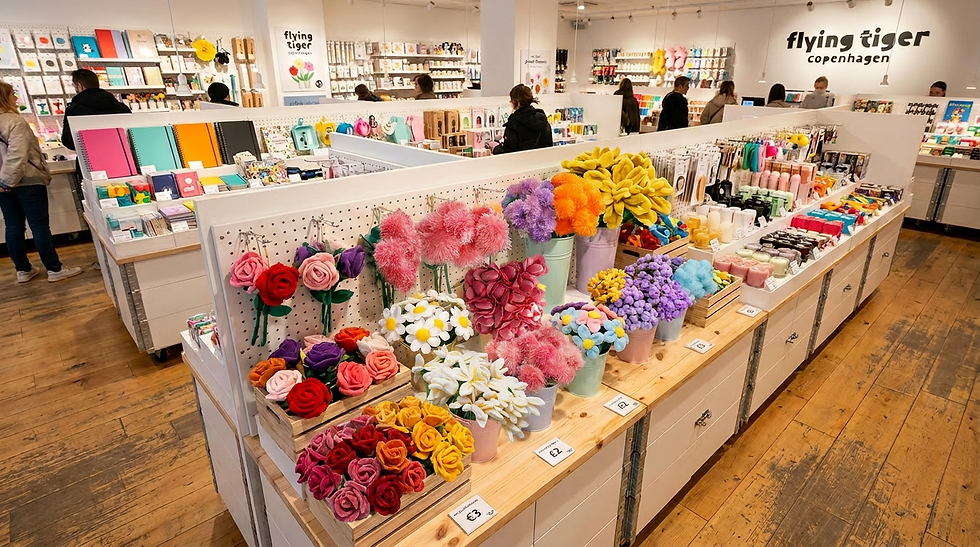
4. The Retail System Behind the Products: Design, Display, and Scalable Execution
A creative product concept only creates business value when it can perform effectively in a retail environment.
Flying Tiger’s product strategy depends not only on design ideas, but also on execution.
Design supports commercial performance
In lifestyle categories, design has several business functions.
It helps products:
Attract attention: Products need to stand out among many alternatives.
Communicate quickly: Customers should understand the product concept without complex explanations.
Support merchandising: Products should work effectively within shelves, displays, and seasonal areas.
Retail presentation influences purchase decisions
A product is not experienced separately from its environment.
Its commercial performance depends on:
packaging
color arrangement
shelf position
display combinations
surrounding products
This is why many lifestyle retailers develop collections rather than individual items.
A group of related products can create a stronger visual impression and encourage customers to explore more.
Scaling creativity across markets
Flying Tiger operates across many international markets, which means creative ideas must also work at scale.
A successful product needs to balance:
design appeal
production feasibility
quality consistency
packaging requirements
logistics efficiency
The challenge is maintaining creativity while ensuring operational reliability.
This is particularly important for categories with frequent launches and seasonal deadlines.
5. What Flying Tiger Copenhagen Reveals About Modern Lifestyle Retail
Flying Tiger Copenhagen demonstrates a broader trend in global retail: products increasingly compete through relevance, not only through function or price.
The company’s model highlights several important capabilities:
Capability | Business Impact |
Strong product discovery | Encourages customer engagement |
Fresh assortment | Creates reasons for repeat visits |
Seasonal thinking | Connects products with occasions |
Design differentiation | Reduces product similarity |
Accessible pricing | Supports frequent purchases |
Scalable execution | Enables international expansion |
The lesson is not that every retailer should copy Flying Tiger’s exact style.
Different retail formats have different customer expectations.
The important insight is understanding how product strategy can create stronger connections between customers and categories.
Conclusion: Creating More Reasons for Customers to Purchase
Flying Tiger Copenhagen’s success comes from building a consistent system around product discovery, assortment planning, pricing, design, and retail execution.
The company shows that affordable products can still create strong consumer appeal when they are developed with a clear concept and placed in the right context.
For retailers operating in gifts, home accessories, floral products, and seasonal categories, the key question is not only:
“What products should we sell?”
It is also:
“How can products create stronger reasons for customers to notice, choose, and remember them?”
Sweetie-Gifts continues to study global retail trends and develop floral gift collections, decorative products, and customized solutions for international markets.
For discussions about floral gifts, lifestyle collections, or product development opportunities:

Annie Zhang
CEO of Sweetie Group

Comments