


Are Forever Roses Toxic? A Clear, Evidence-Based Guide for Home Use, Kids, and Pets


Forever roses are beautiful to display, easy to gift, and much longer-lasting than fresh flowers. That part is simple.
What makes people hesitate is everything they can’t see at a glance: how the roses were preserved, what materials were used, whether there’s added dye or fragrance, and whether the product is actually safe to keep around pets, children, or in everyday indoor spaces.
And that’s exactly why broad claims like “non-toxic” are rarely enough. To answer the question honestly, I have to look at how forever roses are made, what can affect product safety, and where the real risks usually come from.
In most cases, properly made preserved roses are generally low-risk for normal indoor display. But they are still processed decorative products, not untreated fresh flowers, and they should never be treated as edible or chew-safe. The real answer depends on the flower source, preservation process, added materials, and the environment where the product will be used. (ASPCA)
What Are Forever Roses, Exactly?
Forever roses, also called preserved roses, are real roses that have been treated to keep their shape, softness, and color far longer than fresh-cut flowers. They are not artificial flowers, but they are not “natural and untouched,” either.
That distinction matters.
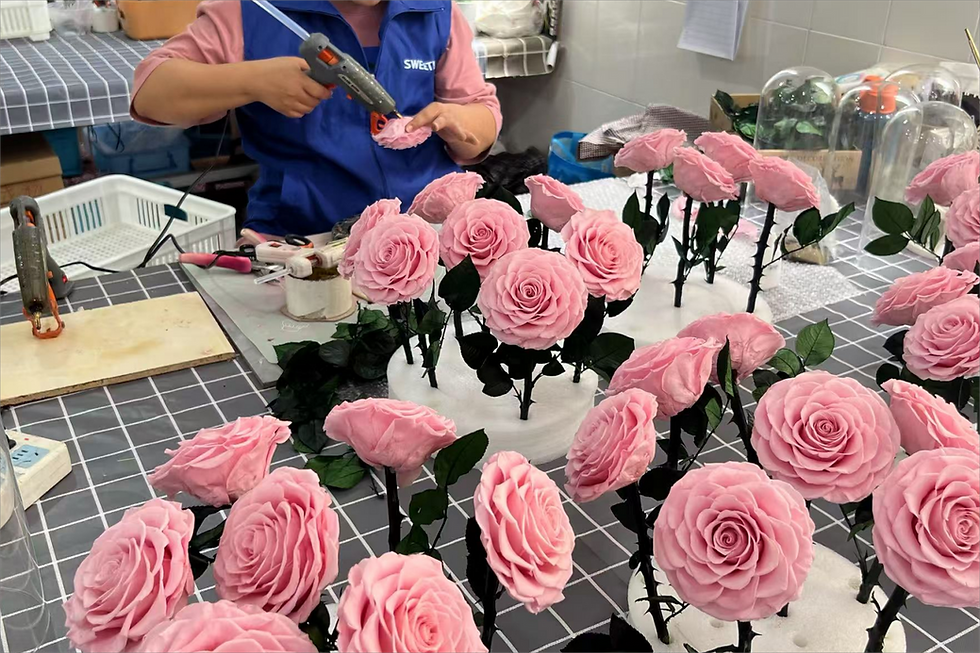
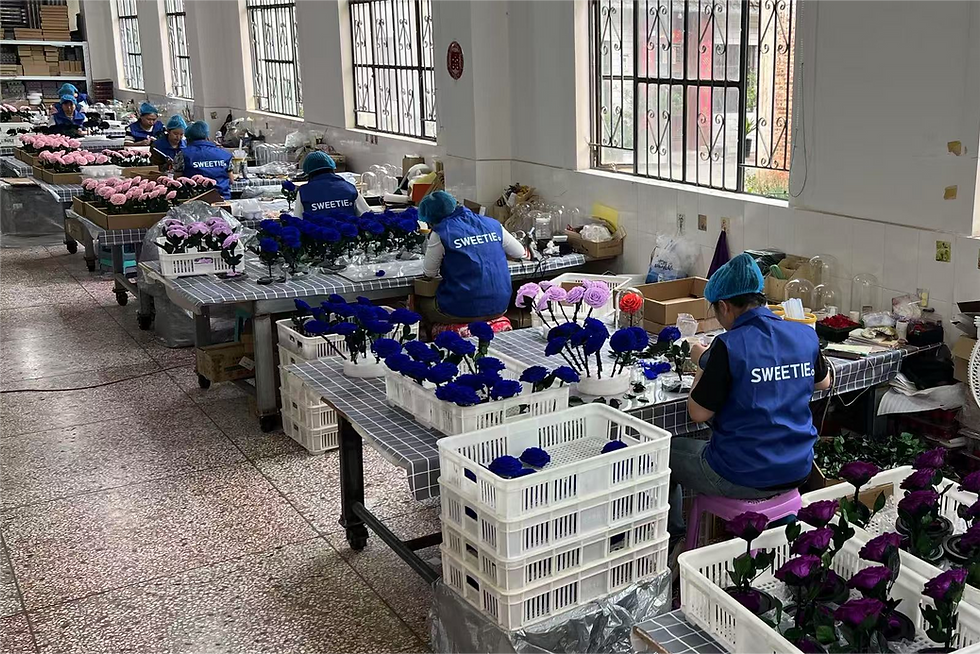
In our industry, preserved flowers are typically made through a series of processing steps that may include dehydration, degreasing, shaping, coloring, and drying. In Sweetie’s internal process document, the workflow includes an initial dehydration and degreasing step in 75% medical-grade alcohol, a second dehydration step in 99.99% anhydrous ethanol, shaping liquid, coloring in ethanol with food-grade pigment, and natural drying. The same document notes that the alcohol evaporates during drying and that the process takes roughly one to two months.
More broadly, preserved floral materials are often stabilized by replacing part of the moisture in plant tissue with glycerin-based solutions or similar systems so the finished material stays softer and less brittle than a typical dried flower. Kansas State University’s extension guidance describes this principle clearly: glycerin preservation works by replacing some of the water in plant tissue, leaving the material soft and pliable. (KSRE Bookstore)
Are Forever Roses Toxic? The Short Answer
My short answer is this:
Most well-made forever roses are not considered highly toxic for normal display use, but they are not meant to be eaten, chewed, or handled like a food-safe product.
That is the most honest version of the answer.
What I do not like is when this question gets reduced to a lazy yes or no. A forever rose is not just a rose. It can also involve dyes, fragrance, glue, stabilizing liquids, surface treatments, foam bases, ribbons, and packaging. So when someone asks whether forever roses are toxic, the real question is usually: safe for whom, in what setting, and under what kind of exposure?
If you’re comparing suppliers and want a straight answer on materials or testing, email us at sales@sweetie-group.com.
What Actually Affects the Safety of Forever Roses?
This is where the conversation gets more useful.
1. The flower itself
A real rose, as a plant, is generally not classified as toxic to dogs, cats, or horses by the ASPCA. That’s an important starting point because many people assume the flower itself is the main concern. It usually isn’t. (ASPCA)
But “non-toxic plant” does not mean “safe to eat.” Even non-toxic plants can still cause stomach upset, irritation, or physical injury if swallowed in quantity.
2. The preservation process
The preservation process matters more than most product pages admit. A properly processed rose should be fully dried, stable, and free from wet residue or strong chemical odor. Production-stage materials like ethanol may be used during manufacturing, but that does not automatically mean the finished product poses the same exposure risk if the process is complete and the rose is properly dried. Sweetie’s process notes specifically say the alcohol used in production evaporates during drying.
This is one reason I’m careful with sweeping language. A finished decorative product and a production-stage chemical bath are not the same thing.
3. Dyes, fragrance, and added materials
This is often the gray area.
Some preserved roses use food-grade pigments. Others may use fragrance, glue, or decorative coatings. Those added materials do not automatically make a product dangerous, but they can increase the chance of irritation, odor sensitivity, or concern for households with children or pets. Sweetie’s internal process file references food-grade pigment for coloring, which is a more reassuring detail than a vague “safe materials” claim with no explanation behind it.
4. Upstream flower sourcing
This point gets overlooked all the time: preserved roses begin as real flowers, and decorative flowers can carry pesticide residues depending on the growing and handling chain. That does not mean every forever rose is unsafe, but it does mean buyers should avoid assuming that “natural flower” automatically means “clean flower.” If a supplier cannot explain sourcing and processing clearly, that’s a signal worth paying attention to.
Are Forever Roses Safe Around Pets and Children?
This is where readers usually want a more specific answer, so I like to break it down by real-world use.
Situation | Practical Risk Level | What I Recommend |
Normal indoor display for adults | Usually low | Fine for display if the product is well made and fully dry |
Homes with cats or dogs | Usually low if untouched, higher if chewed | Keep out of reach; do not treat as pet-safe |
Homes with babies or toddlers | Moderate if accessible | Avoid placing within grabbing or mouthing distance |
Fragrance-sensitive households | Product-dependent | Choose low-odor, no-added-fragrance options when possible |
Unknown low-cost product with strong odor | Higher concern | Avoid until materials and process are clarified |
That table may look simple, but it captures the real issue: display risk and chewing risk are not the same thing.
Cats and dogs
The ASPCA lists true roses as non-toxic to cats and dogs. That’s helpful, but it still doesn’t mean a preserved rose arrangement belongs on the floor next to a curious pet. The risk is not just the rose itself. It can be the fragrance, dye, glue, floral foam, ribbon, or physical choking hazard from decorative parts. (ASPCA)
So if a customer asks me, “Are forever roses pet safe?” my honest answer is: they are usually low-risk as display items, but they are not pet toys, and they should not be left where animals can chew them.
Babies and young children
I’m even more cautious here.
Not because preserved roses are automatically toxic, but because babies and toddlers interact with objects in the least predictable way possible. They grab, crush, mouth, pull, and swallow. That changes the risk profile immediately. Even a product that is perfectly fine on a shelf may not be appropriate at child level.
If you’re buying for a family-oriented retail setting or a gift line, this point matters more than people think.
Need clear answers on preserved rose materials for retail, gifting, or custom projects? Email sales@sweetie-group.com.
When Should You Be More Careful?
There are a few situations where I think buyers should slow down and ask more questions.
The product has a strong chemical smell
A strong, lingering odor is never a great sign in a decorative floral product. It may not prove toxicity, but it does suggest the buyer should ask about fragrance, coatings, glue, or drying quality.
The color rubs off easily
If a flower sheds visible color during normal handling, that tells me the finish may not be stable. It doesn’t automatically make the product dangerous, but it does raise quality and exposure questions.
The seller relies on vague promises
“Non-toxic.”“Eco-friendly.”“Safe for everyone.”
Those phrases sound comforting, but by themselves they don’t mean much. I trust a supplier more when they can explain the process in plain English than when they stack up pretty adjectives.
The product will be used in a sensitive setting
That includes:
homes with pets that chew everything
homes with toddlers
hospital-adjacent gifting
enclosed retail displays with strong fragrance sensitivity
projects where customers are likely to ask for material transparency
In those cases, the safer move is to choose products with a clearer process, lighter odor, and more transparent material discussion.

How to Tell if a Forever Rose Product Is Higher Quality
This is the part buyers can actually use.
Here’s what I look for when I want more confidence in a preserved rose product:
A clear explanation of how the roses are made
If a supplier can explain dehydration, shaping, coloring, and drying in a straightforward way, that usually signals a more mature process. Sweetie’s own production materials describe those steps in detail rather than hiding behind generic marketing language.
Stable appearance without wetness or residue
A good preserved rose should look clean, dry, and finished. It should not feel oily or leave visible residue during normal display use.
No aggressive artificial smell
A light scent is one thing. A sharp chemical smell is another.
Realistic claims
I trust a product page more when it says “low-risk for normal display use” than when it says “100% harmless.” Absolute safety language usually makes me more skeptical, not less.
Supplier transparency
If a buyer asks, “What dyes are used?” or “Can you explain the preservation process?” a serious supplier should be able to answer without sounding evasive.
FAQ About Forever Rose Safety
Are forever roses toxic to cats?
Real roses are generally considered non-toxic to cats, but preserved rose products should still be kept out of reach because cats may chew petals, glue, ribbon, or other decorative parts.
Are forever roses toxic to dogs?
They are usually low-risk as display items, but they are not chew-safe. The main concerns are physical ingestion, decorative materials, and gastrointestinal upset rather than the rose itself.
Are forever roses safe around babies?
They can be displayed safely, but I would not place them where babies or toddlers can grab, mouth, or pull them apart.
Do forever roses contain chemicals?
Yes. Preserved roses are processed decorative flowers, so they may involve stabilizing liquids, dyes, fragrance, or glue depending on the product. That does not automatically make them dangerous, but it does mean they should not be treated like untreated fresh roses.
Are forever roses safe to smell?
In most cases, yes, for normal display use. But fragrance-sensitive people may prefer low-odor versions, especially in smaller indoor spaces.
What is the biggest safety mistake buyers make?
Assuming that “real flower” means “nothing was added,” or assuming that “non-toxic” means “safe to chew.” Both are oversimplifications.
Final Thoughts
Forever roses are one of those products that look simple from the outside and become more nuanced the moment someone asks a practical question. That’s not a bad thing. It just means the best answer has to be more precise than a slogan.
My view is straightforward: properly made forever roses are generally low-risk for normal indoor display, but they are still processed decorative products, not edible items and not chew-safe items. The real safety question comes down to process quality, material transparency, and how the product will actually be used.
If you’re sourcing preserved roses for retail, gifting, or private label projects, the best choice is rarely the supplier with the prettiest “safe” claim. It’s the supplier who can clearly explain how the roses are made, what materials are involved, and where caution still makes sense.
If you’d like to discuss preserved rose materials, custom projects, or sourcing questions in more detail, email us at sales@sweetie-group.com.
CEO of Sweetie Group


Comments