


Amazon CEOs’ Survival Playbook: How To Compete Profitably With Chinese Sellers


Every Amazon CEO eventually runs into the same wall.You launch a good product, build strong reviews, keep ads under control. Then a Chinese seller appears at half your price with similar quality, Prime delivery, and a willingness to accept margins you’d never consider.
If this feels like a pricing problem or an operations problem, it isn’t.You’re competing against an entire system: faster product cycles, lower landed costs, integrated supply chains, and teams trained for platform speed.
You can’t out-hustle that system. But you can out-strategize it—if you shift from “seller thinking” to CEO-level decision making.
This playbook focuses on the moves that actually change your P&L.
Index:
1. Get clear on the game you’re playing
Before thinking about ads, margins, or new SKUs, a CEO must answer one foundational question:
What kind of Amazon business are we?
Most companies fall into one of three strategic types:
Brand-driven
You win with story, positioning, and trust. Amazon is your acquisition engine.
Ops-driven
You win with speed: fast testing, fast iteration, fast correction.
Supply-chain-driven
You win with cost efficiency and manufacturing advantage.
If you don’t know which is your anchor, your team will chase tactics that don’t fit your structure.
If you’re unsure which model your company truly fits, we’re happy to walk through it with you. Contact us at sales@sweetie-group.com.

2. Stop fighting battles you can’t win
Some Amazon categories are unwinnable for Western companies at your cost base. The signals tend to be obvious:
Commoditized, low-complexity products
Price-sensitive customers sorting low to high
Multiple Chinese sellers sourcing from the same factory
Ad costs rising while ASP stays flat
If you insist on staying in these segments, you are choosing long-term margin compression.
A simple CEO tool is to classify every ASIN into three groups:
Category | What It Means | Action |
Kill | Low margin, no differentiation | Exit quickly |
Defend | Your product stands out | Maintain focus |
Double-Down | True advantage + healthy profit | Scale aggressively |
Most companies discover they’re wasting resources keeping “Kill” items alive. Strategic subtraction often produces the biggest profit recovery.
3. Turn China into part of your solution
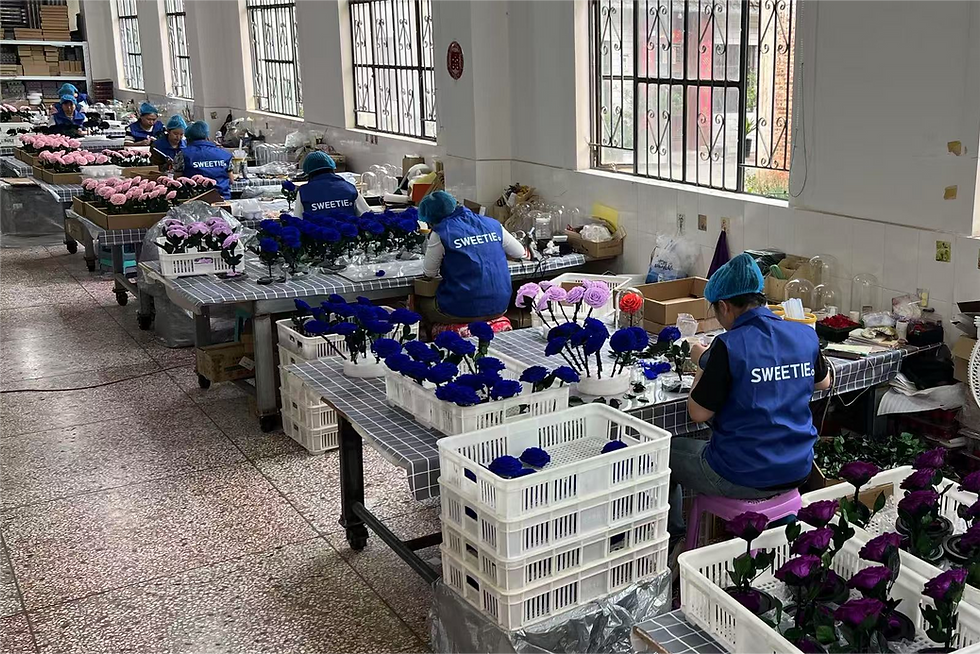
Competing with Chinese sellers does not mean cutting China out. In many cases, it means using Chinese capabilities as part of your competitive engine.
The companies we see scaling sustainably do one or more of the following:
Use Chinese factories as a rapid R&D lab
Factories are exceptionally good at fast sampling, testing, and iteration. Your team focuses on market insight; they focus on feasibility and speed.
Build a China-side operations pod
Listing optimization, inventory pacing, and launch mechanics can often be executed more efficiently by specialists who live inside the ecosystem.
Adopt a dual-layer supply chain
Bulk manufacturing in China plus a small local buffer warehouse dramatically reduces stockout risk and improves ranking stability.
If designed correctly, this is not outsourcing control. It’s outsourcing inefficiency.
Want to understand what a balanced China partnership looks like from the manufacturing side? Email sales@sweetie-group.com for examples.
4. Redesign your profit model around LTV, not the first order
Chinese sellers often win the first transaction. They rarely win the relationship.
A CEO can regain leverage by reframing Amazon’s role:
Amazon is your front door, not your entire house.
That means assigning roles to your SKUs instead of expecting each one to do everything:
Hero SKUs drive visibility and reviews
Profit engines deliver margin quietly and consistently
Acquisition SKUs bring in new customers, even at thin margins
Your job is to turn Amazon buyers into brand buyers through packaging, post-purchase communication, and a product roadmap built for repeat engagement.
This is where Western brands have an advantage Chinese sellers struggle to copy.
5. Upgrade your operating system
Chinese sellers are fast because their systems are built for speed.You don’t need to mimic their culture, but you do need to redesign your decision rhythm.
What works:
Cross-functional squads with P&L responsibility
Weekly experiments instead of quarterly adjustments
A CEO dashboard that highlights margin health, stockout risk, and LTV trends, not just top-line sales
When teams move faster, your margin decisions improve, poor SKUs die sooner, and inventory sits for fewer days.
If you need help evaluating where your operating system is slowing you down, reach us at sales@sweetie-group.com.

Final reflection
You won’t beat Chinese sellers everywhere. You don’t need to.
Winning as an Amazon CEO today is about making smarter decisions about where you compete, how you structure your supply chain, and which parts of your operation deserve your resources.
Every company that survives this next decade will share three traits:
They avoid unwinnable price wars
They leverage China intelligently instead of resisting reality
They build LTV engines that competitors cannot easily imitate
If you’re ready to rethink how your Amazon business competes and want input from a partner who understands both the Amazon battlefield and China’s manufacturing ecosystem, send a note to sales@sweetie-group.com.

Warm Regards,
CEO of Sweetie-Group


Comments