


How Amazon Home Décor Owners Can Increase Enterprise Value When Competing With Chinese Sellers


If you sell Home Décor on Amazon, you’ve probably felt this shift in your numbers even when your revenue looks “fine” on paper:
Your price ceiling keeps dropping.
Your ad costs keep rising.
Your best sellers get copied faster than you can refresh them.
One bad batch, one spike in breakage, or one stockout can wipe out weeks of profit.
That’s not just a margin problem. It’s an enterprise value problem.
When Chinese sellers flood a niche with lookalikes and lower prices, the biggest damage is that your business starts to look replaceable. Replaceable businesses trade at lower multiples, even if they are still selling.
In this post, I’m going to stay focused on Amazon Home Décor, with a giftable positioning layer (because giftable products behave differently in pricing power and customer decision-making). My goal is to help you build a business that becomes more valuable over time, not just busier.
If you want a second set of eyes on your Home Décor assortment from a “giftable + supply chain” perspective, email me at sales@sweetie-group.com. I’m happy to share what I’m seeing work right now.
What enterprise value means on Amazon
In the Amazon world, “enterprise value” is not your sales. It’s what your business is worth because of its future cash flow and its defensibility.
A simple way to think about it:
Strong enterprise value comes from predictable revenue, durable margin, real differentiation, and lower operational risk.
Chinese seller competition hurts enterprise value when it forces you into commodity economics: thin margins, high ad dependence, and constant fear of replacement.
So the real question is not “How do I beat Chinese sellers this quarter?”
It’s:
How do I build a Home Décor business that is harder to replace and easier to value?
If you’re actively building toward an exit, or you simply want a business that feels stable again, keep reading.
The four drivers that raise your valuation multiple
Most Amazon buyers (and frankly, most founders who’ve been through a rough price war) end up judging value through four drivers:
Revenue quality: Is your income diversified and predictable, or tied to one SKU and one season?
Margin durability: Are you keeping profit after returns, breakage, fees, and ads, or only before?
Defensibility: Do you have something that’s hard to copy and hard to replace?
Risk discount: Are there avoidable risks that would scare a buyer or compress your multiple?
Home Décor is a category where Chinese sellers often win on cost and speed. Your edge usually comes from building a system that performs well even when the market gets crowded.

Revenue quality: stop building a one-SKU business
In Home Décor, revenue quality is fragile because the category naturally encourages:
lots of similar listings,
trend-driven spikes,
heavy seasonality,
and quick imitation.
If your growth comes primarily from one hero SKU, you’re not building value, you’re building exposure.
What revenue quality looks like in Home Décor
Here are the patterns I associate with stronger enterprise value:
Lower dependence on Top 1 and Top 5 SKUs
Multiple price tiers (good/better/best), not one price point
A repeatable launch system that works even when a single product slows down
Seasonality management where holidays lift you, but don’t define you
A practical diagnostic (answer honestly)
Does your Top 1 SKU represent more than 25% of revenue?
Do you need coupons or deals to stay competitive?
Do you “win” only during two major gifting moments and struggle the rest of the year?
Is your new-product pipeline real, or mostly wishful thinking?
If you answered yes to two or more, your first EV lever is portfolio structure, not “more ads.”
If you want help mapping your assortment into a clear “good/better/best + giftable” portfolio (without bloating SKUs), email me at sales@sweetie-group.com and tell me your category and target ASP.
Margin durability: calculate the profit that actually survives
Home Décor margins can look healthy until you account for what quietly destroys them:
breakage and replacements,
returns due to “not as expected,”
dimensional weight fees,
storage costs during slow months,
and ad inflation in crowded niches.
If you want enterprise value, you have to optimize contribution margin, not just gross margin.
The only margin that matters: contribution margin
A cleaner way to manage Home Décor profit is:
Contribution Margin
= Price
− Product costs (COGS + packaging)
− Amazon costs (FBA fees + inbound freight)
− Growth costs (ad spend)
− Quality costs (returns/refunds + replacements/breakage)
= Profit you can trust
Chinese seller competition makes this worse because you get pressured on price while your operational costs stay the same or rise.
Where Home Décor owners usually lose money
Here’s a table you can use to audit your business quickly.
Profit leak | Owner KPI to track | What usually fixes it | EV impact |
Damage in transit | Damage rate, replacement rate | Packaging engineering, internal supports, better protection | Stabilizes ratings and reduces hidden costs |
Returns (expectation gap) | Return rate and top return reasons | Better visuals, clearer listing, tighter QC consistency | Improves margin durability and demand confidence |
Dimensional weight fees | FBA fee per unit, packaging size | Reduce package volume without harming presentation | Improves cash flow per unit |
Ad dependence | TACoS trend, organic share | Better conversion, keyword focus, stronger creative | Makes profit more predictable |
Stockouts | Stockout days, lead-time variance | Forecasting, earlier production planning, dual sourcing | Protects rank, lowers recovery cost |
If you take only one idea from this post, take this: in Home Décor, packaging is not “extra.” Packaging is a profit lever.
When you reduce damage and return rates, you don’t just save replacement costs. You stabilize your star rating, protect conversion rate, and reduce how hard you need to bid to stay visible. That is enterprise value.
Defensibility: in Home Décor, “giftable” is pricing power
Most Home Décor products are bought for self-use. That tends to be price-sensitive.
Giftable Home Décor behaves differently.
When someone buys a gift, they’re not only buying the object. They’re buying peace of mind:
Will it look premium when it arrives?
Will it arrive intact?
Can I give it immediately without extra work?
Does it feel meaningful?
If your listing is competing purely on price, Chinese sellers have the structural advantage.
If your product is positioned as giftable, you can move the conversation away from price and toward perceived value. That shift increases enterprise value because it supports higher ASP, higher margin, and stronger review language.
The “Giftable Moat Stack” for Home Décor
When I say “giftable,” I do not mean adding a ribbon and calling it a day. I mean building a product system that is harder to copy profitably:
Premium, protective packaging that reduces damage and presents well
Cohesive design language across a small series (not random SKUs)
Occasion clarity: who it’s for and why it fits (mother, partner, friend, housewarming, thank you)
Bundle logic that creates a complete gifting solution
Review reinforcement: customers naturally say “perfect gift,” “beautiful presentation,” “arrived safely”
This is how you escape the commodity trap in a category filled with lookalikes.
If you’re developing giftable Home Décor products and want practical input on packaging that protects both reviews and margins, email sales@sweetie-group.com. Tell me your product type and your current damage/return pain points.

Risk discount: why good Amazon businesses still sell cheap
I’ve seen sellers with strong revenue get valued conservatively because their risk profile is messy. In Home Décor, risk discount usually comes from three places.
Platform and listing risk
IP complaints, frequent variations changes, review volatility, listing takedowns
Too much dependency on a single listing that can be attacked
A buyer will ask: “If this listing goes down, what happens to the business?”
Supply chain risk
Home Décor is highly visual. Small inconsistencies can lead to big returns:
color variance,
finish variance,
packaging inconsistency,
damaged arrival.
If your supply chain produces uneven results, you pay for it in returns, reviews, and ad efficiency.
Also, some giftable décor products require more production planning than typical commodities. If your production cycle is long or your process is not easily rushed, you cannot “fix” a holiday stockout with a last-minute order. This is exactly why owners who plan earlier tend to build stronger, more stable businesses.
Cash flow and inventory risk
Overbuying for a holiday and then discounting aggressively afterward
Stockouts that drop rank and force you to spend heavily to recover
The more predictable your planning and the tighter your inventory logic, the less risk discount you carry.
A practical playbook: build a giftable Home Décor value ladder
If you want an actionable approach that ties directly to enterprise value, this is where I’d start.
Step 1: Choose SKUs that can earn a gift premium
Not every décor item should be giftable. Focus on products that naturally fit occasions and emotional purchase reasons.
A good giftable candidate typically has:
strong visual impact,
easy “wow” unboxing,
stable quality control,
and low breakage risk after packaging is engineered correctly.
Avoid products where:
the value is hard to see in photos,
the product is easily substituted,
or the size/fragility creates unpredictable costs.
Step 2: Build a three-tier value ladder (good/better/best)
This is one of the most reliable ways to defend against low-end price floors.
Good: entry gift option, clean presentation, basic but solid
Better: upgraded packaging, added personalization or bundle element
Best: premium materials, special edition design, strong occasion story, complete gift readiness
The key is that all three share a recognizable design language, so your brand looks coherent and valuable.
Step 3: Engineer packaging for premium presentation and low damage
Owners often treat packaging as a cost line. In giftable Home Décor, packaging is a system that controls:
damage rate,
return rate,
review language,
and perceived value.
If you can reduce damage and returns while improving unboxing, you are improving both margin durability and revenue quality.
Step 4: Operationalize seasonality instead of gambling on it
Enterprise value rises when your business is run like a system, not a guess.
For major gifting moments, plan backwards:
design lock date,
sample approval date,
production start,
inbound shipping window,
FBA receiving buffer,
launch date.
If you treat holidays like predictable campaigns, you stop getting surprised. That stability is worth money.
Step 5: Build proof assets buyers pay for
If you ever sell your business, the buyer will want evidence of repeatability:
supplier scorecards,
QC standards,
packaging specs,
inventory planning rules,
product roadmap discipline.
Even if you never sell, these assets make you more resilient while competing.
If you’re trying to build a “giftable” ladder and need an OEM/ODM partner who can support design iterations, packaging structure, and stable quality, email me at sales@sweetie-group.com. I’ll tell you what’s realistic for timelines and cost targets.
The supplier question: you do not beat China by avoiding China
A lot of U.S. sellers assume the answer is “source outside China.” Sometimes diversification makes sense. But the deeper truth is: you beat Chinese seller competition by choosing a supplier strategy that supports defensibility, not just cost.
When you evaluate manufacturing partners for giftable Home Décor, I would look for:
Consistent quality control for visual categories
Fast sampling so you can keep up with trend cycles
Packaging engineering that reduces damage without inflating dimensional weight
Holiday capacity planning so you do not get crushed by lead-time surprises
OEM/ODM capability so you can build products that do not look like everyone else’s
This is where the right factory relationship changes your enterprise value. Not because it makes you the cheapest, but because it makes your business more stable and more differentiated.
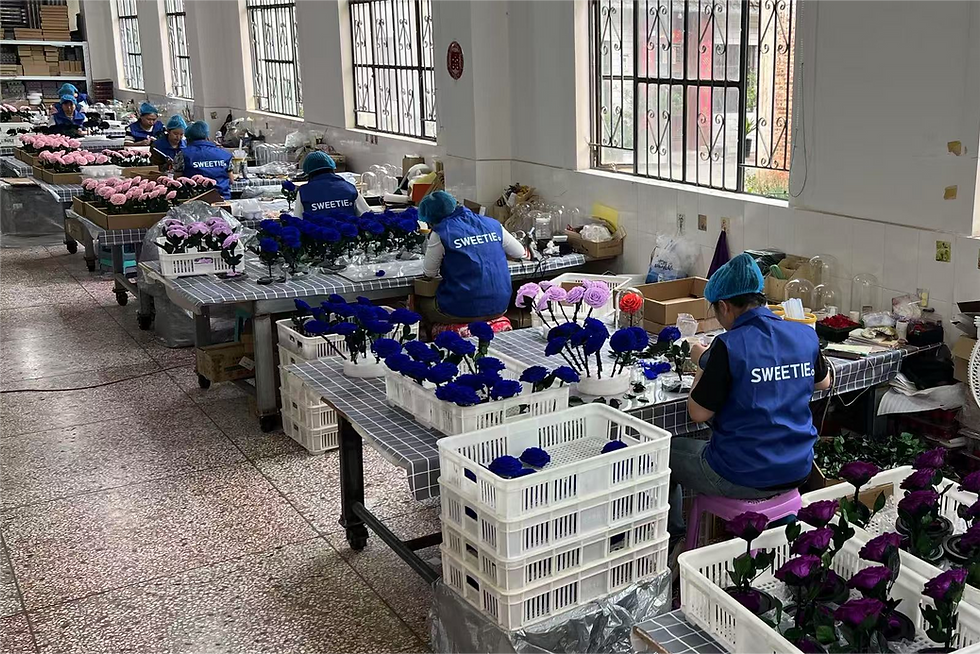
At Sweetie-Gifts, we focus on “Flower + Everything” product development. We support giftable Home Décor brands with design development, stable production, and e-commerce-ready packaging solutions. We operate with production bases in Kunming (preserved flower products) and Yiwu (gift and décor categories), and we’re used to working with global customers who need consistency, not surprises.

Frequently asked questions
Should I match Chinese sellers on price?
If you can win with cost and maintain margin durability, maybe. But most Home Décor owners cannot outlast a price floor set by factory-direct competition. The higher-EV path is moving toward differentiation and giftable positioning that gives you pricing power.
What KPI improves enterprise value the fastest in Home Décor?
For many sellers, it’s improving contribution margin by reducing hidden costs: damage, replacements, returns, and ad dependence. In giftable Home Décor, packaging improvements often create a chain reaction across all four.
Is giftable packaging worth the cost?
It is worth it when it reduces damage and returns and increases perceived value. The decision should be made by running the numbers on contribution margin, not by guessing.
How do I become harder to copy?
You build a system: cohesive design series, packaging structure, bundles, occasion positioning, and consistent quality. Copycats can imitate one SKU. It’s harder to imitate a well-run system profitably.
Final takeaway: build an asset, not just a listing
Chinese sellers will keep getting faster, cheaper, and better at the fundamentals. That’s the reality.
Your opportunity in Amazon Home Décor is to build a business that earns a higher valuation because it has:
more predictable revenue,
more durable profit,
defensible giftable differentiation,
and fewer reasons for a buyer to discount the risk.
If you’re building giftable Home Décor products in preserved florals, artificial florals, or related décor gifting formats and you want a supplier partner who understands both product development and e-commerce packaging, email me at sales@sweetie-group.com.
CEO of Sweetie Group


Comments