


Why Venus et Fleur Became the Benchmark in Preserved Roses


I’ve seen preserved flowers evolve from a niche craft into a global luxury-gifting category. And I’ve also watched wave after wave of brands copy Venus et Fleur (VEF)’s surface cues—hat boxes, rose grids, soft palettes—only to discover that the look is the easiest part.
VEF became the benchmark because it didn’t simply sell preserved roses. It built a repeatable operating system that makes a fragile product behave like a luxury good at scale: consistent, photographable, shippable, and predictable under peak-season stress.
What VEF Really Built
The category-level move VEF made was simple to describe and hard to execute:
It turned flowers from a perishable gesture into a long-lived object.
That reclassification changes customer expectations in three ways:
The evaluation window expands.
Fresh flowers are judged on Day 1. A preserved arrangement is silently judged on Day 7, Day 30, and Day 200. This means quality isn’t “delivered,” it’s maintained.
The purchase becomes risk management.
In premium gifting, buyers aren’t paying for botanical beauty alone. They’re paying to avoid failure: wilted petals, late delivery, cheap-looking packaging, mismatched color, or a gift that disappears in three days. When the gift is meant to signal status and care, “not failing” is worth a lot.
The product enters home décor.
Once flowers behave like a décor object, the buyer’s mental comparison set shifts from florists to lifestyle brands. That’s where premium pricing stops feeling like a floral markup and starts feeling like an interior purchase.
If you’re building a VEF-adjacent brand, this is the first strategic question I would ask:Are you still selling “flowers,” or are you selling certainty + display value?
If you want to sanity-check your concept before investing in molds, packaging, and inventory, email me. I’m happy to share the checklist I use to evaluate whether a “premium” idea will actually hold up at scale: sales@sweetie-group.com.
The System Behind the Aesthetic
Most people talk about VEF’s aesthetic as if it’s taste. I read it as product engineering.
1) The rose grid is a stability strategy
The dense, uniform rose placement does at least three jobs at once:
Luxury signaling: order implies control, control implies premium
Damage control: less movement in transit means fewer broken petals
Variance buffering: a single imperfect bloom is less visually dominant when the composition is dense
In other words, “beautiful” is also “robust.”
2) Packaging is not branding—it’s performance
Preserved flowers don’t require water, but they are still fragile. In premium gifting, you’re not just shipping a product—you’re shipping a moment. Packaging is the system that prevents physics from ruining that moment.
When I evaluate a premium preserved-flower packaging program, I don’t start with the logo. I start with these questions:
Compression resistance: will the lid deform under stacking pressure?
Fit tolerance: do the lid and base stay aligned after vibration?
Internal support: does the insert prevent micro-movements and abrasion?
Surface durability: do suede, matte films, soft-touch coatings scuff easily?
Assembly repeatability: can your team produce identical results at scale?
A lot of “VEF-inspired” brands fail because they treat packaging as an afterthought and then try to “customer-service” their way out of damage rates.
3) Color consistency is the invisible premium
Luxury buyers tolerate fewer surprises. Color is one of the most expensive surprises.
If your “signature blush pink” drifts between batches, customers don’t interpret it as a manufacturing reality. They interpret it as dishonesty (“the photos weren’t real”) or cheapness (“this isn’t premium”).
The brands that scale treat color like a controlled standard:
approved master sample
batch-to-batch comparison
“stop ship” thresholds when drift is obvious
reference retention (keeping a physical baseline)
In my experience, color control is one of the clearest separators between brands that look premium once and brands that stay premium for years.

How the Growth Engine Worked
VEF is often explained as “celebrity marketing.” That’s the visible part. The deeper mechanism is product-as-media.
A preserved rose box is a near-perfect social object:
instantly legible in a feed
readable as expensive without explanation
suitable as a background prop in homes, offices, dressing rooms
easy for recipients to post (it’s gift-coded)
But here’s the point that matters for operators:
Virality is not a marketing outcome. It’s an operational stress test.
When demand spikes, the brand either:
protects the experience (and strengthens reputation), or
breaks the experience (and leaks trust)
This is where VEF’s “system” shows. Benchmarks aren’t created by one viral moment—they’re created by surviving the second-order effects: backorders, QC drift, rushed assembly, inconsistent customer communication.
The brands that endure typically build three disciplines early:
SKU discipline
A curated hero set, not unlimited customization. Luxury feels more premium when the assortment is controlled—and operations become far more predictable.
Peak-season planning
Valentine’s Day and Mother’s Day are not normal weeks. They’re operational exams. Brands that scale build backward calendars for components, assembly, QC, and shipping cutoffs.
Service recovery scripts
Luxury customer care is not just “refund or not.” It’s tone, speed, clarity, and solutions that preserve dignity for the gifter and recipient.
Where Copycats Break
People can copy a hat box in a week. They can’t copy a mature operating system in a week.
Here are the most common failure points I see when brands try to replicate the VEF playbook:
Failure point | What customers experience | What’s actually broken |
Color drift | “This doesn’t match the photos.” | No batch standard, weak inbound QC, no reference retention |
Petal damage in transit | Broken petals, messy unboxing | Insert design, density strategy, and vibration control not engineered |
Packaging scuffs/deformation | “It looks cheap up close.” | Material selection + surface durability testing missing |
Peak-season collapse | Late shipments, inconsistent builds | Capacity planning, staffing ramp, and component lock-in are absent |
Over-customization | Endless variants, slow lead times | SKU sprawl destroys forecasting and QC repeatability |
If I had to summarize why copycats stall, it’s this:
They copy the visual form, but they don’t adopt the operating rules.
Luxury is a promise. Your rules are how you keep it.
If you’re planning peak-season production and want a second set of eyes on risk, email me. I’ll send back a short operator-style risk list with the top 3 fixes I would implement first. sales@sweetie-group.com
Lessons for Brands Scaling Now
If you’re building a premium preserved-flower line today, I’d focus on adopting the structure behind VEF rather than chasing the same silhouette.
Here’s the framework I use.
1) Build a “hero SKU core” you can defend
I’d rather see five flawless SKUs than fifty mediocre ones. A tight hero set allows:
consistent photography
repeatable assembly
stable component sourcing
disciplined inventory planning
Luxury is often built by subtraction.
2) Define measurable quality gates
“Premium” cannot be a feeling inside your team. It has to become gates that stop shipments.
A practical way to think about QC for preserved-flower gifting is three checkpoints:
Incoming QC (flowers, boxes, inserts, accessories)
In-process QC (assembly consistency, density, alignment)
Pre-ship QC (surface defects, logo placement, final presentation)
Even a simple “stop ship” rule—when defect rate exceeds a threshold—prevents small drifts from becoming brand damage.
3) Engineer packaging like a product
I always treat packaging as part of the product bill, not a marketing add-on. It should be tested for:
drops
vibration
compression
abrasion/scuff resistance
humidity/temperature exposure (for coatings and adhesives)
The goal isn’t perfection. The goal is predictable performance at scale.
4) Design for peaks from day one
Peak seasons reward brands that plan backwards:
lock components early
pre-build what can be pre-built
reserve assembly capacity
set realistic cutoff times
keep hero SKUs prioritized
This is also where brands decide whether they want to be “always available” or intentionally scarce. Either choice can work—if it’s operationally intentional.
5) Protect your premium with repeatability
The real moat in preserved-flower luxury isn’t a secret recipe. It’s repeatability:
repeatable color
repeatable feel
repeatable unboxing
repeatable service recovery
Once a customer trusts that repeatability, you’re no longer competing on price. You’re competing on peace of mind.
Closing Thought
VEF became the benchmark because it raised the minimum standard for the entire category: not just “a box of roses,” but a system that can deliver a luxury outcome consistently—even under pressure.
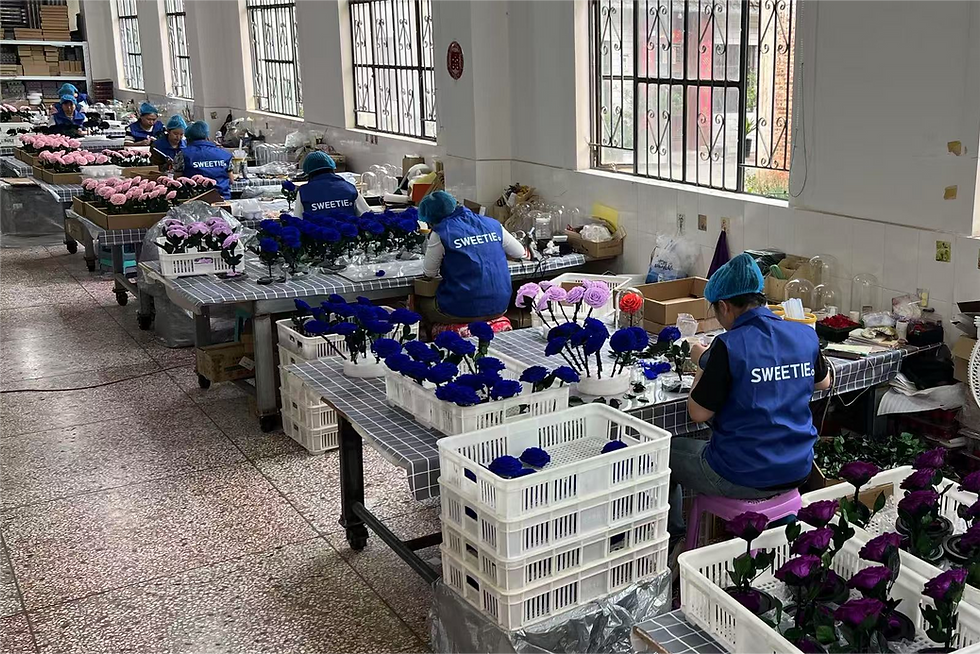
At Sweetie-Gifts, I spend my time on the less visible half of this industry: product development cycles, packaging engineering, QC routines, and seasonal capacity planning for preserved-flower gifting programs. If you’re building a premium line and want a manufacturing partner who understands both the aesthetic and the operating physics, you can reach me at sales@sweetie-group.com.
CEO of Sweetie Group


Comments