


Selling Preserved Flower Bouquets on Amazon: How to Reduce Complaints and Improve Customer Experience


Preserved flower bouquets can sell well on Amazon. Demand is real, and so is the gift appeal.
But this is also a category where customer experience can be harder to control than it first appears. A bouquet may look beautiful in photos, generate clicks, and still end up with avoidable complaints about size, presentation, or delivered condition.
The reason is simple: customers do not judge preserved flower bouquets as ordinary decorative products. They judge them as gifts. That means small gaps between expectation and reality can quickly affect reviews.
From a manufacturing perspective, reducing complaints usually starts long before customer service gets involved. It begins with product definition, bouquet structure, packaging, and visual accuracy.
This article looks at the most common complaint triggers in the category and what Amazon-focused sellers should pay attention to in order to improve customer experience.
Why Preserved Flower Bouquets Often Get Mixed Reviews on Amazon
A preserved flower bouquet sits in a strange but fascinating spot in the market.
It is not a fresh bouquet.It is not a dry floral bunch in the rustic home décor sense.It is not a faux bouquet, either.But many end customers do not fully separate those categories in their minds.
That alone creates friction.
A buyer may click because the bouquet looks soft, romantic, and giftable. What they imagine, though, may still be closer to fresh flowers than preserved flowers. Or they may compare it, unconsciously, to artificial flowers they have seen in stores. Or to dried bouquets on Pinterest. Three different mental references. One product. That is a lot of expectation to carry inside one box.
Then comes the second issue: small differences feel bigger online.
In a physical store, someone can look closely, feel the size, and understand the product in seconds. On Amazon, the customer builds the whole expectation from images, text, reviews, and price. So a modest difference in scale, texture, fullness, or presentation can feel like a broken promise, even when the product itself is not objectively poor.
That is why this category often gets mixed reviews. It is not because the market does not work. It is because the category is highly sensitive to expectation gaps.

The Complaint Patterns That Show Up Again and Again
After looking at this category through both product development and e-commerce feedback, a few complaint patterns come up over and over.
They are not random. They are surprisingly consistent.
Complaint trigger | What usually causes it | What helps reduce it |
“Smaller than expected” | Photos exaggerate visual volume; no strong scale reference | Clear size graphics, hand-held shots, tabletop context |
“Doesn’t look like the pictures” | Studio styling is better than delivered appearance | More realistic listing photos and tighter production consistency |
“Looks fake” | Poor product explanation; overly decorative material mix | Better education on preserved flowers and more natural bouquet design |
“Arrived damaged” | Weak internal support or packaging not built for parcel shipping | E-commerce-oriented fixation and protective packaging |
“Not worth the price” | Gift feel is weak; bouquet looks decorative instead of premium | Better material balance, cleaner presentation, stronger packaging experience |
1. Size expectations are often misaligned
This one sounds almost boring, until it becomes expensive.
In floral gifting, “smaller than expected” is rarely just about centimeters. It usually means the product did not deliver the emotional weight the customer thought they were paying for. A bouquet can be technically accurate in size and still disappoint if the photos created a larger, fuller, more dramatic impression.
That is why scale communication matters so much in this category. Not as fine print. As part of the product itself.
2. The delivered look does not match the listing photos
A bouquet photographed in ideal studio conditions can be beautiful. Soft angles. Fluffed petals. Carefully controlled lighting. Perfect front-facing shape.
But the customer does not receive a studio setup. The customer receives a shipped product.
If the bouquet shape changes too much after packing and delivery, or if the visual density is not consistent across production, the first reaction is often immediate: This is not what I saw online.
That sentence has caused many poor reviews in many categories. In preserved flower bouquets, it carries even more weight because the product is emotional and visual from the very first second.
3. Customers do not always understand what “preserved” means
This is one of the quietest problems in the category, but one of the biggest.
A preserved flower bouquet is made with real flowers, but it is not a fresh-cut bouquet. It behaves differently. It looks different in subtle ways. It has a different texture expectation. If the listing does not explain that clearly, some buyers will interpret the product through the wrong lens.
Then the comments start:“It looks dry.”“It looks artificial.”“It’s not like fresh flowers.”“It feels more decorative than expected.”
In many cases, the real issue is not the bouquet alone. It is the missing explanation.
4. Shipping damage changes the first impression
Parcel shipping is not gentle. Everyone in e-commerce knows that. A preserved bouquet may survive the trip structurally, but still lose the feeling it needed to create.
A slightly pressed flower head. A shifted filler element. A bouquet face that looks flat instead of lively. A support component that becomes visible. None of these sound dramatic in a factory discussion. But they matter a great deal in a customer review.
Because in gift categories, the first impression is the product.
5. The bouquet looks too decorative, not premium enough for gifting
There is a fine line between “pretty” and “premium.” Preserved flower bouquets often live right on that line.
If the filler mix is too busy, the color story feels synthetic, or the bouquet shape looks more like a craft arrangement than a thoughtful gift, the customer may not say all of that directly. They may simply say it looks cheap. Or that it is not worth the price.
That sentence hurts because it usually reflects a design problem, not just a taste problem.
6. The product definition is not clear enough
Sometimes the bouquet itself is fine. The confusion comes from everything around it.
Does it include a vase?Is it meant to stand on its own?Is it a bouquet only, or a presentation gift set?Does it need light arranging after unboxing?
If those points are vague, customers will fill in the blanks with their own assumptions. That rarely ends well.
If you are reviewing preserved bouquet ideas for Amazon, it often helps to discuss those details before sampling starts, not after the listing is built. A short email to sales@sweetie-group.com can save a long chain of revisions later.

What End Customers Usually Expect?
The most useful thing about complaint analysis is not the complaint itself. It is what the complaint reveals about the buyer’s hidden expectation.
In preserved flower bouquets, those expectations are surprisingly stable.
They want the bouquet to last longer than fresh flowers
This is not a bonus. It is the starting point.
A preserved bouquet is expected to deliver more shelf life, more display time, and less maintenance than a fresh bouquet. If that value is not felt clearly, the product loses one of its strongest reasons to exist.
They still want it to feel like a real gift
This is where the category gets demanding.
Customers want longevity, yes. But they do not want a product that feels like a compromise. They still want romance. Softness. Beauty. That little pause people have when they open a box and feel they received something thoughtful.
They want something that lasts, without losing the emotional language of flowers.
They want the product to be easy to understand
No one wants to feel confused after opening a gift.
Buyers want to understand the size quickly. They want the product type to make sense. They want the bouquet to feel intentional, not puzzling. The simpler the product is to understand, the stronger the customer experience becomes.
They want the delivered product to be close to the promise
This, more than anything else, is the heart of the matter.
For preserved flower bouquets on Amazon, customer experience is often a promise-matching issue. If the delivered product feels aligned with the promise, reviews tend to be warmer. If the delivered product feels like a different version of the promise, complaints appear very quickly.
How to Reduce Complaints?
A lot of teams think complaint reduction starts in customer service. It usually does not.
In this category, it often starts in the product page, the design brief, and the packaging spec.
Set more realistic size expectations
One of the easiest ways to create unnecessary complaints is to show a bouquet beautifully, but without scale.
A better approach is simple:
include clear size graphics
show the bouquet in hand or on a real tabletop
use angles that reflect actual volume, not inflated volume
make the bouquet size part of the visual story
People do not resent smaller bouquets. What they resent is surprise.
Explain clearly what the product is, and what it is not
Preserved flowers need plain-language explanation.
Not technical language. Not over-selling. Just clarity.
The listing should help customers understand:
these are real flowers
they are preserved, not fresh-cut
they are different from dried bouquets
they are different from artificial bouquets
they do not need watering
they should be kept away from direct moisture and harsh sun
The clearer the definition, the fewer false expectations.
Use photos that reflect the delivered appearance
This point deserves more attention than it usually gets.
Beautiful photography matters. Of course it does. But in this category, visual honesty matters more. If the bouquet usually arrives with a certain shape, density, and presentation, the listing should reflect that honestly.
A softer promise with stronger delivery nearly always performs better in the long run than an exaggerated promise with a higher complaint rate.
Clarify the presentation format
Customers should not have to guess:
bouquet only
bouquet with vase
bouquet in a gift box
bouquet ready to display
bouquet that needs light arranging after delivery
Clarity here does not reduce conversion. In many cases, it improves trust.
If your team is unsure whether a bouquet should be sold as a simple bouquet, a boxed presentation bouquet, or a ready-to-display gift format, that discussion is worth having early. It is much easier to solve at the product stage than in the review section. Reach us at sales@sweetie-group.com if you want a second opinion from the factory side.

How Better Product Development Improves Customer Experience
This is the part that often gets overlooked in online selling conversations.
People talk about listings. Keywords. Advertising. Reviews. All important. But for preserved flower bouquets, customer experience is often decided much earlier, inside product development.
Choose bouquet structures that travel better
Not every attractive bouquet structure is e-commerce friendly.
Some shapes look airy and romantic in a showroom but shift too easily in parcel delivery. Some filler combinations create nice visual movement but do not hold shape well after transport. Some bouquet faces collapse too quickly once pressure is applied.
That does not mean the design has to become stiff or boring. It means the bouquet needs to be built with delivery reality in mind.
Develop products for shipping, not just for photos
A bouquet that photographs beautifully is not automatically a bouquet that arrives beautifully.
That one sentence explains a lot.
Parcel shipping tests the structure, the support method, the packaging design, and the bouquet’s ability to hold its front-facing impression. A product developed only for visual appeal may still struggle after fulfillment. A product developed for both appearance and delivery is usually the stronger long-term SKU.
Improve perceived value through better material balance
Premium feeling is often built quietly.
Not from one expensive flower head alone, but from how the whole bouquet reads at a glance:
main flower proportion
filler restraint
natural-looking layers
color depth
gift-ready harmony
Too much filler can make a bouquet feel busy. Too much novelty can make it feel less refined. Too much contrast can make it feel more decorative than elegant.
The strongest bouquets usually feel edited, not crowded.
Treat packaging as part of the product experience
In preserved flower bouquets, packaging is not just protective. It is interpretive.
It tells the customer how to see the product.
Good packaging protects flower heads, controls movement, supports shape, and improves the opening moment. Weak packaging does the opposite. It lets the product feel ordinary before the bouquet has even had a chance to speak for itself.
That is one reason packaging should never be treated as an afterthought in this category.
Why Manufacturing and E-commerce Thinking Need to Work Together
This is where the real leverage is.
A manufacturer may understand flower materials, handwork, and production flow. An e-commerce team may understand listings, reviews, and parcel delivery. But preserved flower bouquets do best when those two kinds of thinking meet in the same conversation.
Because many complaints start long before customer service ever sees them.
They begin when the bouquet style is defined without thinking about transport.When the packaging is built for shelf display, not parcel pressure.When the listing is written without enough product education.When the photo promise gets ahead of the production reality.
In other words, complaints often begin upstream.
That is why supplier selection matters more here than in many simpler categories. A preserved bouquet supplier should not only be able to make flowers look nice. They should also understand consistency, packaging logic, customization, and the practical difference between a showroom sample and an online repeat-order SKU.
How Sweetie-Gifts Supports E-commerce Sellers
This is exactly how preserved flower bouquets are approached at Sweetie-Gifts.
The work is not treated as “just making a floral item.” It is treated as building a product that has to survive the whole chain: design, sampling, packaging, shipping, unboxing, and customer judgment.
Sweetie-Gifts combines manufacturing capability with e-commerce awareness, supporting online stores with product selection, mail-order packaging, OEM/ODM, and small-batch testing. The group operates factories in Kunming and Yiwu and works with more than 300 online stores worldwide.
Preserved flower bouquets are rarely improved by one isolated fix. Better results usually come from a more connected approach:
adjusting bouquet structure for delivery
improving the packaging fit
refining the gift feel
clarifying product definition
testing small changes before scaling larger orders
That is also why small trial runs can be so useful. A category like this often benefits from testing the real delivered experience before making a larger commitment.
If you are building a preserved flower bouquet line for Amazon, an online gift store, or a seasonal campaign, email sales@sweetie-group.com. A quick conversation about bouquet style, packaging, or OEM direction can often reveal issues that are much cheaper to fix early.
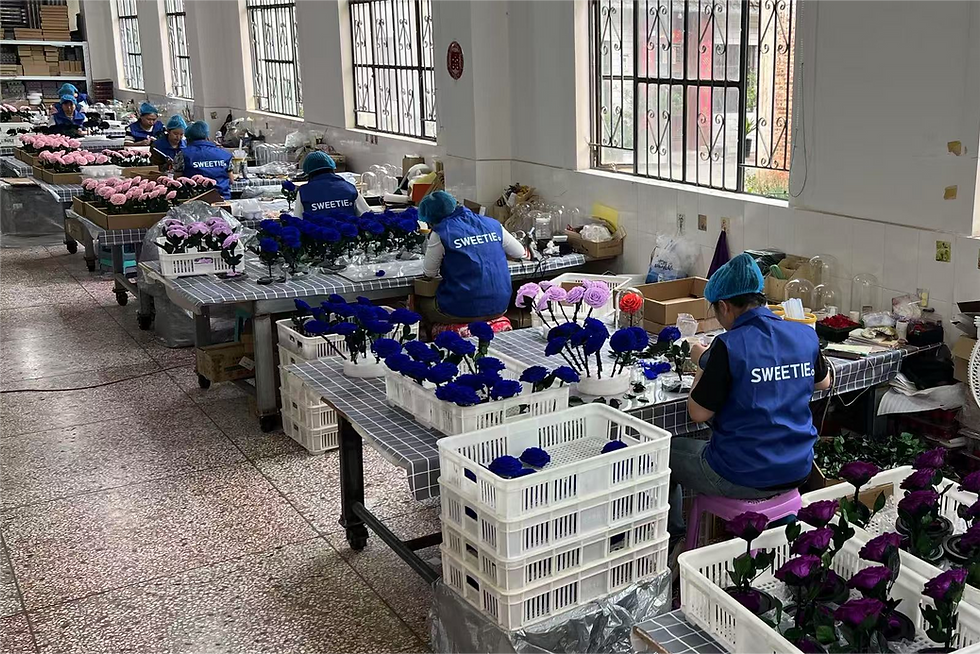
A Simple Supplier Checklist for Amazon-Focused Preserved Flower Bouquets
Before moving forward with a supplier, it helps to ask a few very practical questions.
Product questions
Is the bouquet structure stable enough for parcel shipping?
Is the product clearly defined as preserved, not fresh-cut?
Is the size easy to communicate online?
Does the bouquet look premium in normal lighting, not only in studio styling?
Packaging questions
Is the packaging designed for parcel delivery, not just retail display?
Does it protect flower heads from pressure?
Does it help preserve the bouquet face during shipping?
Does the unboxing experience support the gift value?
Supplier questions
Can the supplier keep the delivered look consistent across production?
Can they support bouquet adjustments for online channels?
Do they understand the gap between a sample and an e-commerce repeat order?
Can they support OEM/ODM and smaller trial quantities?
These are not glamorous questions. But they are usually the questions that separate a smooth product launch from a frustrating one.
Final Thoughts
Preserved flower bouquets can do very well on Amazon. That much is clear.
But this is not a category where success should be measured by clicks alone, or even by early sales alone. The stronger measure is whether the delivered product keeps the promise the listing made. That is where complaints shrink, reviews improve, and repeat business becomes more realistic.
In this category, customer experience is shaped by a chain of decisions:product definition, bouquet structure, material balance, packaging design, and visual communication.
When those decisions work together, preserved flower bouquets can feel elegant, giftable, and commercially strong.
When they do not, even a promising product can lose trust faster than it should.
Sweetie-Gifts has more than 19 years of floral gift industry experience, supports OEM/ODM development, and is familiar with the production schedules and mail-order packaging needs of e-commerce customers. If preserved flower bouquets are part of your online product plan, contact sales@sweetie-group.com to discuss bouquet development, packaging options, and practical next steps.

CEO of Sweetie Group


Comments