


How to Scale Floral Gifts in Grocery and Supermarkets: Lessons from Alibaba's Freshippo Garden


If you’ve ever tried to grow flowers inside a supermarket business, you already know the uncomfortable truth: flowers don’t fail because customers don’t like them. Flowers fail because retail systems hate uncertainty.
Shrink is unpredictable. Color varies. Packaging gets scuffed. A “pretty” display collapses the moment a busy store associate restocks it in a hurry. Then the category gets labeled “too risky,” and the planogram space quietly goes back to snacks.
Over the last few years, I’ve watched Freshippo (Hema) take the opposite path. They treated floral as a real category with a real operating system, not a seasonal decoration. And through Freshippo Garden, they built a model that can scale across many stores because the work happens upstream: product structure, packaging engineering, seasonal cadence, and execution simplicity.
I’m writing this for supermarket and new retail teams outside China who want the same outcome: a floral category that is repeatable, giftable, and operationally predictable.
What “scalable” actually means in floral retail
In grocery and mass retail, “scalable” doesn’t mean you can source more stems. It means you can roll out across dozens or hundreds of doors and still hit the same basics:
Predictable shrink and damage rates
Reliable display life (the product still looks like the photo after transport, handling, and lighting)
Simple store execution (no special training, no fragile rework)
Seasonal readiness (launch dates and replenishment don’t drift)
A clear price and gifting ladder (so customers can decide fast)
Freshippo Garden’s success, in my view, comes from designing for those five realities from the beginning.
If you’re building or fixing a floral gift program and want a quick, practical benchmark for timelines and packaging, email me at sales@sweetie-group.com. I’ll share what “retail-ready” usually looks like before you spend a quarter learning it the hard way.

The quiet engine behind Freshippo Garden: two tracks, one system
A scalable floral category usually needs two tracks that work together:
Everyday flowers (high frequency, fast turns, freshness-driven)
Seasonal floral gifts (project-driven, display-driven, margin-driven)
When retailers only run the first track, flowers stay “nice” but fragile as a business. When they add the second track, floral becomes a dependable seasonal sales driver, because gifting behavior is more predictable than daily self-purchase.
This is also where preserved flowers earn their place. Preserved is not “better than fresh.” It’s simply more controllable for certain retail missions, especially seasonal gifting.
Fresh vs preserved: a retail decision, not a floral debate
Here’s a simple way I think about it when I’m planning holiday assortments with retail teams.
Retail need | Fresh flowers tend to win when | Preserved floral gifts tend to win when |
Turn speed | You want quick rotation and daily demand | You want a longer selling window |
Risk tolerance | Stores can manage freshness and shrink | You need predictable condition on arrival |
Labor reality | Associates can maintain displays frequently | You need “unbox and sell” simplicity |
Gifting behavior | Shoppers want that just-bought freshness signal | Shoppers want keepsake value and packaging |
Logistics | The chain can support cold-chain handling | You want easier transport and shelf stability |
Seasonal planning | You can react in-season | You want to build early and ship in waves |
That table sounds simple, but it prevents a lot of expensive mistakes. I’ve seen retailers try to force fresh into roles where preserved is structurally safer, and then conclude “floral gifts don’t work.” In reality, the format didn’t match the job.
What Freshippo got right: flowers treated like a seasonal project
Most supermarket teams treat floral like a department. Freshippo Garden treated seasonal floral like a project calendar.
That difference shows up in how decisions get made:
You plan backward from shelf date.
You lock packaging early because packaging is what protects margin.
You design the product as a unit that survives the real world: transport, stocking, customer handling, and bright retail lighting.
You keep store execution simple enough that it survives a Friday night rush.
From my side, this project mindset is exactly how we’ve supported Freshippo Garden. Across major marketing holidays throughout the year, the shared goal has been consistent: build giftable floral products that look great on shelf and arrive in stable condition at scale.
The most underrated lever: packaging that reduces chaos
If I could say one thing to every supermarket buyer, it’s this: in floral gifts, packaging isn’t decoration. Packaging is loss prevention.
In retail, the product’s “truth” is what arrives at the store and what still looks good after handling. That truth depends heavily on:
Scratch resistance and dust resistance (especially for display boxes)
Internal fixation so flower heads do not touch walls or lids during transit
Shelf-ready structure that protects the product and speeds stocking
Clear visibility so customers understand value in seconds
When packaging is engineered properly, you don’t need hero-level store staff to keep the category looking premium. That’s when floral stops being fragile and starts behaving like a real seasonal program.
If you’re evaluating a floral gift program for Valentine’s season, Mother’s Day, or year-end holidays, send a note to sales@sweetie-group.com. I can share a packaging and merchandising checklist that retail teams use to reduce damage and simplify store execution.

The “three red lines” for retail-ready floral gifts
Over time, I’ve learned there are three deal-breakers that decide whether a floral gift program scales or stalls.
1) Store execution must be simple
If the product requires careful assembly, constant repositioning, or delicate touch-ups, it will fail in busy stores. The best seasonal floral gifts behave like this:
Open carton
Place on shelf or PDQ
Face forward
Done
Simple wins, especially across large chains where execution varies by store.
2) Quality must be consistent enough to build trust
In floral, customers are buying with their eyes. Retail teams need confidence that what ships matches what marketing approved. That means managing predictable variables:
color consistency within acceptable range
stability of attachments and accessories
presentation consistency across production lots
This is less about “perfect” and more about “reliable.” Reliable is what lets retailers reorder without fear.
3) The design must be mass-producible without losing the idea
Some floral concepts look beautiful in a studio and fall apart in production. If a design can’t be built repeatedly with stable outcomes, it will become a customer service problem. A scalable retailer makes mass production feasibility part of the design brief, not an afterthought.
A copyable playbook for supermarkets outside China
If you’re a supermarket, convenience chain, or quick-commerce retailer, here’s a practical framework you can copy without needing Freshippo’s scale.
Step 1: Build a seasonal calendar with two product roles
For each holiday, define:
Hero gifting items (higher perceived value, stronger packaging, stronger storytelling)
Companion add-ons (small footprint, quick decision, easy to display)
Don’t overcomplicate it. Two roles are enough to create a real “basket,” which is what supermarkets need.
Step 2: Choose formats that match your operational reality
If your stores struggle with shrink, labor, or display maintenance, lean harder into preserved floral gifts during peak seasons. If your chain has strong store execution and fresh handling, keep fresh as the everyday traffic driver.
The win is not choosing one forever. The win is matching the format to the job.
Step 3: Engineer the packaging before you scale
Before you roll to 100 stores, solve packaging like you mean it:
drop and vibration protection for logistics
scratch resistance for display
clear visibility and quick-shop communication
minimal store handling steps
When packaging is right, everything downstream becomes easier: stocking, customer experience, and returns.
Step 4: Treat seasonal floral like a program, not a one-off
Retail doesn’t reward one-time creativity. It rewards repeatable programs that get sharper every season.
A good seasonal program has a feedback loop: what sold, what got damaged, what stores struggled with, what customers reacted to. That loop is how you compound results instead of restarting every holiday.
Where Sweetie fits into this story
Rather than talk about us, let me be specific about what we actually do when we support programs like Freshippo Garden.
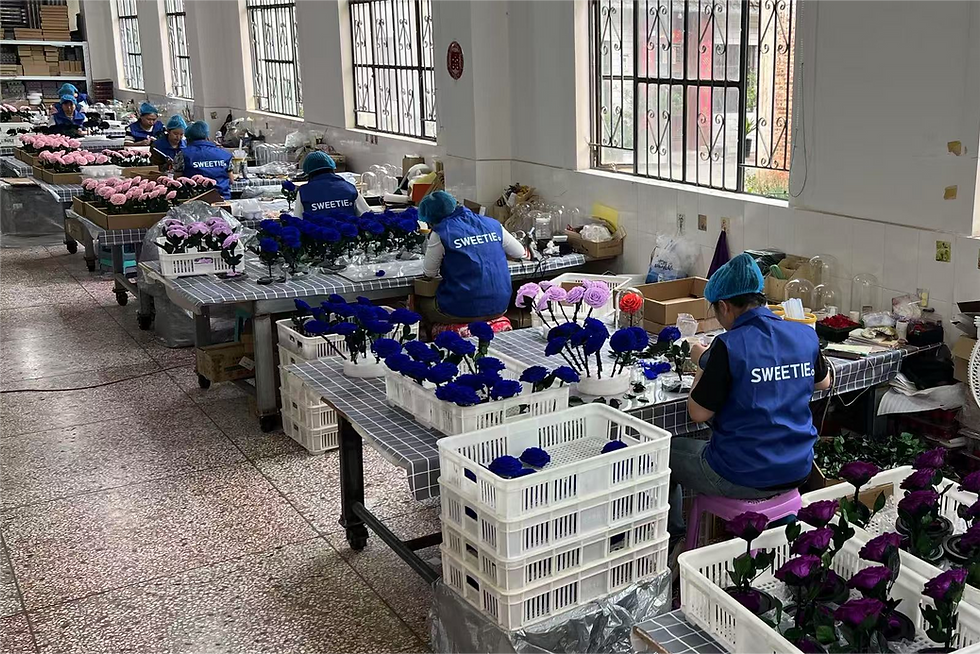
Sweetie-Gifts operate like a retail product development and delivery partner: product design support, packaging engineering, sampling, and mass production execution. Our job is to help retail teams launch seasonal floral gifts that look premium on shelf, survive logistics, and scale across stores without turning into a labor headache.
If you want to explore a seasonal floral gift program for your chain, the simplest next step is to email sales@sweetie-group.com with your target holidays, your channel type (supermarket, convenience, gift, e-commerce), and your rough price ladder. I’ll reply with a realistic starting approach and what information we usually need to move fast.
CEO of Sweetie Group


Comments