


Luxury Retail Case Study: Jo Malone’s Valentine’s In-Store Experience Strategy


Valentine’s season is always a stress test for luxury retail. Traffic rises, gifting urgency spikes, and every brand is fighting the same invisible battle: turning a purchase into a moment that feels personal, elevated, and worth remembering.
What I found especially instructive about Jo Malone London’s Valentine’s approach is how deliberately it was built as an in-store experience strategy rather than a one-day promotional push. The brand treated February like a sequence of reasons to visit, anchored by a single, highly photogenic gifting ritual: the “Everlasting Roses” presentation.
This article breaks down the structure, why it worked as a luxury experience, and what brand and retail experience teams can borrow without copying any one brand’s aesthetic.
Campaign snapshot
Jo Malone’s February programming (as communicated through its public events calendar and store-level messaging) centered on a few consistent ideas:
A gifting ritual that visually transforms a product into a finished present (not just “wrapped”).
Personalization services that add value without changing the core product assortment.
A calendar of experiences that extends Valentine’s beyond a single peak weekend.
A retail-friendly use of everlasting/preserved roses as a presentation element—designed to be repeatable across stores.
One sentence summary: Jo Malone turned gifting into a repeatable in-store ritual—then reinforced it with scheduled experiences that kept February feeling active, not “over after February 14.”
The strategy in one sentence
Jo Malone designed a luxury experience around a simple rule: make the gift presentation itself the star—then use timed in-store services to create multiple reasons to return.
That sounds straightforward, but it’s hard to execute at scale. The details are where this becomes a real case study.

What made the experience feel “luxury,” not promotional
1) A gifting ritual, not just gift wrap
Luxury doesn’t only live in materials; it lives in choreography. The “Everlasting Roses” presentation wasn’t positioned as packaging. It was positioned as a finishing touch—an in-store ritual that signals care, time, and intention.
This matters because it changes how the customer feels about the purchase. Instead of “I bought a product,” the customer walks away thinking, “I created a gift.”
2) A signature visual system customers want to photograph
You can tell when a retail experience was designed with real-world camera behavior in mind. The rose presentation is inherently “complete” in a photo: a strong focal point, clear framing, and a recognizable Valentine’s cue. The result is a natural photo moment that doesn’t rely on customers inventing content ideas.
For retail experience teams, this is the difference between hoping for UGC and designing for it.
3) Personalization as premium service
Hand-painted bottles (and later, experiences like calligraphy) are a classic luxury play because they add meaning rather than adding discount. They also create built-in storytelling: the customer can explain the purchase in a sentence, and the sentence feels elevated.
In practice, personalization works best when it’s treated as a scheduled service, not a last-minute add-on. That approach protects staff bandwidth and keeps execution consistent.
4) A February calendar that creates repeat visits
The most overlooked Valentine’s opportunity is the “before” and “after.” Jo Malone’s February programming essentially created a ramp-up, a peak, and a continuation—each with a slightly different reason to visit (gifting, personalization, wellness, expression). That sequencing is what turns a seasonal moment into a month-long retail strategy.
Where everlasting roses fit into a scalable experience design
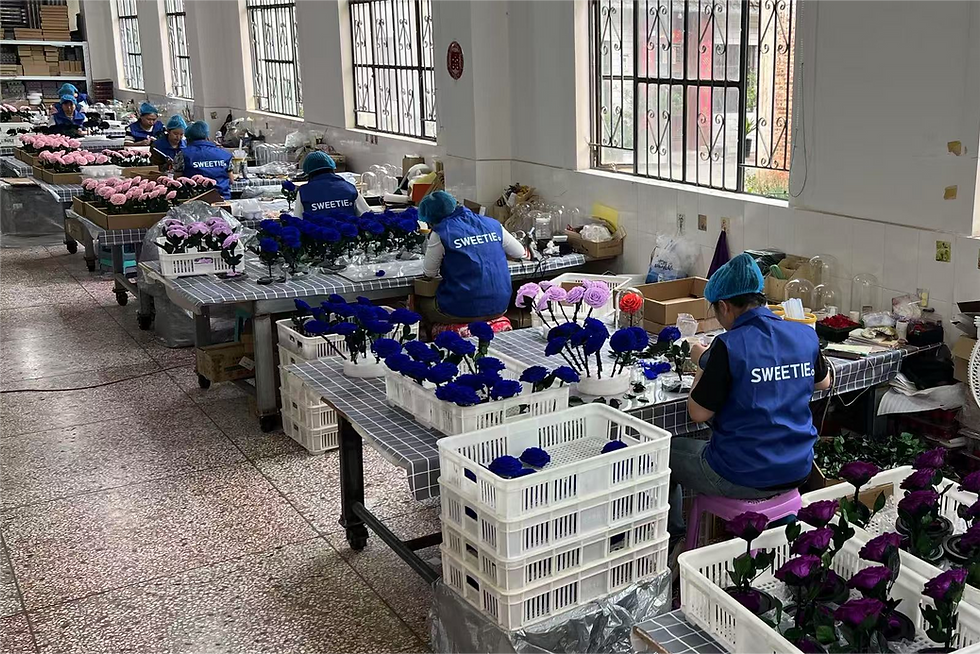
I look at preserved roses through a very practical lens: not as decoration, but as a repeatable presentation module that has to work under real retail constraints—multiple locations, different staff, variable traffic, limited setup time, and strict visual standards.
Here’s why preserved (everlasting) roses are particularly well-suited for luxury retail activations:
Visual consistency
Preserved roses maintain a stable look over the course of the activation, which helps keep displays photo-ready across the full campaign window.
Lower maintenance burden
They support clean, consistent presentation without daily upkeep routines that can vary by store.
Scalable execution
When you need the same experience to feel “the same” across different locations, preserved roses function like a standard component rather than an artisanal variable.
Predictable logistics
Planning is easier when the presentation element doesn’t depend on day-to-day freshness cycles. That predictability supports allocation, replenishment planning, and staff training.
If you’re planning a seasonal activation and want a quick sanity-check on whether a preserved-rose module is feasible for your store network, you can email me at sales@sweetie-group.com. A short note with your store count, target dates, and display format is enough to start a practical conversation.
A simple playbook teams can borrow without copying the brand
When I deconstruct the approach, I don’t see “a rose campaign.” I see a retail experience framework:
Step 1: Define the signature visual module
Pick one hero presentation that:
reads as premium from 6 feet away,
photographs cleanly,
and is repeatable by staff with minimal artistic variance.
Step 2: Add one customer-participation ritual
Examples include:
in-store presentation assembly,
personalization appointments,
a gifting message moment (writing, calligraphy, card rituals).
The goal is to create a “completion moment” the customer remembers.
Step 3: Build a calendar, not a single date
Instead of one peak day, schedule multiple mini-peaks with different reasons to visit. Even simple programming creates rhythm.
Step 4: Engineer for execution
This is where many beautiful concepts stall. The activation must come with:
a clear SOP,
a time-per-transaction target,
staffing guidelines,
packaging/transport protection,
and replenishment logic.
If you only design the concept, you get variation. If you design the system, you get scale.
One clean way to visualize the February approach
A single table can help clarify why this felt like a strategy, not a one-off:
February focus | In-store purpose | Customer takeaway |
Early February gifting presentation (Everlasting Roses) | Make gifting instantly “finished” and photo-ready | “This looks like a luxury gift the moment I buy it.” |
Personalization weekend (Beautiful Bottles) | Add premium meaning without changing product assortment | “This is mine (or theirs), not just another bottle.” |
Valentine’s peak (Roses Rendezvous) | Reinforce emotion and experience during the highest-intent window | “This feels like an occasion, not an errand.” |
Post-peak programming (Wellness / Calligraphy) | Extend momentum and invite repeat visits | “There’s still a reason to come back.” |
Execution details that often decide success
If I had to distill the operational lessons for retail experience teams, they would look like this:
Standardize the visual module: placement rules, density, and the “finished look” should be easy to replicate.
Protect speed: the ritual must fit the reality of peak-day traffic; otherwise, consistency collapses under pressure.
Clarify thresholds and availability: if there’s a qualifying purchase requirement or limited supply, the language should be consistent so customers don’t experience different rules store-to-store.
Plan replenishment like a retailer, not an event planner: stores need confidence that the experience can run the full advertised period.
Train for the photo moment: small details (clean background, consistent orientation, presentation angle) dramatically affect shareability.
What brand and retail experience teams can take away
Design the photo moment first, then build the purchase path around it.
Use premium services to add value without discounting.
Make the activation modular so it can travel across stores.
Extend Valentine’s beyond one day with a calendar of reasons to visit.
Treat materials as part of the experience system, not as decoration.
If you’re building a Valentine’s (or Mother’s Day) gifting experience and want help stress-testing the execution side—especially consistency, packaging protection, and scale—email sales@sweetie-group.com. I’m happy to share practical considerations that teams often uncover only after the first rollout.
FAQ
What makes an in-store gifting ritual feel premium?
A premium ritual has a clear “before and after.” The customer can see the transformation, and the final presentation looks intentional, not improvised.
How do you keep a seasonal display consistent across stores?
Consistency comes from a modular design, a simple SOP, and realistic time requirements for staff during peak traffic.
What’s a realistic lead time for a preserved-rose retail activation?
Lead time depends on the display format, customization, and volume. For multi-location rollouts, the planning phase is often just as important as production time.
How can brands add value without discounting during Valentine’s?
Scheduled personalization and gifting services are a proven path because they add meaning and experience, not price reduction.
What display formats work well for department store counters?
Compact, photo-friendly modules with clear boundaries and low maintenance demands tend to perform best in high-traffic counter environments.
CEO of Sweetie Group


Comments