


Preserved Flower Decor: What It Includes, How It’s Made, and What Matters in Supply


Finding attractive preserved flower decor is usually the easy part.The harder part is knowing which products can actually be customized well, protected in transit, and supplied consistently.
That is why this category deserves a closer look.
preserved flower decor refers to finished decorative products made with preserved flowers rather than loose floral materials. The category can include tabletop pieces, glass dome arrangements, boxed floral designs, wall or hanging decor, and seasonal decorative items. It is broader than a single gift product and more product-focused than preserved flower materials sold for floral design.
What preserved flower decor usually includes
One reason this keyword is often misunderstood is that it covers a broad range of finished products. It does not refer to one standard item. Instead, it usually describes preserved flower products that are ready for display, gifting, retail presentation, or decorative use in interior settings.
A useful way to define the category is this: preserved flower decor begins when preserved flowers are turned into a finished visual product with a clear structure, presentation format, and decorative purpose.
That distinction matters. Loose preserved roses, hydrangeas, moss, and filler flowers are materials. Decor is the finished product created from those materials.
In practice, preserved flower decor often includes:
table and shelf decor
glass dome floral pieces
boxed floral arrangements
wall or hanging floral decor
seasonal and themed decorative items
At Sweetie, preserved flower decor is approached as a product category rather than a single item. Product development typically starts with format, presentation, and manufacturability, not just flower selection.
If you are comparing preserved flower decor ideas and want input from a manufacturer, feel free to email us at sales@sweetie-group.com.

The most common product forms in this category
Because preserved flower decor is a wide category, it helps to look at the most common product forms one by one.
This is one of the most familiar formats. Small arrangements, compact centerpieces, and decorative floral accents designed for desks, counters, shelves, or side tables all fall into this group.
These products may look simple, but they often require careful control in production. Proportion, flower height, visual balance, and finishing details all affect whether the product feels polished or ordinary.
Glass dome floral decor
Glass dome designs are one of the clearest examples of preserved flowers becoming structured decor products.
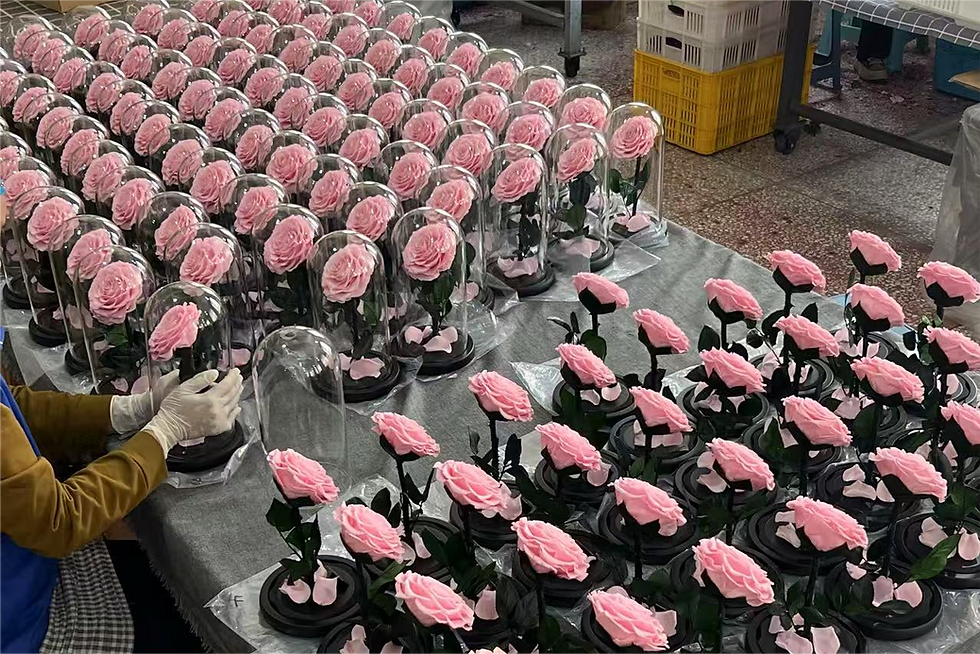
A dome arrangement is not simply flowers placed under glass. It depends on stem fixation, spacing, visual height, internal balance, and packaging protection. A strong design must still hold its shape after handling, packing, and shipping.
This format is especially useful in understanding the category as a whole: a design only becomes a real product when it can survive real-world conditions.
Boxed floral decor
Flower boxes are often treated only as gift products, but many of them also belong in preserved flower decor because they are structured decorative items with a defined form, composition, and presentation logic.
A well-developed floral box depends on more than the flowers inside it. Box depth, bloom placement, filler proportion, color contrast, and opening presentation all contribute to the final result. A flower box can feel premium and intentional, or flat and generic, depending on these details.
Wall or hanging floral decor
This is a smaller but meaningful part of the category. Preserved flower decor can include framed floral pieces, hanging decor, and other wall-based decorative applications.
These products require a different kind of product planning. Weight, attachment method, shape retention, and long-term visual stability become more important than they are in tabletop formats.
Seasonal and themed decorative pieces
This is where the category becomes especially adaptable. Preserved flower decor is not limited to classic floral styling. It can also be developed around seasonal themes, color stories, holiday concepts, mascots, symbolic accessories, and branded presentation.
That flexibility is one reason the category continues to perform well across different markets. It can stay visually recognizable while still adapting to different product directions.
Why preserved flower decor is more than a visual product
A great deal of content about preserved flowers focuses on appearance alone. Color, beauty, sentiment, and atmosphere are all important. They are also only part of the story.
From a manufacturing perspective, preserved flower decor is not just a visual concept. It is a finished product system.
That means several practical questions matter just as much as appearance:
Can the structure remain stable after shipping?
Can the approved sample be reproduced consistently?
Can the packaging protect the product without damaging presentation?
Can the product be assembled efficiently without losing quality?
These questions are what separate a visually appealing sample from a commercially workable product.
In this category, beauty still matters. It simply has to work together with structure, protection, and repeatability.

What can actually be customized
Customization is one of the strongest advantages of preserved flower decor, but it is also one of the easiest areas to oversimplify.
The most accurate answer is not “everything can be customized.”A better answer is that different parts of the product can be customized in different ways, with different effects on timeline, structure, and repeatability.
Flower varieties and color palette
Color is usually the most flexible part of the product.
Main flowers, supporting flowers, filler materials, and overall tone can often be adjusted to match a seasonal story, a product concept, or a brand direction. Even small color changes can create a very different product mood.
Containers and structural format
This is where customization becomes more technical.
Changing a dome base, box size, tray depth, vessel shape, or display format often affects more than appearance. It can change assembly steps, shipping stability, carton layout, and production efficiency.
A product that looks only slightly different to the eye may behave very differently in development and production.
Decorative accessories and theme details
Accessories often define the commercial identity of the product.
Ribbons, tags, cards, symbolic elements, acrylic pieces, jewelry pairings, holiday icons, and branded inserts can all shift the story of a preserved flower decor design. In many projects, these details are what move a product from generic floral decor into a more distinctive product line.
Packaging and presentation
Packaging is often underestimated in this category.
It does not only protect the product. It also frames the product. It affects first impression, perceived quality, and unboxing experience. In preserved flower decor, packaging is part of presentation, not just a shipping requirement.
If you would like to discuss customization, packaging, or sampling, contact us at sales@sweetie-group.com.
What affects quality in preserved flower decor production
Quality in preserved flower decor depends on more than the flower itself. In finished products, several factors work together to shape the final result.
Production factor | Why it matters |
Raw material selection | Affects texture, bloom condition, and overall consistency |
Color consistency | Keeps product lines visually uniform |
Structural fixing | Helps the product stay stable during handling and transport |
Handcrafted detail control | Maintains finishing quality across repeated production |
Packaging protection | Preserves presentation after shipment |
Raw material selection
Strong finished decor begins with stable materials. Flower condition, stem strength, filler quality, moss cleanliness, and accessory compatibility all affect the final product.
Color consistency
This becomes especially important in repeated production.
A preserved flower decor line often depends on visual harmony. If one unit leans warmer or cooler than another, the overall presentation becomes less cohesive. That difference may be acceptable in a one-off handmade item, but it becomes far more visible in a product line.
Structural fixing
This is one of the most important and least visible parts of the product.
A flower head that shifts, a tilted stem, or a loose decorative element can make a finished piece feel unstable even when the flowers themselves are beautiful.
Handcrafted detail control
Preserved flower decor usually retains a handcrafted character, and that is part of its appeal. But handmade should never mean uncontrolled.
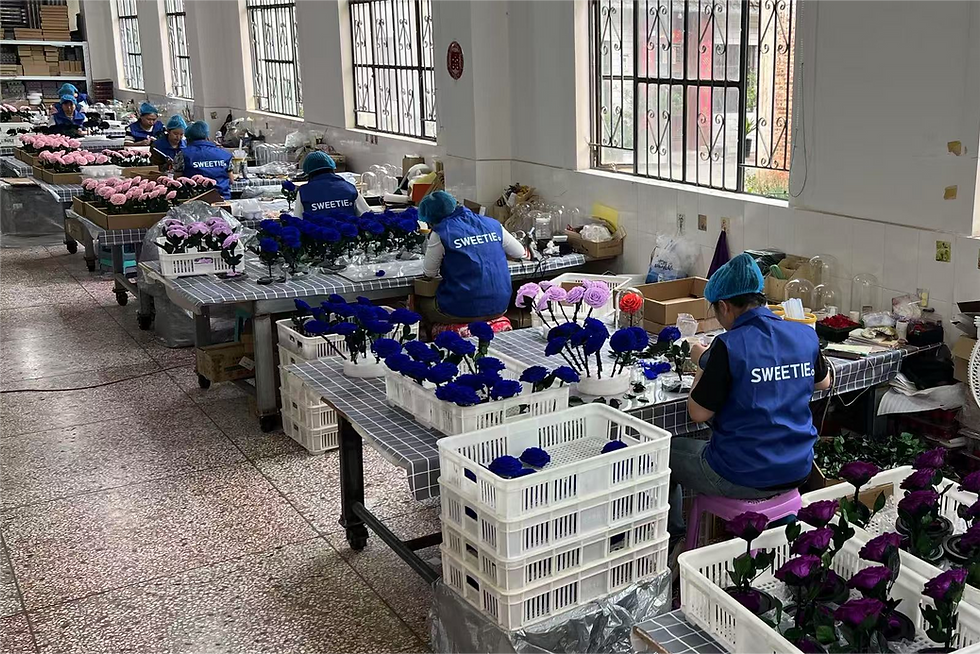
Strong handmade production depends on clear standards, trained assembly, and consistent finishing references. Without those controls, even a good design can become uneven in repeated orders.
Packaging protection
This is often where product quality is proven.
A preserved flower decor piece that looks refined in a sample but arrives damaged, misaligned, or dusty is not a successful product. In this category, arrival condition is part of product quality.
What makes supply stable in this category
Many people search for products first, but the deeper question is usually about supply.
A preserved flower decor sample may look attractive. The more important question is whether the design can be repeated, protected, and delivered consistently without losing the qualities that made it attractive in the first place.
Several factors usually determine supply stability.
Sample-to-production consistency
An approved sample should be the starting point for production, not an unrealistic showpiece that cannot be repeated.
Capacity for repeat orders
Supply stability depends in part on whether the producer is structured for repeatable manufacturing rather than one-off assembly.
Cross-functional coordination
Preserved flower decor often involves more than one workflow at the same time: product development, sourcing, assembly, packaging, quality inspection, and shipment. Stable execution depends on how well those steps are coordinated.
Seasonal timing pressure
This category is often influenced by gifting seasons, event cycles, and retail timing. Lead time control matters because demand spikes can affect both availability and consistency if the workflow is not prepared.
How we approach preserved flower decor at Sweetie
At Sweetie Gifts, preserved flower decor is developed as a combination of floral design, product structure, handcrafted assembly, and supply planning.
That approach matters because preserved flowers do not become decor simply by being placed in a container. A successful decor product usually requires decisions about format, composition, presentation, packaging, and repeatability from the beginning of development.
In practical terms, this means balancing three things at the same time:
visual appeal
manufacturability
supply stability
Some projects require stronger standardization for repeat orders. Others need more flexibility for customization, seasonal variation, or branded presentation. The right approach depends on the product goal, but the development logic remains the same: a design is only commercially useful when it can be made well, protected well, and supplied well.
If you need some samples, please email us at sales@sweetie-group.com.
Final thoughts
Preserved flower decor is not a single product. It is a category shaped by design, structure, handcraft, and supply capability.
That is why the most useful questions go beyond appearance. Product type, customization range, packaging, consistency, and supply stability all matter when evaluating this category.
A beautiful sample is a good start. A well-developed product is something more.
If you are exploring preserved flower decor and would like to discuss product ideas, customization, or sampling, please email us at sales@sweetie-group.com.
CEO of Sweetie Group


Comments