


Plush Flowers vs. Fabric Flowers vs. Artificial Flowers: Which Type Fits Your Project?
- Annie Zhang

- Nov 18, 2025
- 6 min read
Updated: Jul 24

Not all artificial flowers are designed for the same purpose.
A soft plush flower displayed at a pop-up shop serves a different role from a realistic fabric rose used in wedding décor. A molded plastic flower installed in a commercial space has different advantages again.
The terminology can be confusing because plush flowers and fabric flowers are both technically types of artificial flowers. For a practical comparison, this article separates the category into three common product groups:
Plush flowers, made with soft, dimensional textile components
Traditional fabric flowers, made mainly with thinner textile petals
Plastic or PU artificial flowers, made with molded or formed components
The right option depends on the required appearance, customer interaction, display environment, customization, and packaging.
What Are the Three Flower Types?
Plush Flowers
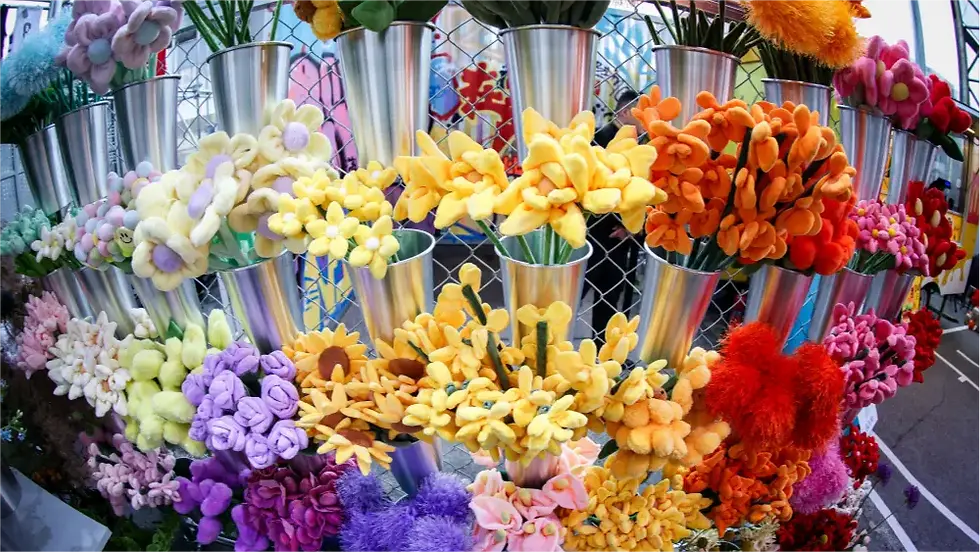
Plush flowers are soft textile flowers made with fabric petals, leaves, flower centers, and supported stems.
Some designs include filling in selected areas to create volume. Others rely on fabric structure, stitching, folding, and shaping.
They are often sold as individual flowers, mixed into bouquets, or developed as gift sets, event merchandise, and branded collections. Their appearance may be realistic, playful, oversized, or sculptural.
Plush flowers are especially suitable when the product is intended to be touched, selected, carried, or kept as a gift.
Traditional Fabric Flowers
Traditional fabric flowers usually use thinner woven, coated, printed, or pressed textile petals. They are often called silk flowers, although many are actually made from polyester, nylon, or other synthetic fabrics.
These flowers commonly focus on botanical detail and realistic floral presentation. Petal shapes, color gradients, veins, curved edges, and flexible stems help them blend into conventional arrangements.
They are widely used for weddings, interiors, window displays, floral styling, and seasonal decoration.
Plastic or PU Artificial Flowers
Plastic or PU artificial flowers use molded materials for petals, leaves, flower centers, stems, or supporting components.
The quality range is wide. Basic products may have visibly molded surfaces, while premium real-touch flowers can use PU, foam, coated textiles, and mixed materials to achieve a softer and more realistic effect.
These flowers are often selected for long-term displays, commercial decoration, structured installations, and environments where shape stability or easy cleaning is important.
Key Differences at a Glance
Feature | Plush flowers | Traditional fabric flowers | Plastic or PU flowers |
Surface and touch | Soft, tactile, dimensional | Light, thin, fabric-like | Firm to soft, depending on material |
Typical appearance | Playful, gift-oriented, sculptural | Realistic, elegant, decorative | Structured, detailed, sometimes real-touch |
Common formats | Individual flowers, bouquets, gifts, event items | Bouquets, arrangements, wedding and interior décor | Commercial displays, installations, permanent décor |
Main customization | Shape, fabric, color, label, packaging | Color, print, pressing, stem, leaf, arrangement | Mold, color, finish, size, and components |
Main packing concern | Compressed flower heads and bent stems | Creased or crushed petals | Scratches, broken parts, bulky components |
Best commercial fit | Retail gifts, pop-ups, events, branded projects | Weddings, interiors, floral styling | Long-term decoration and structured displays |
No type is automatically better. The best choice is the one that fits the project’s commercial purpose.
Which Type Works Best for Retail and Gifting?
Plush flowers are often the strongest option when the flower itself is the product.
Their soft surface encourages handling, and different flower types can be displayed individually for selection. Stores can sell one flower as a small gift or allow several flowers to be combined into a personalized bouquet.
They also support branding through:
Printed or embroidered labels
Custom colors
Bouquet sleeves
Gift cards
Boxes and retail displays
Traditional fabric flowers are more suitable when the main goal is decorative styling. They can be used around gift packaging, in store displays, or as part of larger floral arrangements.
Plastic or PU flowers are useful for permanent visual merchandising, especially when the display needs a stable form or a surface that can be cleaned regularly.
For current plush flower styles and custom options, contact sales@sweetie-group.com.
Which Type Works Best for Events?
The answer depends on whether the flowers are merchandise, decoration, or both.
Pop-Ups and Interactive Events
Plush flowers work well for flower-market-style pop-ups, brand activations, product launches, and creative events.
Visitors can select flowers by type or color, build bouquets, and take the product home. The merchandise becomes part of the event experience rather than simply decorating the venue.
Custom labels, cards, wrapping, and color palettes can connect the products to the event identity.
Backdrops and Floral Styling
Traditional fabric flowers are often more practical for arches, table arrangements, photo areas, and decorative installations. Their lighter petals and conventional floral appearance allow them to blend into larger arrangements.
Structured or Long-Term Installations
Plastic or PU flowers may be suitable for displays that need defined shapes or longer installation periods.
Outdoor use should never be assumed from the material name alone. UV exposure, moisture, temperature changes, color stability, metal corrosion, and adhesive performance should be confirmed for the specific product.
Which Type Works Best for Weddings and Interiors?
Traditional fabric flowers remain a practical choice for weddings, hotels, restaurants, window displays, and home decoration.
They can create realistic arrangements without the short lifespan of fresh flowers. Their flexible stems are useful for bouquets, arches, centerpieces, and wall installations.
Premium plastic or PU components may be added where more detailed flower centers, leaves, or real-touch surfaces are required.
Plush flowers can also be used in weddings and interiors, but the result is different. They are more suitable when the project deliberately wants a soft, artistic, colorful, or playful style rather than conventional floral realism.
How to Choose the Right Flower Type
1. Define the Product’s Role
First decide whether the flower will be:
Sold as a gift
Used as event merchandise
Installed as decoration
Added to another product
Displayed for a long period
A flower selected as merchandise needs attractive branding and packaging. A flower used only for decoration must perform well from the expected viewing distance.
2. Choose the Desired Look and Touch
Plush flowers suit projects that need softness, visual impact, and tactile appeal.
Traditional fabric flowers suit realistic floral styling and lightweight arrangements.
Plastic or PU flowers suit projects requiring stable shapes, detailed molded surfaces, or selected long-term applications.
3. Consider How the Product Will Be Handled
Products displayed for customers to touch and choose need durable assembly and a surface that remains presentable after handling.
Decorative flowers may be viewed but rarely touched. Installation products may need to tolerate cleaning, movement, or longer display periods.
4. Review Packaging Before Approval
Packaging can change how the product looks when it arrives.
Plush flower heads may be compressed. Thin fabric petals may crease. Molded components may scratch or break.
Before confirming a product, check:
Flower recovery after unpacking
Stem movement inside the carton
Petal or surface damage
Packing density
Storage conditions
Preparation required before display
A good sample is not enough if the product cannot survive normal packing and delivery.
How Sweetie Supports Floral Product Projects
Sweetie-Gifts develops floral gifts through its “Flower + Everything” approach. Our experience covers plush flowers, preserved flowers, soap flowers, crochet flowers, rose bears, and customized gift combinations.
For plush and textile flower projects, support can include:
Product and flower-shape development
Color and material selection
Sampling
Printed or embroidered labels
Bouquets, baskets, pots, and boxed gifts
Retail and event presentation
E-commerce packaging
Bulk production inspection
Sweetie’s strength is not based on claiming that one material is always superior. We help match the flower structure, appearance, packaging, and branding to the intended sales channel.
A plush flower program for an interactive pop-up needs a different solution from a realistic floral arrangement for an interior project. A branded gift set also requires different labels and packaging from a large decorative installation.
For product selection or custom development support, send your requirements to sales@sweetie-group.com.
Frequently Asked Questions
Are plush flowers a type of artificial flower?
Yes. Artificial flowers are a broad category that includes textile, plastic, PU, paper, foam, and mixed-material products. Plush flowers are a textile-based subtype with a soft, dimensional surface.
What is the difference between plush flowers and silk flowers?
Plush flowers use thicker, softer materials and are often developed as tactile gifts or event merchandise. Silk-style flowers usually use thinner textile petals and focus more on realistic arrangements and decoration.
Which flower type is best for events?
Plush flowers suit interactive events and take-away merchandise. Traditional fabric flowers work well for floral styling and backdrops. Plastic or PU flowers may suit structured or longer-term installations.
Which type is easiest to customize?
All three types can be customized, but the process differs. Plush and traditional fabric flowers often use changes in fabric, pattern, color, and labels. Plastic or PU flowers may require new molds, finishes, or component development.
Final Thoughts
Plush flowers, traditional fabric flowers, and plastic or PU artificial flowers serve different commercial purposes.
Plush flowers are suitable for tactile gifting, interactive retail, events, and branded merchandise. Traditional fabric flowers support realistic floral styling, weddings, and interiors. Plastic or PU flowers provide structured forms for selected commercial and long-term displays.
The right choice should be based on the product’s role, appearance, handling, environment, packaging, and customization needs.
For a product catalog or help selecting the right floral format, contact sales@sweetie-group.com.

CEO, Sweetie-Gifts


Comments