


Magnificent Roses Brand Analysis: Why 1-800-Flowers Built a Preserved Rose Line

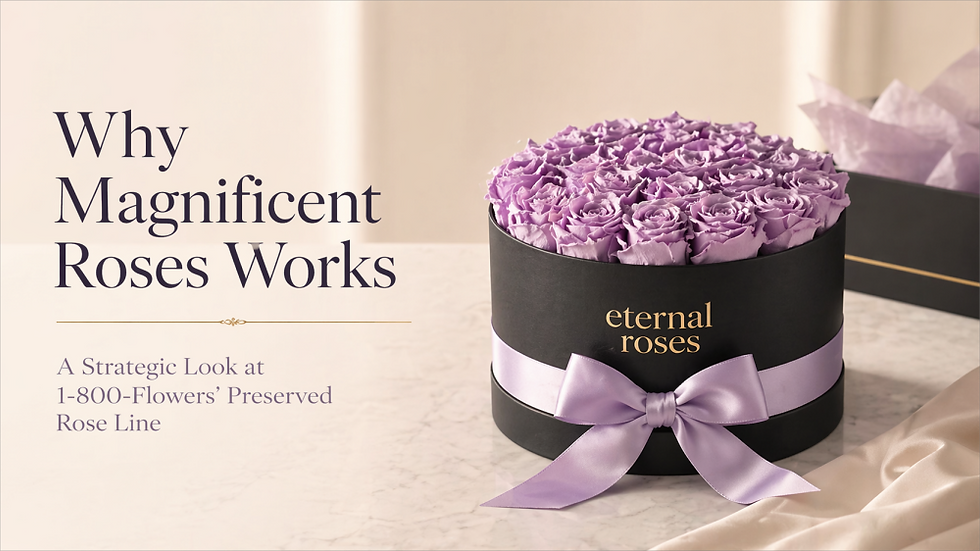
Many floral gifting brands sell preserved roses. That alone is not especially interesting.
What makes Magnificent Roses worth studying is that it does not feel like a simple preserved-flower add-on. It feels like a line built to do a very specific job inside a much larger gifting business. Instead of treating preserved roses as just another premium floral option, 1-800-Flowers appears to have shaped them into a more structured gift language—one that still speaks through flowers, but behaves more like a keepsake system.
That distinction matters more than it may seem.
Once preserved floral is treated as a gift system rather than a side category, the logic changes. The products are no longer just flowers in different containers. They become part of a more carefully managed emotional pathway. Assortment becomes more selective. Packaging becomes more strategic. Color starts carrying more meaning. Personalization becomes easier to integrate. The line begins to do more than expand choice. It starts to shape how the gift is understood.
That is why Magnificent Roses deserves a closer look.
Why Magnificent Roses Is Worth Studying
The strongest reason to pay attention to Magnificent Roses is not that it sells preserved roses well. Many brands do that.
The real reason is that the line appears to have been given a more deliberate role.
Inside the 1-800-Flowers world, Magnificent Roses does not read like a loose category extension. It reads like a bounded format. That makes sense in the context of a business that publicly positions itself as a broader gifting platform spanning floral, gourmet, baskets, and keepsakes, rather than as a florist-only brand.
That broader context changes what preserved floral can become.
In a florist-first business, preserved roses can remain a useful product type. In a gifting platform, they can take on a more strategic role. They can hold onto the emotional clarity of flowers while moving the gift toward something more lasting, more displayable, and more collectible.
That seems to be the role Magnificent Roses plays.
It gives 1-800-Flowers a way to stay inside floral while offering a gift that feels:
more permanent
more object-like
more expressive
more suitable for personalization
more adaptable to different gifting moods
That is not a small upgrade. It is a structural one.
For brands building preserved floral collections, the harder question is rarely how many products to add. It is how to make the line read clearly as a gift system. That is exactly the kind of product conversation that often starts at sales@sweetie-group.com.

Where Magnificent Roses Fits in the 1-800-Flowers World
Fresh flowers are still the emotional center of 1-800-Flowers. That is part of what makes Magnificent Roses so smart.
The line does not compete with that center. It extends it.
If the platform only wanted to push customers toward higher-ticket gifting, it had many options. It could move them into gourmet, keepsakes, baskets, or other non-floral categories. But Magnificent Roses does something more elegant. It allows customers to upgrade the gift without stepping outside the language of flowers.
That is the key.
The purchase still feels floral.The symbolism still feels floral.The emotional instinct still begins with flowers.
But the product now behaves differently. It lasts longer. It sits in the room differently. It carries more visual permanence. In some cases, it can also hold message, personalization, or collaboration value in ways that fresh flowers usually cannot.
This is why Magnificent Roses matters inside the 1-800-Flowers ecosystem. It creates an in-category upgrade path. Instead of asking the customer to stop thinking in flowers, it lets the customer stay there—just at a different level of gift meaning.
That is a subtle move, but a powerful one.
A lot of gifting brands can sell a beautiful product. Fewer can create a smooth transition from one emotional level of purchase to another without breaking the category language. Magnificent Roses appears to do exactly that.
A Curated System, Not a Wide Collection
One of the most revealing things about Magnificent Roses is what it does not try to do.
It does not try to become an endless preserved floral universe. It does not chase total category coverage. It does not seem interested in turning preserved floral into an overbuilt menu of loosely connected ideas.
Instead, it feels edited. That is one of its strengths.
The publicly visible assortment goes well beyond a standard preserved rose box page. It includes classic rose boxes, statement hearts, petite gifts, message-led styles, centerpieces, bud vases, mixed preserved floral products, personalized keepsake formats, and collaboration-driven pieces. But even with that variety, the line still feels contained.
That is not accidental. A wide collection makes a category easier to shop by product type. A curated system does something else: it makes the line easier to remember as a gift language.
The line seems to revolve around a few clear emotional formats
Statement floral gifts
These are the products closest to the classic premium preserved rose idea: recognizably floral, visually composed, and easy to understand as a strong gift.
Romance-forward expression gifts
Heart-based shapes and direct sentiment-led pieces push the line toward stronger symbolic gifting.
Display-led floral objects
Bud vases, centerpieces, and more décor-like forms move the line away from boxed flowers alone and toward objects that stay present in the room.
Personalized keepsake gifts
Photo-driven, message-driven, and keepsake-box formats deepen the sense that the gift is meant to be retained, not just received.
This is where the line starts to feel more intelligent than a normal assortment. The products are not simply different from one another. They appear to be built around a few repeatable emotional roles.
That is what makes the system legible.
Not broad.Legible.
And in gifting, legibility often matters more than scale.
How It Upgrades the Meaning of Flowers
A lot of preserved floral analysis stays on the obvious point: preserved roses last longer than fresh flowers.
That is true, but it is not the most interesting thing happening here.
The more useful way to understand Magnificent Roses is to think in terms of moment versus presence.
Fresh flowers are often about the moment. They arrive beautifully. They lift the day. They brighten a room. They are emotionally immediate. That is their power.
Magnificent Roses shifts the gift toward something else. The products are framed as decorative, displayable, and capable of lasting far beyond the delivery moment. The preserved roses page presents them not just as floral gifts, but as centerpieces, decorative pieces, and objects that remain part of the recipient’s environment.
That changes the meaning of the purchase.
The customer is no longer only sending beauty for today. The customer is choosing something that can stay visible and continue carrying emotional value over time.
That shift is bigger than durability. It changes how the gift is perceived:
from fleeting to retained
from arrival-based to presence-based
from floral gesture to floral object
from momentary expression to longer visual memory
This is why separate treatment makes so much sense. Once flowers begin to behave more like keepsakes, the surrounding system matters more. The box matters more. The finish matters more. The message matters more. The display context matters more.
Magnificent Roses does not simply preserve the flower. It preserves the relevance of the gift.
The Real Design Language Behind the Line
The line’s strongest design move is not floristry-first. It is gift-first.
That is an important distinction, because it helps explain why Magnificent Roses feels commercially coherent.
The preserved roses page emphasizes decorative presentation, stylish containers, heart formats, centerpieces, mini keepsake gifts, and vase-led objects. Even when the product is still recognizably floral, the presentation is often doing as much work as the flowers themselves.
In other words, these products are designed to be recognized as gifts very quickly.
That has implications for everything else.
Color is doing emotional work
Magnificent Roses does not stay only in traditional romance colors. Alongside classic reds and pinks, the line includes more playful or fashion-adjacent directions such as Sorbet, Kaleidoscope, Sparkle Red, and blush or iridescent styles.
These are not just color choices. They are mood choices.
Some colors support romance.Some support celebration.Some feel sweeter, lighter, or more youthful.Some feel more decorative or trend-driven.
That is why this line feels broader than “rose colors.” It is not simply managing a floral palette. It is managing an emotional palette.
Form is doing emotional work too
Shape is not just a packaging decision here.
A heart carries a different emotional script than a hatbox.A bud vase behaves differently from a centerpiece.A petite keepsake gift sends a different message from a large romance statement.
Form changes what kind of gift the product becomes.
That is why the assortment works better when viewed as a set of emotional formats rather than a list of floral products.
Message-led design matters
Products such as “I Love You” and “Beautiful MOM” make another thing clear: Magnificent Roses is not relying only on rose symbolism. It is also using language directly.
That helps the line merchandise by occasion more effectively. Instead of building separate product worlds for every holiday or milestone, the system can shift tone through message, color, and form.
This is often where a preserved floral line becomes much more commercially flexible. The strongest change is not necessarily more product. Often it is clearer emotional coding.

Why Personalization and Collaboration Matter Here
Personalization works especially well in Magnificent Roses because the product already behaves like a keepsake.
That point is easy to overlook, but it matters.
When a product is temporary, personalization can feel decorative. When a product is already meant to stay visible, personalization feels more natural. It deepens what the gift already is.
That is exactly what the current assortment suggests. The preserved roses page includes personalized couple names, personalized love notes, personalized messages, personalized photos, miniature keepsake boxes linked with Personalization Mall, and personalized bud vase formats. These do not feel like unrelated extras. They feel like natural extensions of a line built around preserved emotional value.
Collaboration works in much the same way.
The LoveShackFancy preserved floral products are a strong example. They bring in another visual world, but they still fit inside the same preserved-floral gift logic. They do not break the system. They refresh it.
That is a very efficient model.
Instead of constantly building entirely new product families, the line can renew itself through:
personalization
color updates
sentiment-led phrasing
collaboration aesthetics
occasion-driven refreshes
That is one reason a restrained system can stay alive longer than a bigger one. It has more ways to evolve without losing clarity.
Once preserved floral starts functioning as a keepsake, personalization becomes much more than decoration. For brands exploring that transition in their own assortment, sales@sweetie-group.com is the most direct way to begin the conversation.
What Magnificent Roses Reveals About Modern Gift Strategy
The most useful lesson here is not that preserved roses can be sold as premium gifts. That is already familiar territory.
The more interesting lesson is that preserved floral becomes far more powerful when it is treated as a gift format rather than simply a flower type.
That shift changes the questions a brand asks.
Instead of only asking:
Which products should be added?
Which sizes should be expanded?
Which colors should be offered?
The better questions become:
What emotional role should this line play?
What kind of object should the recipient keep?
How should the assortment signal romance, celebration, memory, or display?
How can the gift become more meaningful without leaving the floral category?
Magnificent Roses points strongly toward that second way of thinking.
A few strategic signals stand out
Strategic signal | What it suggests |
Edited assortment | Clarity can matter more than scale |
Expanded color language | Color can segment mood and occasion |
Object-like formats | Flowers can move toward keepsake behavior |
Personalization-ready products | Sentiment can be deepened naturally |
Collaboration-led refresh | A line can stay current without becoming messy |
One of the smartest things about the model is that it upgrades the gift while preserving category continuity. The customer is still sending flowers. But the flowers now behave more like enduring gifts.
That may be the clearest strategic achievement of the line.
Final Thoughts
Magnificent Roses is worth studying because it shows what happens when a preserved floral line is given a clear job to do.
It is not trying to be the widest preserved floral collection. It appears to be trying to be something more useful: a recognizable, emotionally structured, and carefully edited gift system inside a much larger gifting platform.
That is why the line feels stronger than a typical preserved assortment.
Its strength does not come from scale alone.It comes from structure.It comes from emotional clarity.It comes from knowing what kind of gift it wants flowers to become.
That may be the most important takeaway of all. Strong gift systems are not built by adding more products at random. They are built by shaping a clearer emotional structure around the products that matter most.
For brands planning preserved floral gifts, personalized keepsakes, or branded seasonal programs, sales@sweetie-group.com is the right place to continue the conversation.
CEO of Sweetie Group


Comments