


How to Choose a Gift Manufacturer That Can Turn Ideas Into Real Products
- Annie Zhang

- Apr 13
- 8 min read

A gift idea can look perfect in a presentation and still fail in the real market.
That is where many projects start to go wrong. The sample looks beautiful. The packaging feels premium. The concept seems ready. Then production begins, and the problems show up: delays, rising costs, damaged packaging, inconsistent quality, or a product that simply does not fit the way it will actually be sold.
That gap matters in almost every gift category, but it becomes especially serious in products that combine design, presentation, and handling requirements, such as floral gift boxes, decorative soap flower gifts, rose bears, plush flowers, branded gift sets, and seasonal promotional items.
Choosing a gift manufacturer is not just about finding someone who can make a sample. It is about finding a partner that can turn an idea into a product that is repeatable, sellable, and deliverable.
1. A good sample is not enough
A sample proves one thing: the idea is possible. It does not prove that the product is ready for production.
That distinction is easy to miss. A single sample can be made with extra time, extra care, or extra handwork that would be difficult to repeat at scale. It can also hide problems that only appear once the product moves through packing, shipping, storage, and retail or e-commerce handling.
That is why approving a sample should not end the evaluation. In many cases, that is where the real evaluation begins.
Some of the most common problems appear only after the sample stage:
details that are too time-consuming to repeat
materials that vary too much from batch to batch
structures that look attractive but are difficult to assemble
packaging that presents well but protects poorly
labor costs that rise sharply in bulk production
A manufacturer that can turn ideas into real products should be able to explain how the product will hold up beyond the sample stage. That includes repeatability, production efficiency, packaging protection, and consistency from one order to the next.
Sample-stage strengths | Production-stage realities |
Fine details | Repeatability at scale |
Attractive presentation | Protection during shipping |
One-time craftsmanship | Process consistency |
Visual impact | Cost and timing control |
Ideal conditions | Real market conditions |
The strongest manufacturers do not treat beauty and practicality as opposing forces. They treat them as problems that should be solved before bulk production begins.
Not sure whether a sample is ready for real production? Email sales@sweetie-group.com.

2. Make sure the manufacturer fits the product category
Not every gift manufacturer is the right fit for every gift project.
A supplier may have a large catalog and still be the wrong choice. A company that handles simple stock gifts well may struggle with customized floral gift sets. A factory that can make a standard presentation box may not be the best partner for a fragile, display-driven product. A supplier that makes one attractive item may not be ready for a branded gift box with multiple components and tighter presentation requirements.
Category fit matters because different products come with different risks.
A preserved flower dome does not behave like a decorative soap flower bouquet. A rose bear is not the same as a plush flower arrangement. A branded beauty gift set is different from a corporate holiday gift or a retail-ready seasonal item.
That is why relevant examples matter more than broad catalogs. A useful supplier conversation should include questions like these:
Have they made similar product types before?
Have they worked with similar packaging formats?
Have they handled a similar level of customization?
Have they supported similar use cases, such as retail, e-commerce, or branded gifting?
The more closely the supplier’s past work matches the real project, the easier it is to evaluate what they can actually deliver.
3. Check how they manage quality, timing, and communication
A surprising number of supplier problems do not begin with the product itself. They begin with weak process control.
A manufacturer may quote quickly and still manage the project poorly. A factory may say yes to every request and still fail to control key details. A supplier may offer a competitive price and still create expensive delays later through unclear communication or unrealistic planning.
That is why quality, timing, and communication should be evaluated together.
Clear communication is not a soft skill in manufacturing. It is a form of risk control. A manufacturer that can explain what is feasible, what may need revision, and where problems are most likely to appear is usually more valuable than one that simply promises everything.
Realistic timing matters too. A fast promise may sound appealing, especially for seasonal gifting or promotional campaigns, but unrealistic lead times often lead to the worst outcomes: rushed work, unstable quality, or last-minute substitutions.
Before moving forward with a supplier, check whether they can clearly explain:
how a sample will translate into bulk production
what parts of the product carry the most risk
what quality checks happen before shipment
what may affect cost or lead time
what changes may be needed for packaging or transit
Strong execution usually comes down to a few simple disciplines: clear approvals, controlled revisions, realistic scheduling, consistent quality checks, and early shipment planning.

4. Packaging and shipping should be part of the decision from the start
A gift product is not finished until it can survive handling and delivery.
That includes warehouse movement, carton pressure, parcel shipping, shelf placement, and final customer unboxing. In gift categories with strong visual appeal, packaging does two jobs at once: it protects the product and supports the perceived value of the gift.
That is where many projects fail.
Packaging is often treated as a late-stage decision, something to solve after the product is already developed. In reality, packaging should be part of the product decision from the beginning. That matters even more for fragile items, exposed floral heads, glass domes, transparent display boxes, or products that need to balance premium presentation with shipping safety.
A common pattern looks like this: the sample photographs beautifully, the gift box feels premium, the structure seems finished, and then real transportation begins. Scratches, crushing, loose fit, or breakage follow.
Internal packaging materials from Sweetie-Gifts reflect this exact issue. Covered flower boxes, open flower boxes, and dome products are packed differently because they do not face the same risks. The company also developed more protective e-commerce packaging options for fragile floral products, including stronger paperboard protection and internal support structures to reduce damage during delivery.
That kind of thinking is not just about preventing returns. It is about protecting the product’s value before it reaches the buyer.
Need help reviewing packaging for shipping, display, or gifting? Contact sales@sweetie-group.com.
5. For custom projects, look for development support, not just production
Custom gift projects usually need more than manufacturing.
That is especially true in branded gift boxes, corporate gifting programs, seasonal launches, promotional items, and IP collaboration projects. In those situations, the real challenge is rarely whether something can be made at all. The challenge is whether it can be made well, on time, and in a commercially sensible way.
Useful development support often shows up early.
A capable manufacturer may suggest a safer structure, a simpler detail, a better insert, a more stable material combination, or a more realistic packaging method. None of that makes the idea less creative. It makes the idea more buildable.
That is one of the clearest differences between a supplier that simply takes orders and a manufacturer that helps reduce production risk.
Sweetie-Gifts’ own development materials show a process built around that kind of front-end support: gathering customer requirements, doing early research, offering sampling or visual development depending on the project, refining the solution based on feedback, then moving into production scheduling, quality inspection, shipment, and after-sales follow-up.
For buyers working on custom gift concepts, that kind of structured support can reduce revisions, protect timelines, and help prevent expensive surprises later.
6. A strong manufacturer should understand commercial reality, not just product specs
A weak supplier focuses only on visible specifications.
A stronger manufacturer also understands the business conditions behind the product.
That matters because retail, e-commerce, and corporate gifting do not follow the same logic. Retail may care most about display impact and packaging appeal. E-commerce may care more about shipping survival, package size, damage control, and margin protection. Corporate gifting may depend on branding, presentation, timeline control, and reliable execution for an event or campaign.
The right manufacturer should recognize those differences and ask smarter questions early:
Where will this product be sold or used?
Does it need to survive parcel shipping?
Is this for shelf display, gifting, or direct delivery?
What price range does it need to fit?
Is this a one-time campaign, a seasonal test, or a repeat item?
This is also where a manufacturer’s experience can make a real difference. Sweetie-Gifts describes specific experience serving retailers, online sellers, gift shops, supermarkets, and corporate buyers, while also supporting overseas e-commerce clients with product selection, pricing fit, scheduling, and mail-order packaging considerations.
That does not mean every project needs a complex process. It means the manufacturer should understand the commercial reality the product has to survive.
7. Watch for these red flags before placing an order
A few warning signs show up again and again in gift manufacturing.
When a supplier says yes too quickly. Fast agreement may sound reassuring, but it often means the difficult questions have not been asked yet.
When the conversation stays too narrow. If the manufacturer only talks about unit price and avoids packaging, production risk, timing, or quality consistency, that is a warning sign.
Weak relevance. A supplier may show many products, but not enough examples close to the actual project. A broad catalog is not the same as relevant experience.
Poor explanation. If the supplier cannot clearly describe how the product will move from sample to bulk order, the project may not be as controlled as it should be.
Lack of practical pushback. Good manufacturers do not agree with every detail just to win an inquiry. They help identify which choices may create trouble later.
That kind of honesty is often a sign of real manufacturing maturity.

8. What the right manufacturer should help achieve
The right manufacturer should make the path from idea to finished product more stable, not more stressful.
That means helping reduce avoidable mistakes. It means thinking beyond the sample. It means understanding the product category, managing repeatability, protecting the packaging, and recognizing the difference between a beautiful concept and a workable commercial item.
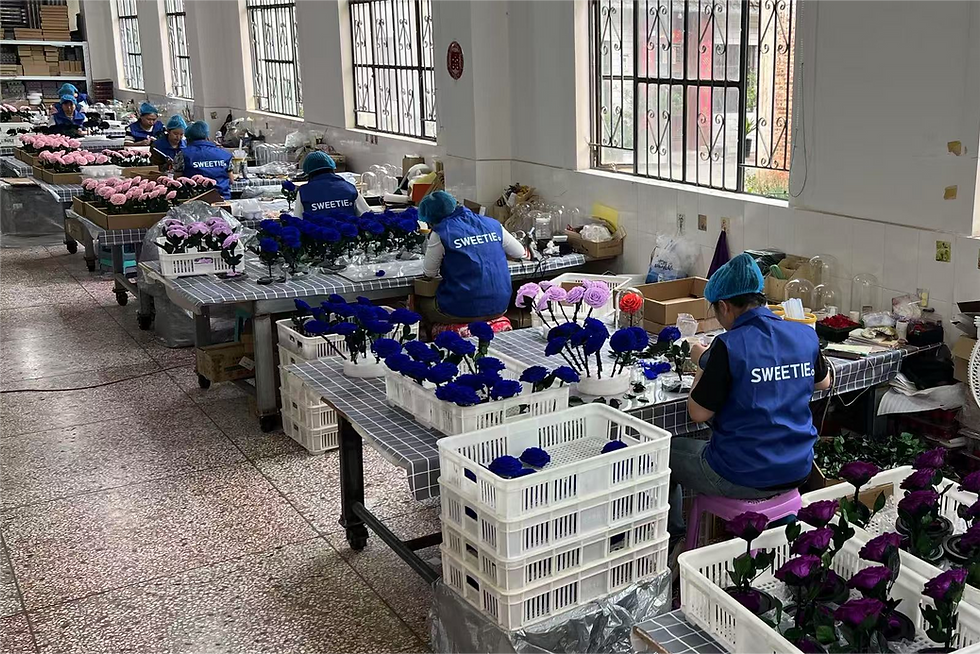
This is also the approach used at Sweetie-Gifts. Projects often involve more than one moving part: product form, presentation, packaging, shipping protection, and commercial fit all have to work together. That is especially true in categories such as preserved flower gifts, decorative soap flower products, rose bears, plush flowers, branded gift sets, and other custom gifting formats. Company materials also document category-based production support across preserved flowers, soap flowers, and PE bear products, along with dedicated daily output capacity in those lines.
That kind of range does not automatically make a manufacturer right for every project. But for buyers developing gift products that combine presentation, packaging, and execution, it is often a sign of stronger real-world capability.
Final thoughts
Choosing a gift manufacturer is not only about finding someone who can make a sample.
It is about finding a partner that can help move a concept into production without unnecessary risk. Product fit matters. Bulk repeatability matters. Quality control, timing, packaging, and communication matter. For custom projects, development support matters too.
The strongest manufacturers are not the ones that simply say yes. They are the ones that help turn ideas into products that work in the real market.
To discuss a floral gift, branded gift box, or custom gifting project, email sales@sweetie-group.com.
CEO of Sweetie Group


Comments