


How Retail Buyers Choose Small Gift SKUs That Actually Sell in Stores


Small gifts are easy to add to a retail assortment.
Choosing the right small gift SKU is the hard part.
For supermarkets, convenience stores, pharmacies, and chain retailers, the issue is not whether small gifts can sell. They already do. The real question is much more practical:
Which small gift deserves real shelf space?
Every season, buyers see another wave of cute, low-cost products. Some look great in a sample room. Some photograph beautifully for a catalog. But once they enter a real store, they face a different test: shoppers have only a few seconds to notice them, understand them, trust the price, and decide whether to put them in the basket.
That is where many small gifts succeed — or quietly fail.
A strong small gift SKU is not only pretty. It is easy to understand, easy to display, easy to price, easy to replenish, and low-risk enough for buyers to consider again next season.
Small Gifts Are Not the Problem. Choosing the Right SKU Is.
Small gifts are already part of everyday retail.
They appear near checkout counters, in seasonal aisles, beside greeting cards, in pharmacy gift sections, at supermarket entrances, and in convenience stores where shoppers are looking for something quick and acceptable to give.
The demand is real. Circana’s 2025 “little treats” research found that 73% of Americans say small indulgences are important to their quality of life, and 62% say they are part of their self-care routine. This does not mean every small gift will sell, but it does confirm a broader behavior: consumers are still willing to buy small, emotionally rewarding products when the price and occasion feel right. (Circana)
Gift occasions also remain strong. NRF reported that U.S. Valentine’s Day spending in 2025 was expected to reach $27.5 billion, including $2.9 billion on flowers, $2.5 billion on candy, and $1.4 billion on greeting cards. For Mother’s Day, NRF expected total spending of $34.1 billion, with flowers reaching $3.2 billion and greeting cards $1.1 billion. Even more important, 48% of consumers said finding a gift that is unique or different mattered most, while 42% wanted a gift that creates a special memory.
That tells us something important.
Retailers do not need “more small things.” They need small gifts that feel worth buying.
A cute sample is not always a commercial SKU. A product must survive the real retail journey: shipping, unpacking, shelf display, customer attention, price comparison, and finally, the moment when a shopper decides, “Yes, this works.”

Test 1: Can Shoppers Understand the Gift in Three Seconds?
In fast retail environments, packaging often has to do the selling before a shopper even touches the product.
A shopper should understand three things almost immediately:
What is it?
Who is it for?
Why should I buy it now?
This matters especially in supermarkets, pharmacies, and convenience stores, where most products do not get help from a salesperson. If a small gift needs a long explanation, it may perform better in a boutique than at checkout.
A strong small gift SKU usually has a clear visual message. A single flower in a transparent box. A small heart-shaped gift for Valentine’s Day. A compact “Thank You” item near greeting cards. A ready-to-gift floral piece beside chocolates or beauty products.
The simpler the buying reason, the easier the decision.
That does not mean the product must be plain. It means the shopper should not have to work hard to understand it.
Test 2: Does the SKU Match the Right Display Location?
A small gift should be designed for a real display location, not just for a catalog photo.
Different retail positions need different product behavior. A checkout product must be quick and low-friction. An endcap product needs visual strength. A seasonal aisle needs immediate theme recognition. A pharmacy gift section needs a product that feels personal, clean, and presentable.
Retail Location | What Usually Works | What Buyers Should Avoid |
Checkout counter | Small, easy to grab, low-decision gifts | Large, fragile, or high-priced items |
Endcap display | Seasonal, colorful, promotion-ready products | Products with weak front-facing impact |
Greeting card area | Emotional gifts, keepsakes, flowers, small add-ons | Items without a clear gifting reason |
Pharmacy gift aisle | Ready-to-gift, personal, comforting items | Products that look too cheap or unclear |
Convenience store | Last-minute, compact, simple gifts | Products that need explanation |
Supermarket seasonal zone | Strong color theme, shelf-ready packaging | Overly narrow holiday-only products |
Convenience stores are a good example. NACS reported that U.S. convenience stores reached record in-store sales in 2024, with foodservice accounting for 27.7% of in-store sales and 38.6% of in-store gross margin dollars. That tells us convenience stores are built around speed, frequency, and immediate need.
A gift SKU for that environment cannot behave like a boutique product. It has to be compact, clear, easy to scan, and easy to decide on.
If you are comparing small gift structures for checkout, endcap, or seasonal displays, you can email us at sales@sweetie-group.com. We can help review which formats may fit your channel best.

Test 3: Is It Low-Decision, Not Just Low-Price?
Low price may get a product considered. Low decision friction is what gets it picked up.
There is a big difference between a cheap gift and an easy gift.
A cheap gift may have a low unit cost but still feel weak, random, or embarrassing to give. A low-decision gift feels safe. It looks presentable. It has a clear use. It does not require extra wrapping. The shopper can buy it without worrying too much.
For retail buyers, this is where perceived value matters.
A shopper may accept a slightly higher price if the product looks giftable, emotionally clear, and ready to give. On the other hand, a very low-priced item can still fail if it looks like clutter.
A good small gift should answer the quiet question in the shopper’s mind:
“Is this nice enough to give?”
That question matters more than many suppliers realize.
As a manufacturer, cost control is always important. But cost cutting should not remove the very thing that makes the item a gift: clean presentation, stable structure, visible quality, and a clear emotional message.
Test 4: Does the Product Look Giftable Without Extra Work?
The easier a gift is to give, the easier it is for shoppers to buy.
Many supermarket, pharmacy, and convenience store gift purchases are last-minute. A shopper may be on the way to dinner, visiting a friend, buying something for a teacher, picking up a Mother’s Day gift, or grabbing a Valentine’s Day item after work.
They do not want a project.
They want something that already looks finished.
That is why ready-to-gift packaging matters. A small product with a clean box, transparent window, ribbon, card, sleeve, or display-ready shape often works better than an unpackaged item that requires extra thought.
For floral gifts, this is especially important. Loose flowers can be beautiful, but non-florist retail channels often prefer products that are already protected, already arranged, and already giftable.
A product that looks complete reduces hesitation.
It also reduces store-level labor.
Test 5: Can It Sell Beyond One Holiday?
Seasonal gifts should have a clear holiday message, but smart SKUs also need an exit plan after the holiday.
Valentine’s Day, Mother’s Day, Christmas, Easter, graduation season, and teacher appreciation periods all create strong gift demand. But seasonal products carry a familiar retail risk: the selling window is short.
If the product does not sell through, it becomes markdown stock.
That is why buyers often look for small gifts that can be refreshed or repositioned. The product may have a Valentine’s Day version, but the same structure could also work for birthdays, thank-you gifts, Mother’s Day, or everyday emotional gifting.
This can be done through:
Color changes
Ribbon changes
Gift card messages
Seasonal sleeves
Display box artwork
Packaging labels
Different flower or material choices
The best small gift structures are often flexible. They can carry a seasonal message without becoming useless the moment the holiday ends.
This is one reason many retailers prefer a stable base structure with changeable visual elements. It reduces development risk while still giving each season a fresh look.
Test 6: Is the Packaging Retail-Ready?
A gift product that needs too much store-level handling is not really low-cost. The labor becomes part of the cost.
Retail-ready packaging is not only about beauty. It is about execution.
Buyers should ask:
Can the product stand or sit properly on shelf?
Is the front-facing view strong?
Can shoppers see what they are buying?
Is the barcode easy to scan?
Can the price label be applied cleanly?
Does the product survive shipping and shelf handling?
Can store staff replenish it quickly?
Does it work in a PDQ tray, counter display, shelf, or endcap?
Does the packaging protect the gift without making it look bulky?
For small floral gifts, packaging also needs to protect delicate parts. Preserved flowers, soap flowers, artificial flowers, and plush flowers all have different handling needs. A preserved rose may need protection from crushing and humidity. A soap flower may need stable shaping and clean fragrance control. A plush flower may need neat stitching, shape recovery, and display consistency.
Good packaging protects the product, sells the product, and fits the store’s workflow.
When those three things work together, buyers notice.
For retail-ready packaging ideas, including display boxes, sleeves, private-label packaging, or protective structures for floral gifts, contact sales@sweetie-group.com.
Test 7: Can the Supplier Support More Than One SKU?
For chain retailers, a supplier’s execution stability can matter as much as the sample itself.
A single cute product may open a conversation. But retail buyers often need a fuller program.
They may need:
An entry-price item
A mid-price gift
A seasonal hero SKU
A checkout version
An endcap version
A private-label version
A replenishment item
A holiday refresh
This is where the supplier’s development ability becomes important.
Can the supplier adjust packaging for different channels? Can they change colors quickly? Can they support private label? Can they prepare samples on time? Can they manage quality consistency across handmade items? Can they ship before the seasonal window closes?
For small gift SKUs, the product is only one part of the decision. The buyer is also choosing a supply partner.
At Sweetie-Gifts, we look at small floral gifts as retail programs, not only as individual products. A supermarket, a convenience store, a flower shop, and a gift importer may all need small gifts, but they do not always need the same small gift.
That difference matters.
Test 8: Does the SKU Reduce Buyer Risk?
The best small gift SKUs do not only attract shoppers. They also make the buyer’s decision safer.
Retail buyers are always balancing opportunity and risk.
You can ask:
Will this sell through?
Will it break during transport?
Will it take too much shelf space?
Will it still sell after the holiday?
Does the price fit the channel?
Can staff replenish it easily?
Will consumers understand it quickly?
Does it compete with existing SKUs?
Can the supplier deliver on time?
A good small gift reduces these concerns.
It has a clear shopper reason. It has packaging that supports display. It has a manageable price point. It has a realistic seasonal plan. It comes from a supplier who understands retail execution, not only production.
That is the kind of SKU that has a chance to come back next season.

A Practical Checklist Before Adding a New Small Gift SKU
Before adding a new small gift SKU, retail buyers can ask:
Can shoppers understand the product in three seconds?
Does it clearly show who it is for?
Does it look giftable without extra wrapping?
Does the price feel easy to say yes to?
Does the product match a real display location?
Can it work at checkout, endcap, seasonal display, or gift aisle?
Is the packaging retail-ready?
Can store staff replenish it easily?
Is the product strong enough for transport and shelf handling?
Can it sell beyond one holiday?
Can the supplier refresh the color, ribbon, card, or packaging theme?
Does the SKU reduce inventory and execution risk compared with similar gifts?
If a small gift passes most of these questions, it has a better chance of becoming a repeatable retail SKU — not just another attractive sample.
How We Think About Small Gift SKUs as a Manufacturer
A small gift should not be developed only for a beautiful product photo.
It has to survive the real retail journey: production, packing, shipping, shelf display, shopper attention, and finally, the moment someone decides to buy it.
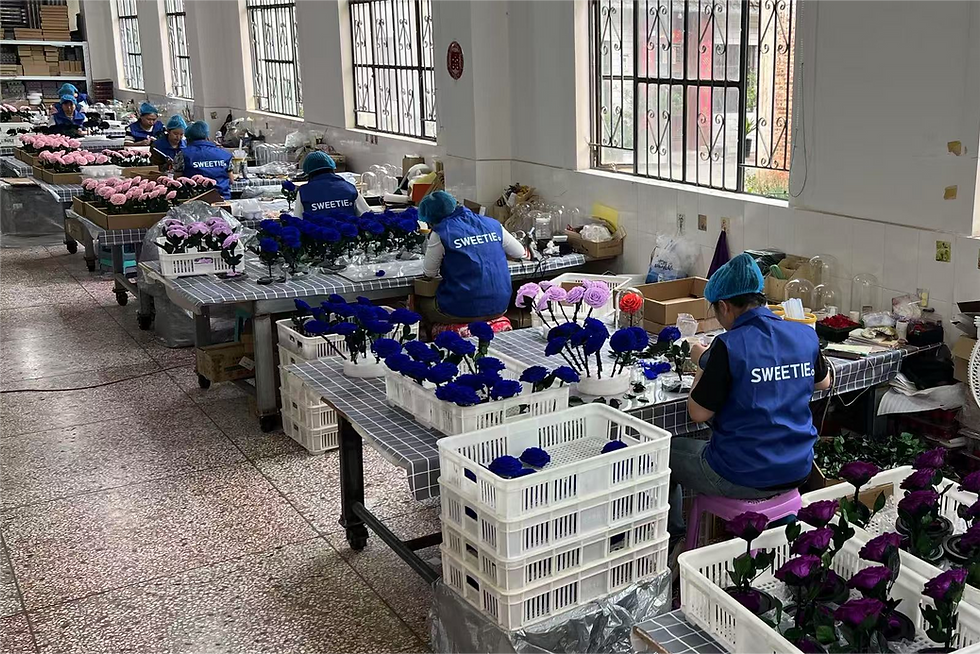
Sweetie-Gifts works with preserved flowers, soap flowers, artificial flowers, plush flowers, floral gift boxes, and custom floral packaging for different retail channels. This range helps us suggest different structures for different buyers.
For example, a convenience store may need a compact, low-decision checkout gift. A pharmacy may need something ready-to-gift and emotionally clear. A supermarket may need a seasonal display product with stronger packaging. A gift importer may need a full assortment with several price points.
The product may be small, but the decision behind it is not.
If you are planning small gift SKUs for supermarkets, convenience stores, pharmacies, or seasonal retail displays, email sales@sweetie-group.com. We can discuss samples, target price points, packaging options, and custom floral gift programs.
The Small Gifts That Last Are the Ones That Make Retail Easier
Small gifts are not new to retail.
The stronger opportunity is not simply adding more of them. It is choosing better ones.
A small gift SKU that actually sells in stores should be easy for shoppers to understand, easy for store teams to display, and easier for buyers to repeat. It should balance price with perceived value. It should look giftable without extra work. It should have a plan beyond one short holiday window. And it should come from a supplier who can support packaging, quality, timing, and seasonal refreshes.
In the end, the best small gifts do two things at once.
They make shoppers feel, “This is easy to buy.”
And they make retail buyers feel, “This is easier to sell.”
CEO of Sweetie Group


Comments