


Buying Soap Flower Bouquets in Bulk? How to Avoid “Perfect Sample, Bad Shipment”


If you’ve ever sourced soap flower bouquets for retail or gifting, this scenario may sound familiar: the sample looks beautiful—full blooms, clean colors, pleasant scent—but when the bulk shipment arrives, something feels off. Colors shift, flowers look flatter, some heads loosen during transport, or the unboxing experience simply doesn’t match what was approved.
This isn’t rare in the decorative soap flower industry. And it’s not always caused by bad intentions or poor factories. In most cases, the problem lies in how samples are made, how bulk production works, and what buyers do (or don’t) lock in before mass production starts.
This article is written to help you understand where the risks come from and how to actively prevent them when buying soap flower bouquets in bulk.
What “Sample vs. Bulk” Inconsistency Really Looks Like
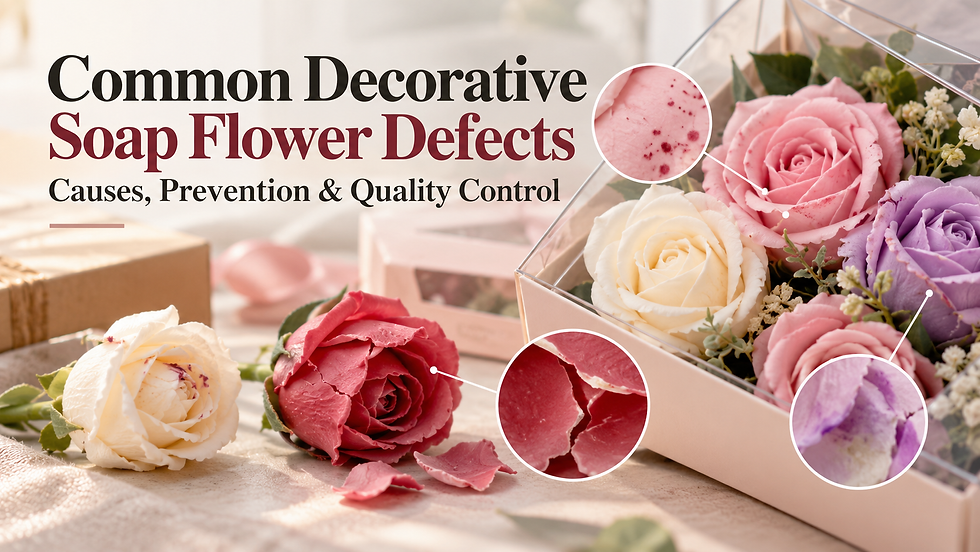
For decorative soap flower bouquets (not cleaning-use soap), inconsistencies usually show up in a few predictable ways:
Color: bulk flowers look duller, darker, lighter, or slightly off-tone compared to the sample
Shape & fullness: petals are flatter, less dimensional, or uneven across bouquets
Texture & firmness: flowers feel harder, softer, or less refined than expected
Scent: weaker aroma, different balance, or a noticeable “chemical” note
Assembly quality: loose flower heads, visible glue marks, or bouquets shifting during transport
If you’ve seen one or more of these, you’re not alone—and you’re not necessarily dealing with a dishonest supplier.
Why “Perfect Sample, Bad Shipment” Happens
1. Samples and bulk orders are often made under different conditions
Samples are usually produced slowly, by experienced staff, with extra attention to detail. Bulk orders, on the other hand, are made on production lines where speed, repeatability, and labor variation come into play. Even with the same design, the output can differ if controls are not clearly defined.
2. Raw material batches change
Decorative soap flowers rely on colorants, fragrance oils, base materials, and adhesives. Small batch-to-batch differences—especially in pigments and fragrance—can visibly affect the final product if not locked or cross-tested before mass production.
3. Forming and shaping parameters are sensitive
For soap flower petals formed through heat or pressure, slight changes in temperature, timing, or pressure can affect petal curl, thickness, and surface finish. These are subtle shifts, but visually noticeable in bouquets.
4. Assembly and packaging create a second risk layer
Even if individual flower heads match the sample, bouquet assembly and packaging can change the final appearance. Inadequate internal support, tight cartons, or long-distance shipping can flatten or deform flowers that looked fine at the factory.
5. Logistics amplify small differences
Bulk orders experience weeks of transit, stacking pressure, and temperature changes. What looks acceptable at production may look very different when unboxed at a warehouse.
Where Buyers Can Actively Reduce Risk
Lock the right reference—not just “a sample”
A single approved sample is not enough. You should clarify what kind of sample it is:
Is it handmade or produced under bulk conditions?
Does it represent final packaging?
Is it made with confirmed materials, or just for visual approval?
A production-level reference sample (often called a PP sample) is far more valuable than an early showroom piece.
If you want help structuring a proper reference sample process for soap flower bouquets, you can always reach us at sales@sweetie-group.com—we’re happy to share what works in real bulk production.
A Note on Who We Are and Why This Matters
At Sweetie-Gifts, we’ve been manufacturing floral gifts—including soap flower bouquets and boxed arrangements—for over 16 years, supplying long-term customers worldwild.
What we’ve learned through years of bulk production is simple: most inconsistencies don’t come from design mistakes—they come from missing controls between sample approval and mass production.
That’s why, in our own projects, we focus heavily on:
production-condition samples (not showroom-only pieces)
material batch consistency
packaging stress testing before shipment
I’m sharing this here not as marketing language, but because these are the exact areas where bulk buyers tend to lose the most time and money.

Key Risk Areas to Control (and How)
Risk Area | What Buyers Should Do |
Color consistency | Approve under standard lighting and define acceptable variation |
Flower shape | Confirm petal count, flower diameter, and openness range |
Scent | Define intensity expectations and test after time, not day one |
Assembly | Specify glue visibility limits and pull-strength expectations |
Packaging | Test compression and movement inside the box |
This doesn’t need to become complicated—but it does need to be written down.
Write These Points Into Your PO or QC Standards
If you want bulk shipments to match expectations, your purchase order should clearly state:
No material or packaging substitutions without written approval
Defined tolerance for color and size variation
Packaging method and carton stacking limits
Responsibility if deformation or detachment exceeds agreed limits
Clear documentation protects both sides and prevents misunderstandings late in the process.
A Quick Way to Diagnose Problems When They Happen
Large variation within the same carton usually points to production or assembly inconsistency
Uniform flattening across many cartons often indicates packaging or transit pressure
Scent complaints after arrival may be related to storage or ventilation, not just formulation
Understanding this helps you address the real cause instead of guessing—or blaming the wrong part of the supply chain.
Final Thoughts
Buying soap flower bouquets in bulk doesn’t have to feel risky. Most “perfect sample, bad shipment” situations are preventable when expectations are defined early, samples truly reflect production conditions, and packaging is treated as part of the product—not an afterthought.
The buyers who succeed long-term aren’t the ones who demand perfection—they’re the ones who manage consistency intentionally.
If you’re planning a bulk order or want to review your current sourcing process, feel free to reach out to us at sales@sweetie-group.com. We’re always glad to share practical insights that help buyers avoid costly surprises.

CEO of Sweetie Group


Comments