


From Freshippo to FamilyMart: How Sweetie Worked with Top Retailers on Floral Gifts in 2025


If you’ve ever sourced floral gifts for retail, you already know the uncomfortable truth: a product usually doesn’t fail in the factory. It fails in the store.
It fails when the color looks slightly off under store lighting. It fails when packaging scuffs during transit and suddenly your “premium” gift looks tired. It fails when a beautiful concept can’t survive mass production, so the final product loses the magic that got it approved in the first place.
And retail is unforgiving. Seasonal windows are short. Planograms are planned. If something goes wrong, it becomes markdowns, returns, and a post-mortem meeting nobody enjoys.
That’s why I’m sharing a practical recap of Sweetie’s 2025 domestic retail projects in China. The channels are local, but the standards are universal: shelf readiness, timing discipline, and risk control at scale.
If you want our “retail-ready floral gift checklist” in a simple one-page PDF you can share internally, email me at sales@sweetie-group.com and tell me what channel you’re buying for.
Index:
What “Retail-Ready” Means to Me (The Non-Negotiables)
When buyers ask me, “Can you do retail?” I don’t answer with product photos first. I answer with standards. Because in retail, the product is only half the job. The other half is consistency. You can click here to explore our retail solutions.
Here are the non-negotiables I use to judge whether a floral gift is truly retail-ready:
Retail Risk Area | What Buyers Usually Worry About | How We Control It at Sweetie |
Batch consistency | “Will the color match the approved sample?” | Tight material selection, controlled processes, and QC checks before shipment |
Timing | “Can you hit the seasonal launch date without excuses?” | Backward scheduling from shelf date, plus a clear sampling and production timeline |
Mass production feasibility | “Can this design actually be made at scale?” | Design-for-manufacturing review before we finalize details and packaging |
Packaging durability | “Will it survive handling, transport, and store replenishment?” | Retail-protective inner packaging, cushioning strategy, and packaging optimization for e-commerce or store distribution |
After-sales risk | “If something happens, will the supplier stand behind it?” | Proactive follow-up and feedback loop after delivery, with corrective actions when needed |
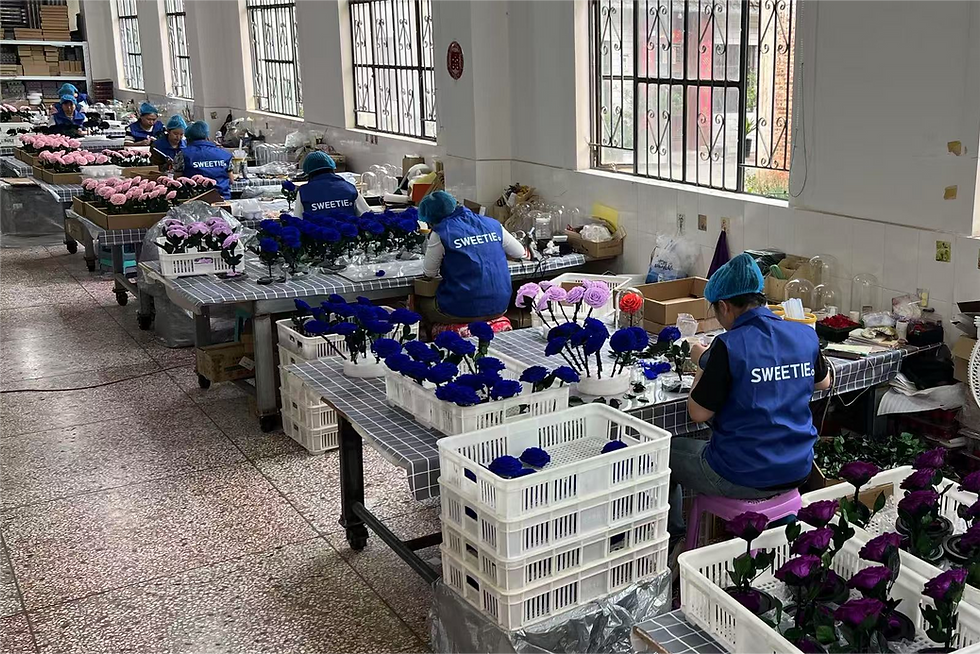
This is also why we’ve invested in a multi-base production setup and dedicated teams for R&D, sales, and operations. It gives us the capacity and the internal rhythm to support seasonal peaks and bulk runs.
Case 1: Alibaba's Freshippo Seasonal Programs
Freshippo is the kind of retail partner that forces you to be honest with yourself. Their seasonal rhythm is fast, their standards are clear, and the shelf is the final judge.
What made these programs work
1) Preserved flowers fit the retail calendar better than people expect.
For many seasonal moments, preserved flowers give retailers something rare: stability. You can plan earlier, ship earlier, and still deliver a product that looks consistent and gift-ready at the moment of purchase. That matters when stores need reliable stock across multiple locations.
2) “Holiday elements” are not decoration; they are retail signals.
In a supermarket environment, the customer is not reading a long product story. They’re scanning. Holiday cues do the job instantly: color palettes, small icons, culturally relevant motifs, and packaging that looks like a gift without extra explanation.
3) IP co-design only works if it can be produced.
IP collaboration sounds glamorous, but the real work is practical. In our process, we simplify features and adjust details early so the character remains recognizable while staying manufacturable. That reduces production risk and protects the retail schedule.
What I’d tell a US or EU buyer who wants a similar result
If you’re planning seasonal retail floral gifts, don’t start with “What’s the trend?” Start with:
What is the shelf date?
What price band does the channel tolerate?
What packaging format survives that channel’s logistics?
What part of the design can break at scale?
If you can answer those four questions early, you move faster and you waste less money.

Case 2: FamilyMart: Convenience Retail Is a Different Sport
Convenience stores look simple, but they’re brutally specific. Space is tight. The shopper is rushed. The product must communicate instantly.
In 2025, our FamilyMart-related work covered:
Valentine’s Day and Mother’s Day: fresh flowers
Teacher’s Day: plush flowers
Why fresh flowers make sense for certain convenience seasons
For high-emotion dates like Valentine’s Day and Mother’s Day, fresh flowers can win because the consumer expectation is immediate and familiar. But it also means the supply chain has to behave like a living system: timing, handling, and display conditions all matter. In convenience retail, the product cannot require “special care knowledge” from store staff.
Why plush flowers made sense for Teacher’s Day
Teacher’s Day is a different emotional moment. People want something sweet, small, and easy to carry. Plush flowers are durable, consistent, and friendly in price positioning. They also avoid the anxiety some shoppers feel about buying fresh flowers last minute.
From a retail standpoint, the plush flower option has a huge advantage: it is more forgiving in logistics and store handling while still delivering a gift feeling.
If you’re building a 2026 seasonal calendar and you want help choosing which occasions should be fresh flowers, preserved flowers, plush flowers, or soap flowers, email sales@sweetie-group.com with your target market and price range. I’ll share the decision logic we use internally.

Case 3: Xiaoxiang Supermarket (Meituan Grocery): Christmas and New Year Are About Visibility and Speed
For Christmas and New Year programs, the product has two jobs:
Look festive from a distance
Hold up through busy handling and quick replenishment
This is where packaging and structure matter as much as the floral design itself. Holiday retail can be rough on products. Items get moved, stacked, and re-merchandised. If a product arrives looking perfect but can’t survive real handling, it’s not retail-ready.
In these seasonal projects, we paid attention to:
Strong holiday visual cues that read quickly
Packaging that protects while still showing enough of the product
Practical construction that resists deformation and damage during store operations

Beyond Retail Shelves: Projects That Still Require Retail-Level Standards
Not every 2025 project happened on a retail shelf. But some non-retail projects are held to retail-level pressure: big volume, fixed timing, and low tolerance for inconsistency.
That’s why I include them here. They’re not “retail cases,” but they are retail-grade in execution.
Case 4: Haidilao Promotional Gifts
Promotional gifts have a unique challenge. The consumer’s attention span is even shorter than retail. There’s no browsing. There’s no comparison shopping. The gift either feels worth keeping or it doesn’t.
Soap flower mini bouquets work well here because they’re:
Consistent in appearance
Efficient to produce at scale
Easy to distribute
Gift-like without being fragile
And just to be clear, our soap flowers are produced for gifting and decoration purposes, not for cleaning. The material system and production approach are designed for bouquet-style gift products.
Case 5: Corporate Gifts (Guokang, Huawei, Aivilan)
Corporate gifting is often harder than retail, because brand risk is higher. When a brand gives a gift, they’re not only giving an item. They’re sending a message about standards.
What corporate buyers tend to care about most:
Consistency across the whole batch
Packaging that looks clean and premium on arrival
On-time delivery with fewer surprises
Stable communication and follow-through
This is where a supplier’s internal system matters more than their showroom. A corporate gift doesn’t need to be complicated, but it does need to be reliable.

A Practical Checklist for Retail Buyers Sourcing Floral Gifts
When buyers tell me they’re switching suppliers, it’s usually not because of one big disaster. It’s because of small repeated problems: color drift, packaging scratches, timelines that slip, and unclear ownership when something goes wrong.
Here’s the checklist I recommend using before you approve any seasonal floral gift supplier:
Can they show you a clear timeline from sample approval to mass production?
How do they control batch consistency, especially color?
Can the design be mass-produced without losing the key visual features?
What does the packaging system look like, including inner protection and outer carton planning?
What happens if something arrives damaged or inconsistent? Who owns the fix?
Can they support peak season capacity without quality dropping?
Do they understand your channel, meaning supermarket vs convenience vs gift shop vs corporate?
If you want, I can also share the way we think about preserved flower production timing. Preserved flowers involve multi-step processing and natural drying time, so seasonal planning has to start earlier than most buyers expect.
Where Sweetie Fits (And How I Like to Start a New Project)
At Sweetie Group, we build floral gifts around a simple idea: “Flower + Everything.” It’s not a slogan to me. It’s a working method. We combine flowers with seasonal storytelling, IP elements, packaging, and manufacturing discipline, so the final product can live in real channels and real logistics.
When a new buyer reaches out, I prefer to start with three questions:
What is your channel and target price band?
What is your seasonal calendar and launch date?
What kind of customer experience do you want on shelf or at gifting?
From there, we can recommend the right material direction (preserved, crochet, plush, soap flower) and the right packaging structure, then move into sampling and production planning.
If you’re sourcing retail-ready floral gifts for 2026, email sales@sweetie-group.com with your seasonal calendar and target market. I’ll suggest a few product directions and a realistic timeline for sampling and delivery.
Closing Thought
Retail floral gifting looks romantic on the outside, but the work behind it is very operational: timing, consistency, and the ability to deliver what was approved, not something “close enough.”
That’s what we practiced throughout our 2025 domestic projects. If you’re buying for the U.S. or Europe, the market details will differ, but the rules of shelf readiness do not.
CEO of Sweetie Group


Comments